Travelling along a River is undoububly one of the most satisfying journeys one can complete. The simple, elequent joy of moving through different landscapes, from hills, mountains, and rapids nearer to the source, all the way down to locks and towns further downstream; it’s hard not to be amazed at how rapidly the character of the river, and it’s surroundings change. The River Severn is the longest river in the UK, and throughout it’s length, it traverses through stunning countryside on the Welsh border. Last week, our Duke of Edinbrugh Gold expedition involved travelling along the river, taking in it’s sights from Cilcewydd to Holt Lock.
Day 1 – 52.5km – A Crash Course in (Seriously) Long Distance Canoeing
To state the obvious, 50km is an awfully long way to paddle. For those of you who haven’t done much canoeing, you generally paddle at approximately walking pace. On a faster river, the speed may approach 6-7kph, and on a slow, flatwater river, it’s not unheard of to struggle to break 3kph in certain conditions. Despite the fact that the river was due to be fast flowing today – we knew there would be a fair few sections were we’d have to get out and walk due to the river being too shallow, and had been warned of a fallen tree blocking the river, requiring a portage around it. Given this, we opted for an early start – and aimed to be on the water for 6:30am.
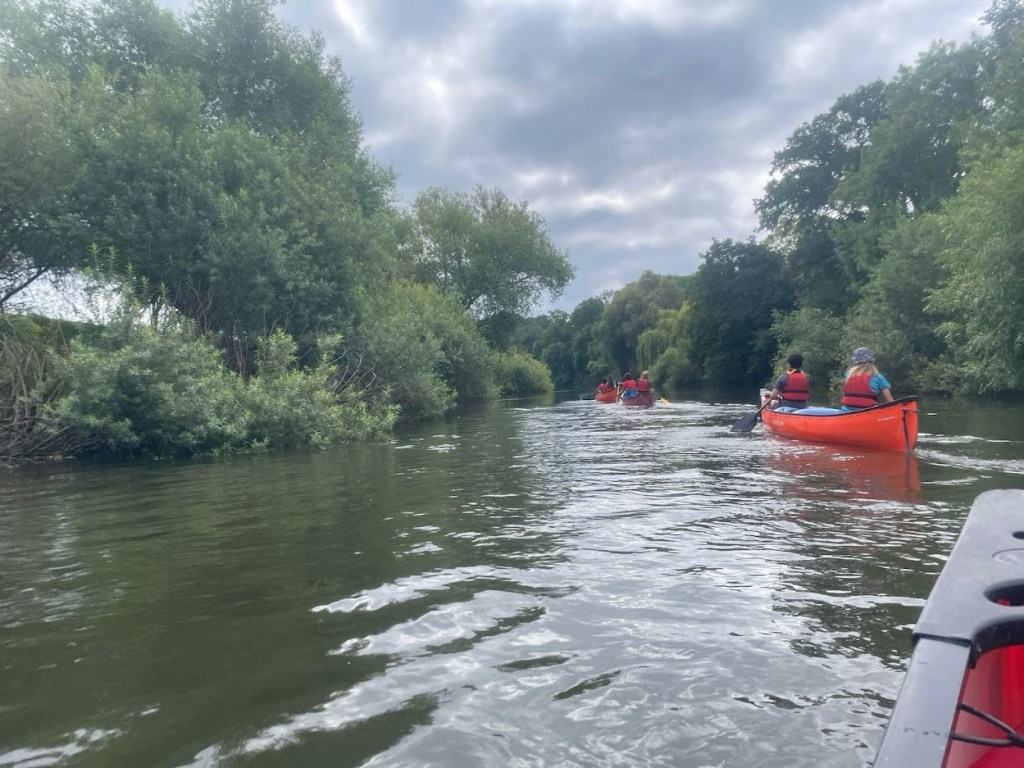
Following this horrifically early start, we began our journey downstream. The river was immediately shallow, and we were already striking the ground with our paddles. What fun! There were occasional sections of grade 1 water, nothing noteworthy, but definitely enjoyable. One of these sections funnelled us towards a tree blocking the river, naturally, we didn’t see this until a little to late, so a very swift cross-deck bow-cut was required to wrench us from the rapid flow into an eddie to the right of the river where we could assess our options.
We pulled all the boats out of the water and noticed an oxbow lake (or something very near to an oxbow lake) to the right. A quick check of the map told us this would connect us to the river just downstream of the blockage. We had no choice but to portage round to the oxbow lake and try to paddle round. Despite this being slightly frustrating so early in the day, the portage was sucessful and we only lost about 20 minutes with all this faff.
Following this, the easy flat water, with intermitant grade one, continued till Welshpool weir. This is a very small weir which is too shallow to run, as we found out. We grounded out halfway and had to walk to the end of the weir – a little dissapointing, but once again, not a big time loss. (NB: We knew the weir would be safe to run and there was no stopper).
The river then proceeded along a narrow channel, with strainers constantly obstructing the path ahead and many sections of grade 1 water. This is a great example of low-risk, high(ish)-concequence paddling; although a capsize would be very unlikely, the strainers would seriously complicate it and would be a significant risk for a swimmer. We realised this a bit before lunch, when we very nearly got pinned beneath a low branch after chosing the wrong channel of the river to go down. We were lucky to be able to wiggle underneath (with difficutly), but if that strainer had extended all the way to the ground, we’d have been in a dangerous situation – and it would have required a fairly sketchy exit of the canoe and lining it back upstream to avoid the river.
The narrow, strainer lined paddling continued as the river began to turn East, towards the River Vyrnwy confluence. The river gradually got wider, and soon we were clear of the forested section (no more strainers!). There was a small weir which we ran (and grounded out on). It was here where we made the largest mistake of the day. The paddlers behind ran the weir before the others had cleared it, and almost caused a nasty accident as one boat narrowly missed my leg, and left me hanging on to the bow of the boat for dear life. What fun!

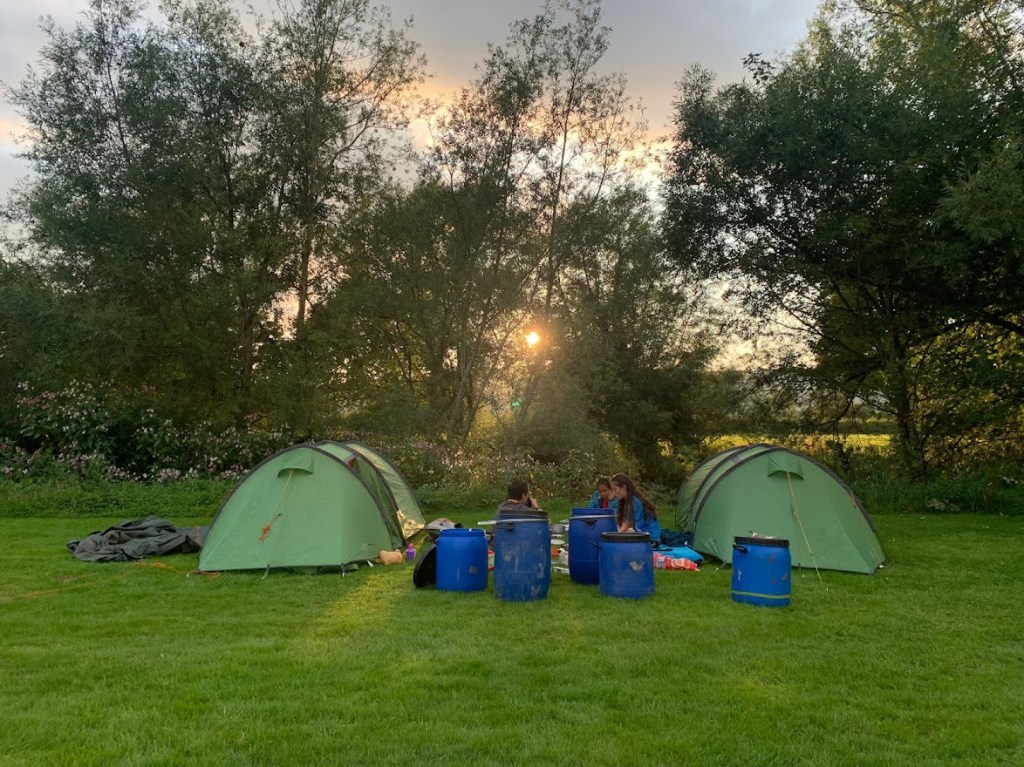
After the River Vyrnwy confluence, the character of the River changed significantly, back to the Severn that you are likely more familiar with. A wide channel of moderately fast water, with a handful of grade 1 sections along it’s course. We paddled on for about 16km after the River Vyrnwy confluence before hitting the campsite. This last paddle was brutal – we were all tired and morale was beginning to dip. Additionally, the dull nature of this paddling made us all the more aware of our sore arms. It was undoububly a relief to reach the campsite that evening at Montford Bridge.
The day took eleven and a half hours overall, and we only stopped for about twenty minutes during that time. This left my legs feeling cramped and left us all feeling a little broken for the next day. Two of our team decided that the expedition wasn’t right for them, so made the decision to head home. This left us feeling low, morale had to be boosted, otherwise the next three days would be extraordinarily tough.
Day 2 – 37km. Don’t trust the Cows.
A late start was called for. 7am alarms were set (please don’t remind me quite how outragous it is that that is considered a late start), but tired heads and low morale meant we weren’t on the water till 9:40. From here, the day began to get better and better. Good chat, and dreams of future expeditions in warmer countries (Italy here we come!) kept us going. The paddle was also somewhat interesting, with enough sections of moving water to keep the boredom at bay. Just before Shrewsbury we pulled onto a beach and had lunch.
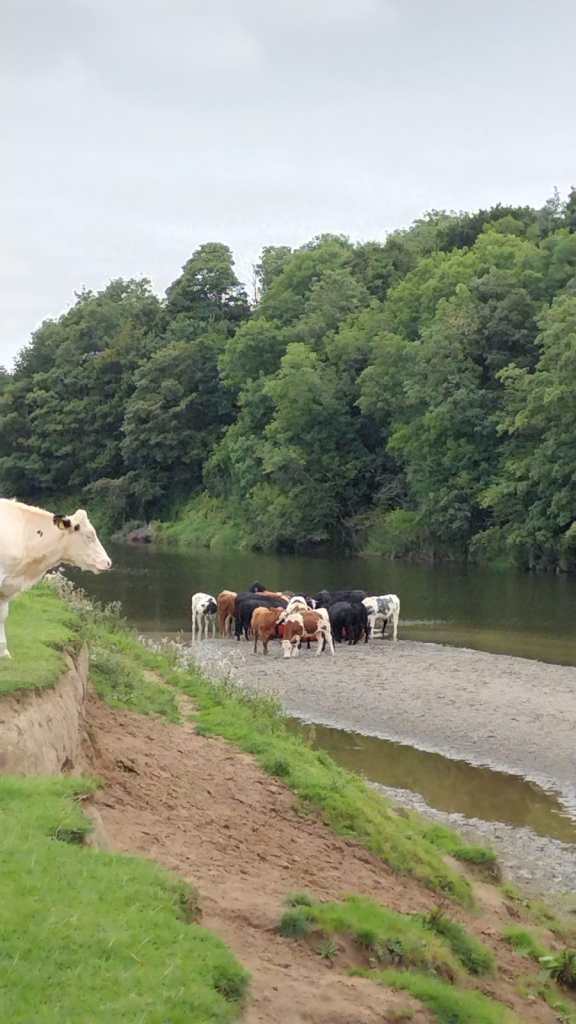
They marched in before we could stop them; an army of cows swarmed our boats, taking them over and preventing us from approaching, especially as they had calves. We were naturally quite concerned – how the hell were we going to paddle the remaining 20km! We searched for the farmer, but only found a fairly exasperated local, who commented that they’re alright and we should approach the boats. They also said they had nothing to do with the cows, so we were a little reluctant to trust them. Luckily, the cows and dispersed enough to allow us to approach the boats in the water, and pull them straight out into the river, avoiding any more cow trouble.
The paddle through Shrewsbury was a little dull, at least until the weir. Sadly, the weir is pretty lethal, and shouldn’t be run, so a frustratingly long portage awaited us. Nevertheless, we got it done, and began our paddle down to Ismore coppice, where we stayed.

That night, the morale was high. We’d just been told that due to a wake at the campsite the following night, we couldn’t arrive before 7pm, that meant a lie in, even by normal standards. What a treat! We (or rather the capable cooks) cooked up a delicious curry and we enjoyed a relaxed evening, chatting late into the night.
Day 3 – 33km – Oops.
After a long lie in, we left the campsite at 10:45 – ridicoulsly late for any expedition. The day started with a really enjoyable and relaxed paddle down towards Ironbridge. The river was mostly flat, but similar to the previous day, had enough sections of easy moving water to keep the interest level high.

That morning, I realised quite how lucky we were to be able to get an opportunity to paddle along the Severn. From a canoe, you develop a unique perspective on the world. These ancient waters have been providing for people for milenia, and as you journey along the river, you develop a unique appriciation of the historic significance of these water. This is still second do the nature that lines the side of the river, we saw a wealth of wildlife and were spotting Kingfishers multiple times per day. All whilst journeying though a wonderful corner of the UK.
We had lunch on a wonderful river bank and began discussing the main topic of the day, Jackfield Rapids. These rapids are a solid grade 2, well within our capabilities. Nevertheless, there was a risk of a capsize, so we took appropriate precautions to mitigate the risk of any wet kit should the worst happen.

As we approached the rapid, we briefly discussed our line of attack. On day 1, we had learned the importance of going one at a time, and communicating properly to each other. After a brief meeting, we concluded that Mia and I should run the rapid first, as we’d both done Jackfield previously, followed by Phoebe and Mimi, and finally Joe and Arno.
We all got down the rapids easily without any fuss, but were offered some additional whitewater training by our assessor to try and develop our skills further. This primarily involved ferry gliding across fast flowing water, moving up the raid, and eddying out. It concluded with a white-water swimming lesson- a key skill required to be safe following a capsize on a rapid.
After Jackfield, we proceeded down towards Bridgenorth. This section of river has a few easy grade 1 sections, but following Jackfield, we’d gotten a little bit negligent; after all, why would anything pose any challenges after that? Perhaps it was unsurprising then that we ran one of these sections two abreast, and Joe and Arno were forced into a branch (I promise our boat had nothing to do with it!) and they capsized. We quickly recovered (I promise those capsize drills are worth the effort), but two team members were left with wet kit, and one team member had almost no dry kit left. The barrels had completely failed to keep kit dry, and sadly, our team members were now paying the price.
As we continued down river, a sad mood fell upon us. For some reason, the capsize had a big affect on the morale of the group as a whole, leaving everyone feeling pretty low. This was made worse by the fact that by this point, it was about 7pm, and we were all getting hungry.
We finally pulled into the campsite at 7:30. To our surprise, the wake was still going on, but (with the permisson of the organisers) we wakecrashed, and began to load our boats into the field and setup tents. We cooked a quick dinner (pasta) and enjoyed some warm showers, but these did little to lighten the mood – it was a bit cold, we were quite damp, and extremely tired.
It’s these moments that are the most memorable in the expedition. For me, the discomfort, and low morale leaves you appriciating home comforts that little bit more at the end of the expedition. These lows also make the high points seem just that bit better, and they highlight quite how much of an emotional roller-coaster a trip can be.
That night, we made the difficult decision to wake up at 5:30am the following day for an early departure…
Day 4 – 37km – The Home Straight
After yesterday’s events, no one was expecting an enoyable last day, but somehow, the team pulled together. We got going swiftly in the morning, and made fast progress down the river, undoububly aided by the fast moving current. We enjoyed a few brief sections of moving water, and basked in the sunlight.
A relaxed lunch break on a beach (underneath an A-road bridge) marked the end of the interesting paddling. Soon after this, we hit Stourport-On-Severn, and began to see all the big boats and tourists. It’s always a surreal experience to go back into civilisation after an expedition; not only do you have a ridiculous amount of kit, you also haven’t really seen all that many people for the last few days, and it’s a little overwhelming to suddenly be back in a big town, with big bots and locks.
After a few short locks, and a painfully boring paddle along a flatwater section, we finished the expedition, enjoying the sun and laughing.
Closing Thoughts
Like all worthwhile journeys, the trip had it’s highs and lows. There were moments where we all felt sore, miserable, and exhausted, but these were outnumbered by the hours of enjoyable paddling on the river. We really got to know the Severn, from it’s narrow and fast start, to it’s slower and wider lower course, all the whilst enjoying stunning countryside.


 Oscar Outdoors