Ottoz Hurzler – Aguille Croux
The Monzino hut is the base used for many of the hard, classic routes up Mont Blanc. From here, you can see the imposing red rock of the Broulliard Pillars, the endless gendarmes of the Peturay Integrale ridge and the remote, and terrifying Freny Pillars. Then there is the Aguille Croux. Although much smaller in stature than its neighbours, the sharp triangular shape, and steep, South Easterly face mirrors the form of the Aguille Noire du Peturay. For smaller adventures, for novice alpinists like ourselves, it is a brilliant playground. You can enjoy a fantastic adventure in its own right, and whilst you’re climbing, you can stare at the great alpine test pieces that surround you, and dream of bigger adventures to come.
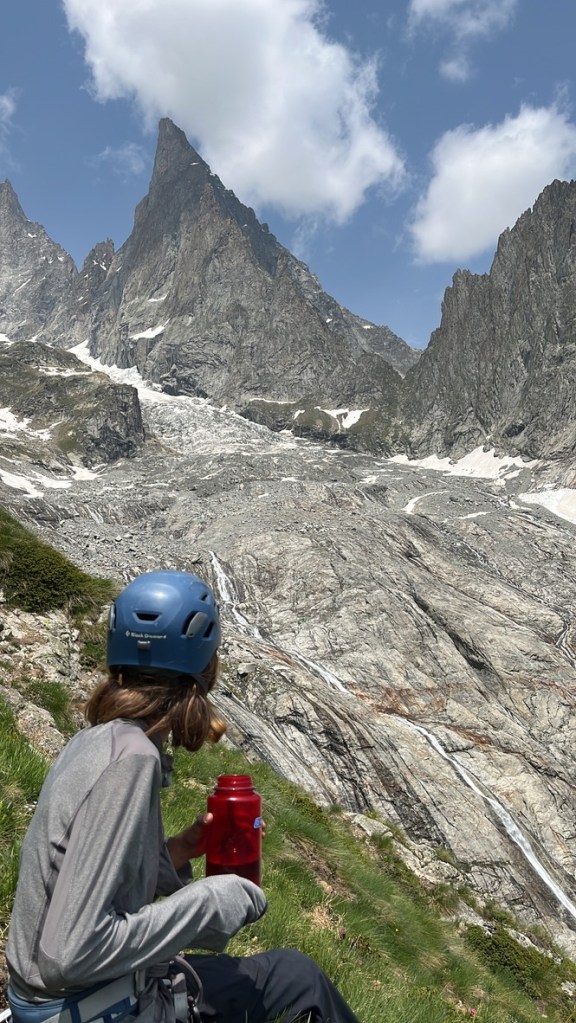
The Ottoz Hurzler is the most famous route on the face. To the summit, it’s 400m or so of brilliant granite. Following a weaving line up the face, tackling the easiest groves and chimneys available, the route has a highly adventurous feel. The line is not obvious from afar, but feels wonderfully organic and intuitive once on route. Naturally, this made it the obvious target for us.
We began our adventure by taking the bus to the end of Val Veny. Being climbers, the thought of a hill walk was frankly revolting. Surely, doing Velociraptor, a 400m sport route with bivvy kit in the packs (the Monzino hut was too expensive for our limited student budget) seemed like a sensible way to go about things. We got to the base of the route, and quickly, we realised how bloody hard it is to climb with such heavy bags.
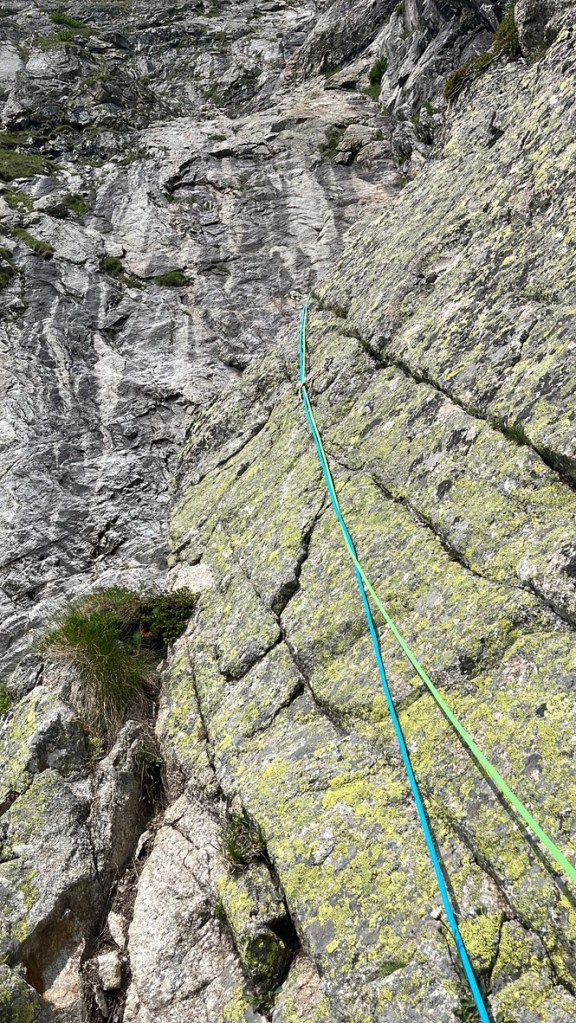
Normally, when climbing on easier terrain, I find it faster and more secure to get high feet and do large foot movements between secure and larger footholds, however, this is not the way to go about things with such a heavy back. We had to adjust to doing much smaller motions with our feet, relying on small granite nubbins to support our weight. Not so confidence inspiring when you’re used to slippery Scottish schist! The granite here however proved to be remarkably grippy, and it was superbly satisfying to be able to use such small footholds.
The route itself was highly enjoyable, weaving a curious line up the wall. The only thing that let it down was its ledgey nature, meaning the positions were a little disappointing.
After this we reached the Monzino hut, rather knackered. The lifts of chamonix had made us soft to the brutal nature of walk ins in the alps. Luckily, cake was available to ease our pain, and we spent several hours in the rifugio, resting, recovering, and relaxing.
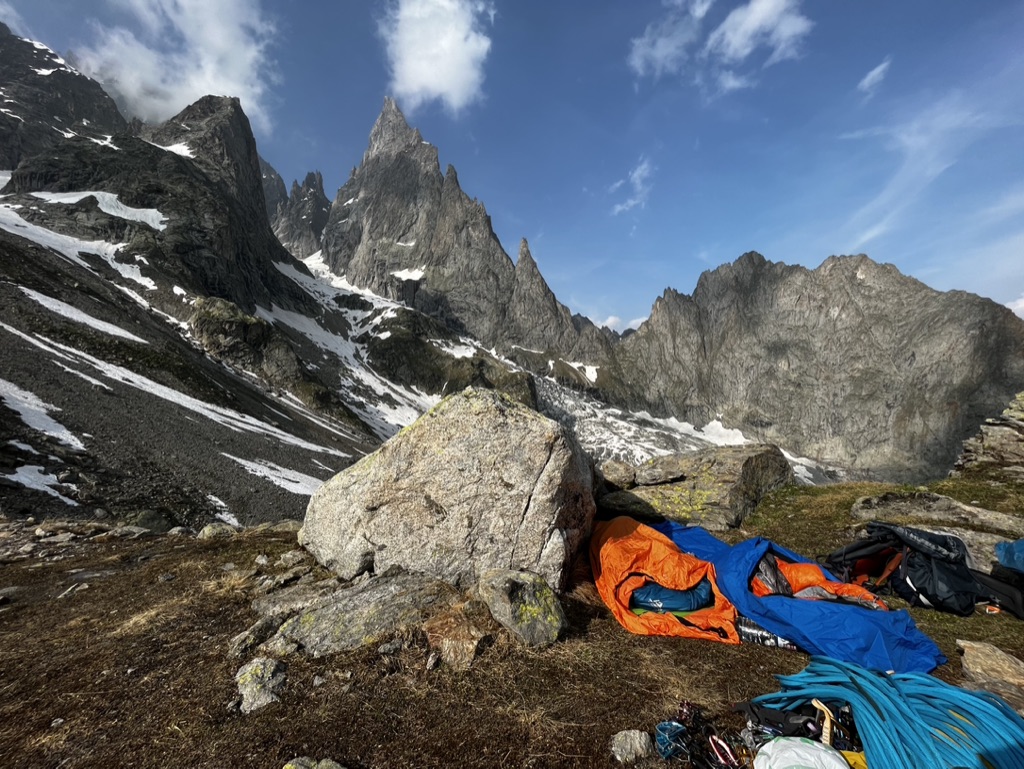
At 6pm the time came to find a bivvy spot. We found a boulder to tuck behind 5 minutes from the rifugio. Due to the extortionate cost of water, we started to melt snow. This was a waste of time. It took half an hour to melt a small amount of water, so we yielded to buying water from the hut, at an utterly extortionate cost. The sad thing was, for 300ml of dirty water, we’d used all of our gas, and as the stove began flickering before we’d even boiled the water for our tortellini. Desperately, we formed a shield around it, using lids, wrappers, and ourselves to eek out all the heat we can from our stove. The water began to boil. We scrambled to add the tortellini. The stove whimpered, coughed, and died, along with our dreams of a well cooked meal. Raw tortellini, and overnight oats it was for us.
The stunning views provided some consolation. I think as climbers we spend so much time in absolutely stunning places we forget to take them for granted. I often catch myself staring at my phone, oblivious to a stunning view. Tonight, at last, the view was too good to miss. To be surrounded by such grandeur: imposing towers and ridges, the red granite glowing in the setting sun, was the best view I’d ever seen, even if the haunting rumble of rockfall reminded us of the dangers is this environment.
The next morning we awoke early, had our oats, and set off. Quickly, the early season snow began to slow us down. The snow has rock hard, and although initially patchy, soon became continuous enough to warrant crampons. There was one section in particular section that was steep and icy, and required careful front pointing to pass through safely. Not as simple as we were hoping!
Eventually we arrived at the start of the route. The initial pitches are easy and rambling, taking in the easy angled, lower section of the wall. We dispatched these quickly, arriving at the base is the real climbing.
The first pitch of interest was a steep wall leading to a layback crack which was rather strenuous. Especially as we had employed a 1 bag between two strategy, Lara had to climb the pitch with both boots, crampons, and ice axes stuffed into my rucksack. Obviously, this made life rather difficult.
The traversing pitch(es) followed. Whilst technically just 1 pitch, it makes sense to split the pitch at the belay on Euroteam to avoid horrendous rope drag. The position on these pitches was superb; you climb just above a small overhang, aware of the hundreds of metres of exposure beneath your feet as you smear your feet against microscopic dimples in the granite. I led the second half of this traverse, and, upon reaching the belay, shouted that it was perhaps the finest pitch of climbing I’ve ever done? Superb positions, technical climbing, and an improbable looking like made it something quite special.

The next pitch is a simple chimney, a little strenuous, but never desperate. The climbing here is once again brilliant, and forces you to rely on your bridging to climb efficiently. The route had recently been rebolted, and perhaps a little excessively. Whilst the bolts make route finding far easier, this pitch would have been far more memorable had it been more in gear. I understand the need for a few bolts to show you the way, but surely placing bolts next to splitter cracks is superfluous?
There is one last pitch of interest on the route, the supposed crux. A steep wall, involving pulling in flakes in a superb position. A brilliant pitch. The bolts are close in this pitch, just a few m apart, so for me, this pitch felt very mellow.
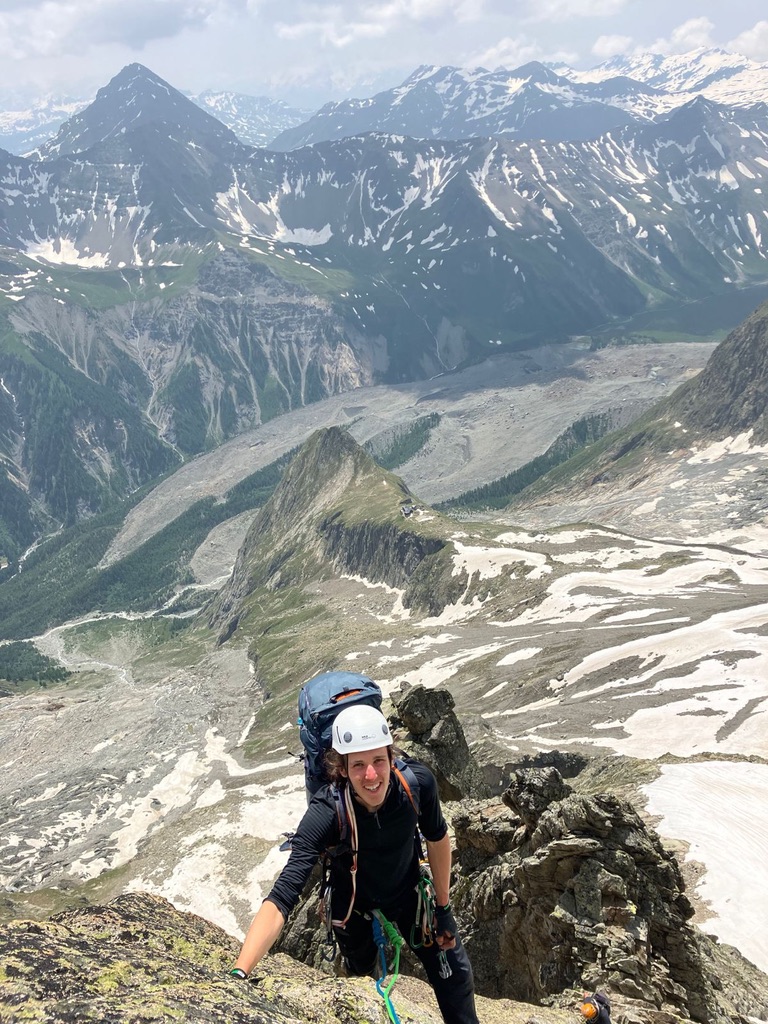
Easy, but memorable climbing led to the summit ridge. Here, we met a euro-wad. An old man, perhaps sixty or seventy, climbing a pitch of about VS happily in mountaineering boots, humming away to himself, no gear in sight. Of course, for him, there was no need to place gear, because there was no chance of him falling off.
We reached the summit ridge, and upon seeing the time, opted to ab down rather than go to the summit. The final ridge had too much snow to climb without putting on boots and crampons and we were concerned about missing the last bus home. A series of well marked abs led down the face.
When I say well-marked, I mean well marked for anyone with some level of competence. I had an…exciting moment where I abed down too far to the left, missed the next ab station, and was forced to purissik up the rope for 30m. The terrain was low angled, so this wasn’t too bad, but as I moved up the rope, I knocked a few rocks onto myself and was forced to take evasive action. I reached the ab station, greeted by the old italian wad, somewhat stressed.
The Wad gave me a hand sorting everything out. He advised us that we could reach the snowfield from here with just one abseil. Thank god!
From the snowfield, there was just one more abseil to reach the glacier, and then the long trudge back to the car park. It was a trudge that never seemed to end. We reached the bottom of the via ferret section, and saw that there was a chance we could make the last bus. Woooo! We started jogging down hill, and just about made the bus.
Dinner, and of course, Ritter, tasted especially good that night. The route was one of the finest I’ve done in my life, and certainly stands out as one of the best of the trip. Yes, the rock quality on the Croux is not up to the standard of the granite on the triolet, but the setting is absolutely superb. The history that surrounds you, and the ‘big wall’ feel of the face is truly something special. I can not recommend this route highly enough.

 Oscar Outdoors