‘Right Charlie, the route looks pretty steady, mostly about HS, good pegs on the belays, obvious route finding, simple descent – an ideal first alpine route for Chodd’.
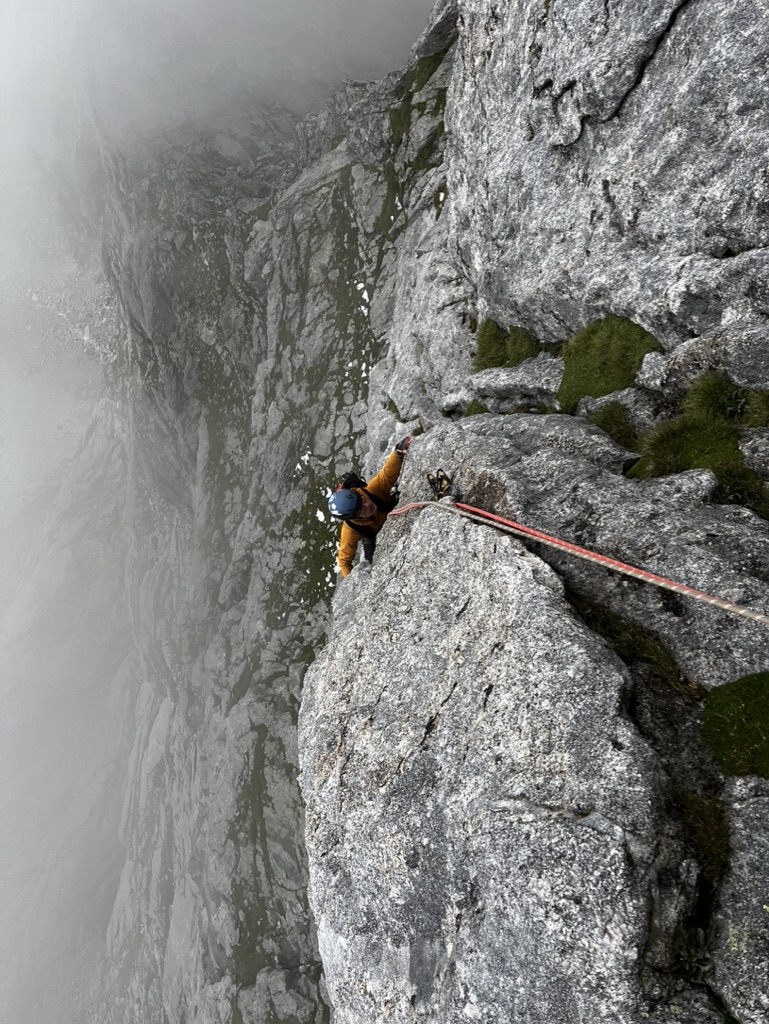
How wrong I was. Turns out, the Italians love a good sandbag – or perhaps have no real grasp of grades at all? Everything about this route turned out to be pretty unexpected – and that’s why it was an absolutely cracking adventure.
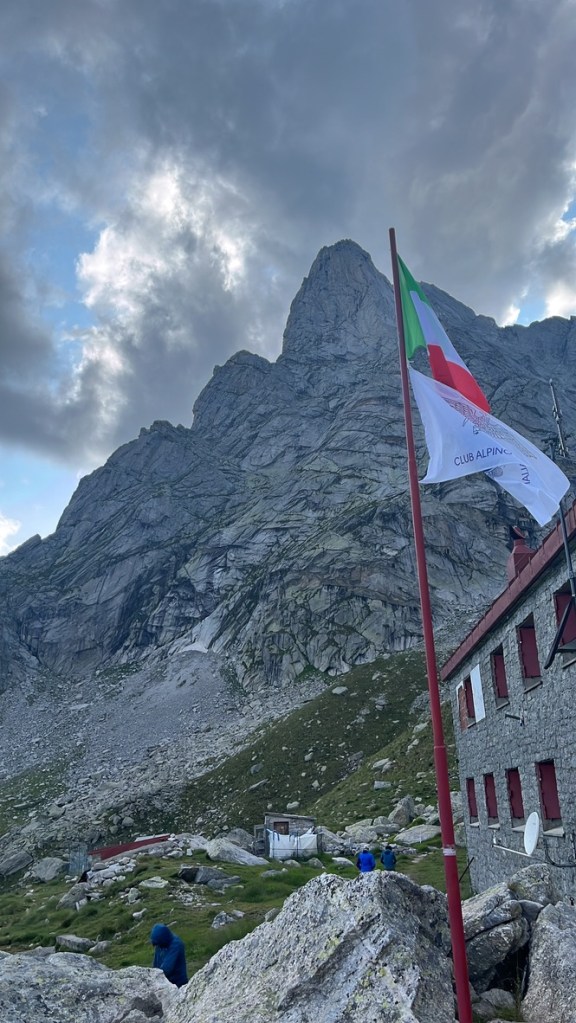
The day started early. We looked outside – the rock was dry. After last night’s rain, this was a nice surprise, and we left the hut in high spirits. I hadn’t seen Charlie for a month, and had missed him. It was lovely to chat to him again!
As we reached the system of ledges that led to the start of the route – we roped up, hoping to be able to use spikes to safeguard ourselves as we scrambled along the loose terrain. This proved to be a poor decision. There were not enough spikes, or gear, to provide ourselves with a reasonable degree of security, and it only added faff and risk. The approach was not particularly easy: the topo in the Solo Granito guide was quite rubbish, and the route finding not particularly intuitive. Eventually, we reached the start of the route. We accidentally simul-climbed half the first pitch, not realising the route had started proper, quickly set up a belay around a big spike, and continued to the first proper belay- two pegs.
Here – the guidebook description simply said – follow the right hand crack. There was a right hand crack above: but it looked utterly desperate. A steep overhanging finger crack led to a blank wall above. This pitch was meant to be 5b? The ground above looked about 6c, and poorly protected. Doubts started arising. Charlie just about had signal on his phone, so we googled the route trying to find a better description and topo.
We managed to find a brilliant website (sassobloss), which had a far better description.
‘climb the slab on the right (piton visible) and with a subsequent traverse to the right go under the vertical of a dihedral; go up it and at its end move left entering a small niche where the belay is located (3 pegs+cord+quick link).’
We looked to our right – the obvious ramp feature made much more sense at the grade. I set off again, eventually finding a piton. Questing on, I found myself below a small bulge. Now, I took the right hand crack. Although not desperate, this pitch was not easy either and felt like a pretty solid HVS pitch. The gear was not the most confidence inspiring in the world, and the moves were strenuous, especially with a backpack on. I reached the belay, somewhat glad. Surely it can only get easier from here?
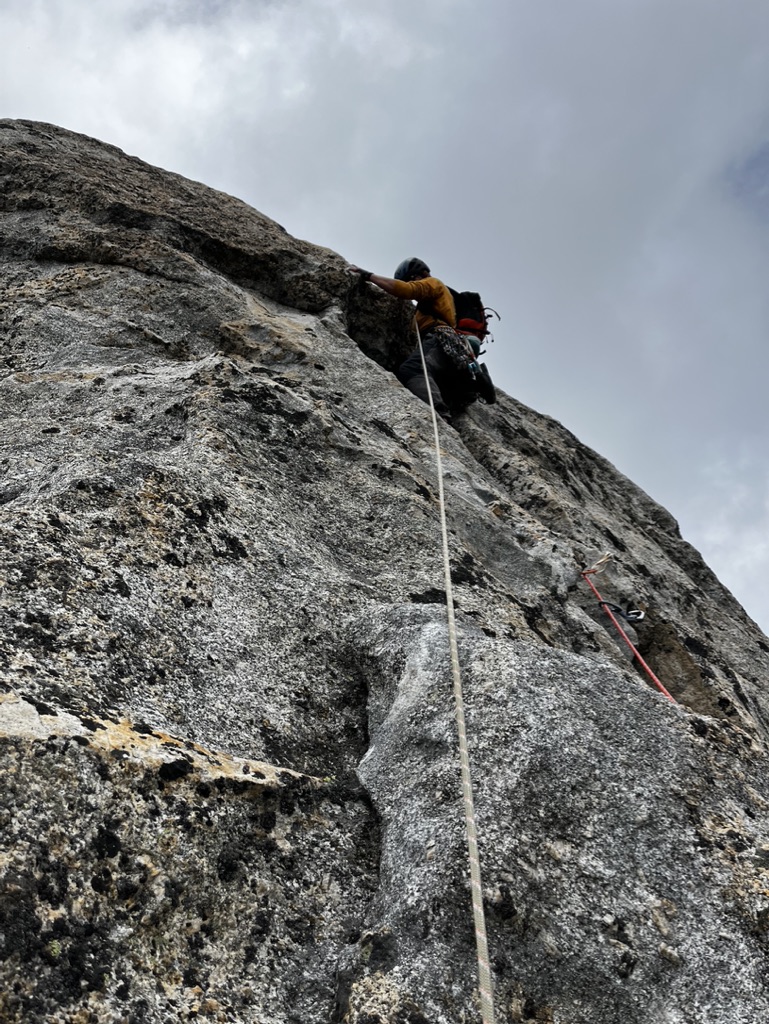
Charlie valiantly led the next pitch, a bold traverse, involving clipping a very wobbly piton and making easy, but exposed moves along a foot ledge. An ‘Of course it’s good enough’ mentality was required to get through this bit smoothly.
I then led the next pitch, a corner, leading to a roof. I went straight through the roof, but the route is meant to go to the left of it. It was here I scuppered myself. I saw a piton high in the hanging groove above and began questing to it. Eventually, the run out became too large, and the rope drag too much. I built a belay with some difficulty as there was little gear. I looked to my right, and exactly level with me, 10m to my right, was a belay built on pegs (old and rusted of course!), and a much more obvious line. Fuck!
I brought Charlie up and sheepishly suggested that I lower him off to the splitting of the crack, and he climbs the correct crack until he is level with me before placing a runner to protect the hard section through the bulge (which was ABSOLUTELY desperate and a cheeky cam pull was deployed. Bonjour!). The blog described this pitch as having 13 pitons. As Charlie quested on, he found none. I was getting anxious at this point – this was not the place to get lost! He boldly led on…
‘Doddster – pitons!”
Thank fuck!
‘How much rope do I have mate?”
“About 25m”
“Right I’ll keep going!”
I kept paying out slack, with growing anxiety as went out of ear shot, and began to have very little rope left.
“Oi, Banford, no rope left”
Nothing….
“Charlie mate ur nearly out of rope!”
He still carried on….
The rope ran out. I’d heard no shout of ‘safe’, and nothing to indicate he was. I trusted Charlie, and knew he’d work something out, but it was a stressful few minutes as I waited to hear his shout from above.
Eventually, I heard something from above accompanied by the familiar tug of Charlie tying his clove hitch – surely that was him? Well, it better be. I took him off belay and felt the ropes pull tight on me? Was I on belay? Or was I about to commit to a rather difficult traverse with Charlie still climbing?
I deconstructed the belay and took a deep breath, I felt the ropes pull in such a way that made me nearly certain I was on belay, and took a deep breath. With hundreds of metres of air beneath my feet, I had to traverse the thin slab as there was not enough rope to lower me to the easy crack. I persuaded the rubber on my shoes to stick to the granite, and began the traverse.
After some tedious moves, I reached the other crack system and began questing up the wet, thrutchy grove. After pulling through an overhang, I heard Charlie’s voice from above. We’d reach the ledge system. Two pitches to go. Happy days.
We worked out where we were on the topo. The guidebook had been laughably wrong (as was later confirmed by the hut guardian), and the climbing far harder and bolder than we anticipated. Charlie had linked two pitches to form a 60m mega pitch.
The next pitch was easy, then, there was the supposed crux. A beautiful slab with a thin crack running up it. This was actually incredibly straightforward and on good rock, unlike the rest of the route.
We reached the summit relieved. What an adventure. The descent was supposedly straightforward. The guidebook described three 60m abseils. That was it. Should be quick and easy….
Three abseils later, I found myself, at the end of my rope, with no ground in sight. I was rather pissed off at this bloody guidebook at this point. I prussiked up the rope, and began a pendulum traverse to reach rocky spur, which I thought might hold the key to reaching the hut (and Ritter!). Upon reaching the spur, I was briefly confused, but there wasn’t really another option, so I told Charlie to follow, whilst desperately searching for a way down.
I realised we could ab down to a system of ledges that we could follow round to the approach, but this would mean leaving kit behind, and deal with a loose, chossy, and frankly somewhat dangerous gully which we downclimbed earlier in the day. Suboptimal…
I continued searching, eventually spotting a cairn. Once the ropes were pulled, we set off towards this lonely cairn. The thing with these so called ‘little men’ is that they are not particularly well maintained on these routes, and upon reaching this cairn, we could see no others. For fucks sake! Bloody guidebook!
We searched around, eventually finding two bolts above a large slab. Happy days! There are few things I enjoy as much as abseiling, especially when you don’t know quite where you’ll end up.
I could see the approach ledges below us…surely this would get us there…
I set off, slowly letting the rope run through my hands. 30m done…still no belay. 40m done….still no belay. 50m done…over a vertical wall. The ends of the rope…a small ledge, but no belay. I looked down and around – I was just 10m above the approach ledges, and the terrain was easy enough to dowmclimb. I grasped on the rocks and took myself off abseil.
‘Rope Free!’
Charlie set off, following me down. It must’ve come as quite a shock to make an abseil only to find me essentially soloing above the approach ledges.
We pulled the ropes, and easily down climbed the approach ledges. Only a short walk was between me and that wonderful bar of Ritter.
What a day! Turns out Val di Zocca loves a bit of sandbagging, and the guidebook author likes to drink a bit too much moretti! It was validating to have the hut guardian point to the guidebook, laugh, and say ‘No good!, did you find the way ok?’.

 Oscar Outdoors