The weather in Val Di Mello had so far been sub-optimal, with frequent afternoon thunderstorms limiting the potential for any climbing. Nevertheless – we journeyed up to the Allievi Rifugio to spend the night. The first objective for the day had been sopping wet – so our eyes turned to Guronsan – a ‘well equipped’ and ‘modern’ route up the 400m Pizzo Torrone Occidentale, at an amenable grade. Everything was telling us it should be a nice, quick, easy day. Back at the rifugio for a nice early afternoon coffee and a slice of cake, but, alas, the mountains never let you get away with things that easily.

Lara quested up the first pitch – a 50m friction slab. This pitch quickly gave us a harsh reality check of the nature of the bolting on this route – run out! The first bolt was about 25m up the pitch, which is not entirely unreasonable given the lower section of the route is likely often covered by snow, but the remaining runouts were large and consequential: the final 25m of climbing, having just three bolts, and given the compact nature of the rock, absolutely no opportunities to place additional protection. The mist in the air coated the rock with a fine layer of moisture: not enough to significantly hinder progress, but enough to make the smears feel sketchy and poor. Lara inched her way further up the pitch, linking together ripples of weakness in rock to make slow but steady progress. I kept paying out rope, feeling relieved each time Lara clipped a bolt, and gradually fearing the consequence of a fall as she edged further away from them. After a masterful lead, she reached the belay.
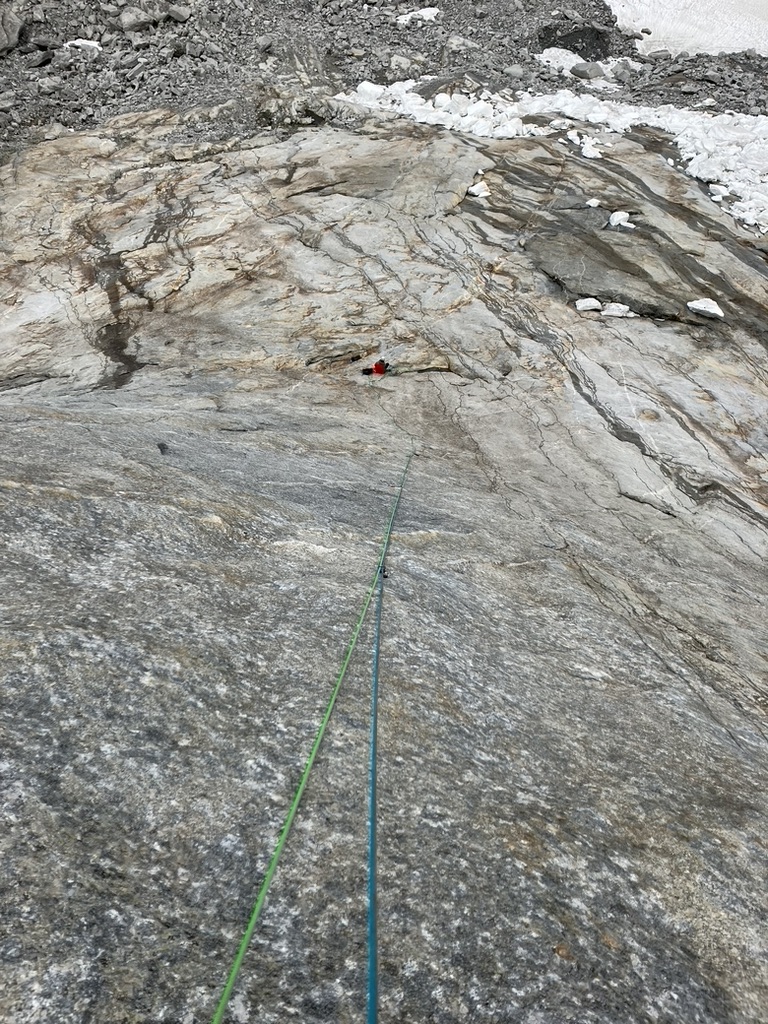
It was my turn to lead now. The next pitch looked no better. There was a 10m runout to the first bolt – risking a factor two fall straight onto the belay, with no opportunities to use any of the small rack we’d brought. I was a little tentative setting off from the belay, but took a deep breath and focused on climbing well and not fucking up. A corner led to a bold step out right, where the first bolt glistened at me. Daring me to commit to the slab and move away from the safety of my corner. I took a deep breath and positioned my foot onto a nubbin of granite, pressing it deeply into the rock, I tentatively transferred my weight to the nubbin. I stayed on the rock, breathed, and clipped the bolt. I was safe. The run out to the next bolt was just as terrifying – the climbing was no easier either, but it was at least more secure and a little steeper and more positive. The pitch continued in this fashion, this cycle of clipping a bolt and creating this bubble of safety around you, then questing your way towards it, knowing that you are entirely committed as the technical and friction-based style of the climbing is exceptionally hard to reverse. The final runout to the next belay was larger, about 15m from the last bolt. 10m before the belay, the rock became sopping wet. I traversed 5m to the left and right of the line to place two pieces of gear: good medium-sized cams.
‘Watch me here Lara, this bit is sopping’.
I began questing up the slab: overgripping terribly in the hope that I would be able to save myself from a massive fall should my feet pop. Slowly – I edged higher, the belay was just metres away now. I was entirely committed, there was no way for me to downclimb the wet rock back to the safety of the gear I’d placed, and although a fall would have been safe, it would have been massive (around 20m). All that was left before I reached some juggy flakes leading to the bolts was a small quartzite band. Terrified, I placed my foot on a crystal and stood up – expecting to take flight at any moment, but to my surprise the wet rock provided just enough friction to keep me on the mountain. Happy days! I enjoyed the final few metres of juggy romping to the belay.
At last I could rest for a little. Lara followed me up the pitch, and we both remarked how utterly terrifying, sandbagged, and serious the climbing had been so far. We agreed to carry on anyway: the next pitch looked better bolted, and it was an abseil descent anyway so we were not exposing ourselves to any additional danger by continuing the climb.
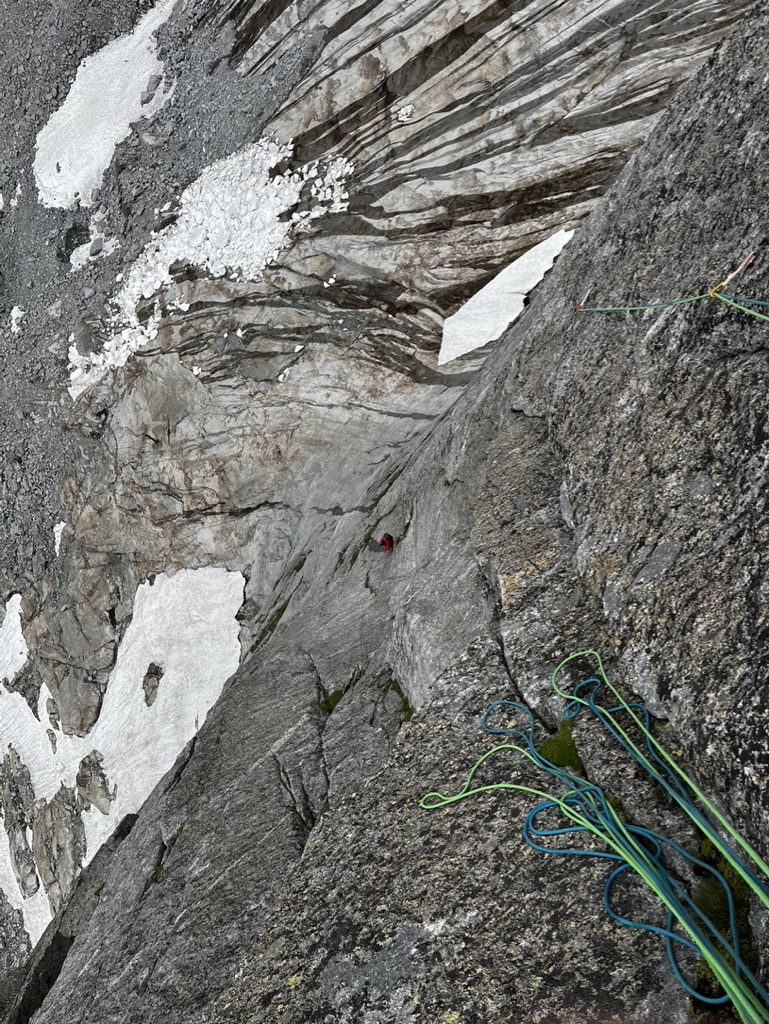
The climbing was more enjoyable now: Lara quested up a slab above to a bulge, which took cams well and was overcome elegantly. The bolts were placed intelligently on this pitch, although still extremely spaced (8-10m apart), they were where you wanted them, protecting difficult moves, but leaving the easier climbing feeling quite bold.
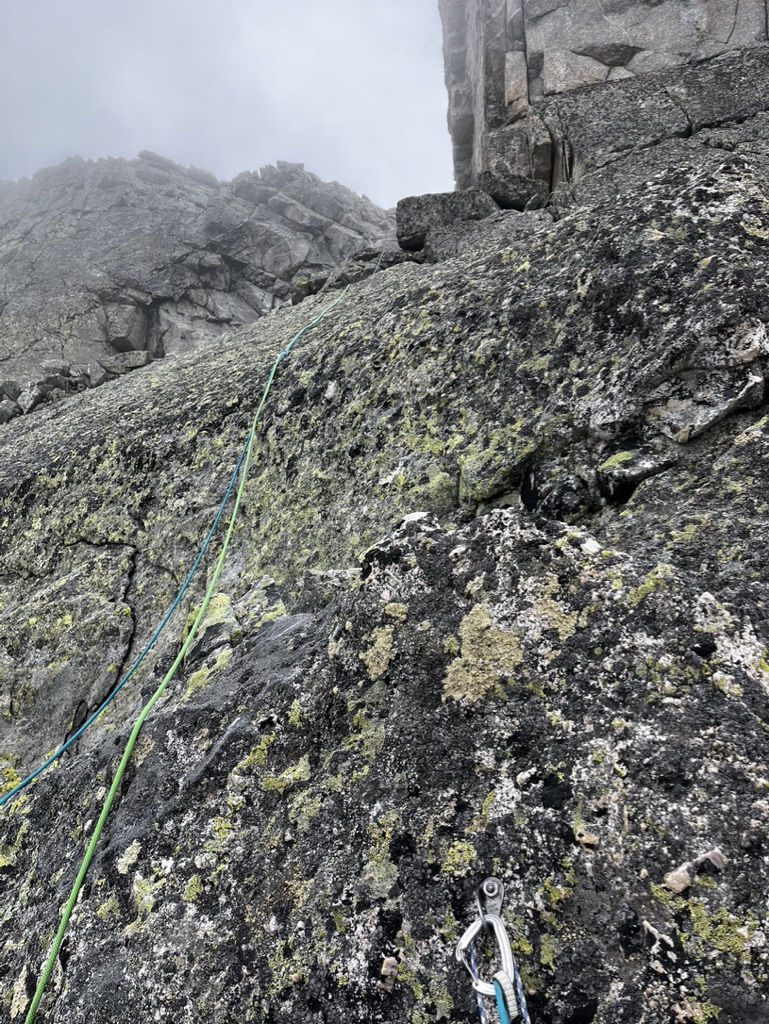
After this pitch, the grade dropped off a bit and the bolting became better. A few rambly pitches led to a spectacular slab, which was amazingly with exciting moves on the arete, involving high feet. A little steeper than the slabs on the first and second pitches, the holds here were more positive, and therefore the climbing felt far more secure and enjoyable. The runouts were even good craic at this point: you never felt unsafe, but you knew you had to pay attention and focus one each individual move.
After a final scramble, we reached the top. It had been a stressful morning with some serious climbing. We layered up, and sat down, enjoying a rest. The weather had come in a bit at this point: cloud has turned into drizzle, and as we had our wraps it felt like we were back in Scotland. We then began the abseils down, the first one dropping straight over a sharp granite edge.
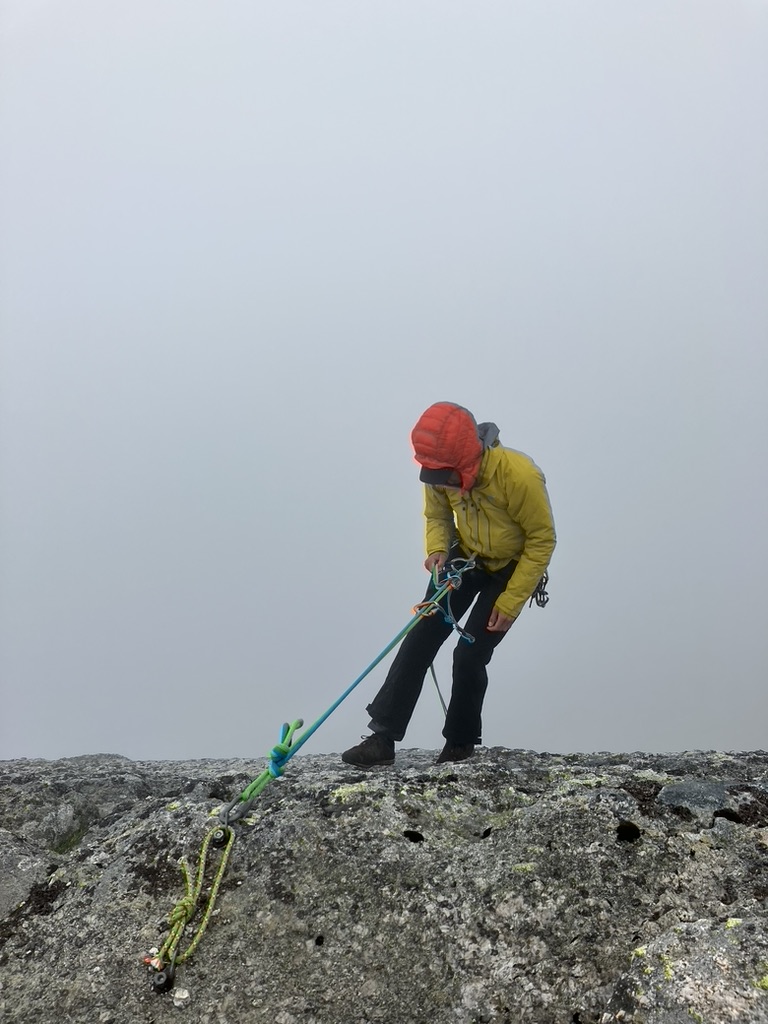
As Lara followed me down, we began to pull the ropes. As we pulled it down from above, my heart sank. The blue rope was badly core-shot, and had a 30cm section of white spindly core showing. Fuck. We both realised this was a serious situation: stuck 400m up a cliff, with no phone signal, in deteriorating conditions. It would be a few hours till any help was sent, so sitting it out would be an unpleasant and rather cold option. We had to solve this on our own. Luckily, we’d taken due care to practice self rescue before the trip, so began to formulate a plan (thank you Jez!).
We had 2x60m ropes originally, and needed 2x50s to get down to the ground. One of our 60m ropes was still intact, so I proposed doing a Krab-Block: weighting the undamaged rope and using the other as a tagline to pull it down. Upon doing the next abseil (conveniently the longest one of the route), we could assess if we had enough ‘healthy’ rope to simply cut off the coreshot end, and make progress down the route with shortened, but still long enough rope, or if we’d need to continue using a Krab block.
I set off – immensely focused. I checked, double checked, and triple checked everything we did, and Lara did the same. Dropping a rope here, or setting up something incorrectly would be unthinkable.
We made it to the next anchor, and to our immense joy, we had enough healthy rope to remove the coreshot section and proceed down as normal. Blissful. Nevertheless, we still had 7 50m abseils to go. Focus was still required.
We carefully made it down, each time we pulled the ropes breathing a sigh of relief as they came hurtling past us – not caught up on some devilish spire of rock forcing complex manoeuvres to retrieve them. I felt exhausted upon reaching the ground.
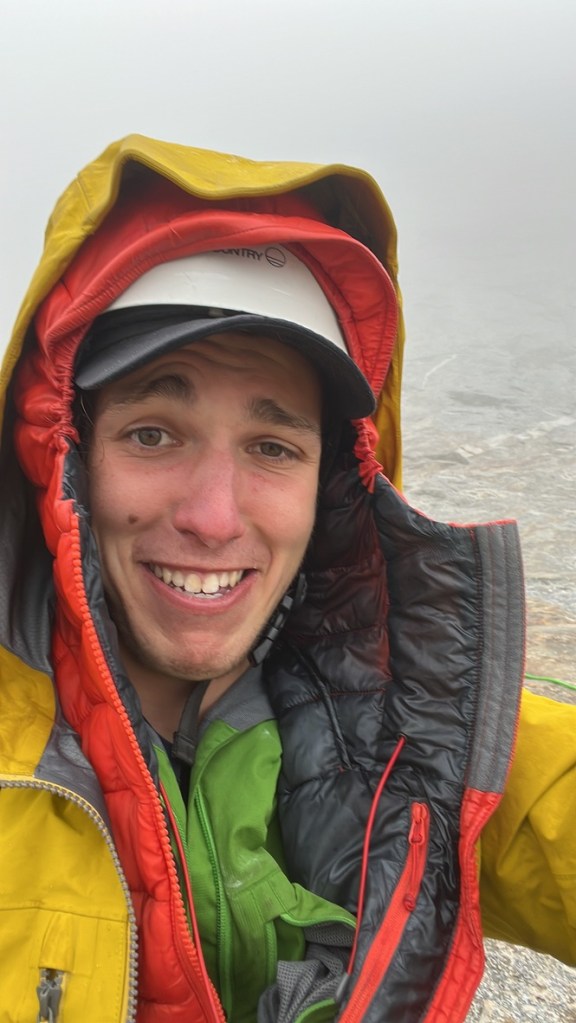
I scoffed a bar of ritter and we made it back to the rifugio. The coreshot had only cost us an hour or so, but mentally it had been a very stressful experience. Ritter, coffee, and tortellini that night tasted especially good, and we schemed our plans for the next days route that evening.

 Oscar Outdoors