The Dalmazzi rifugio is one of my favourite places in the world: a hidden gem for many British climbers, who are hypnotised by the quick hit, lift served alpinism available from Chamonix, which to me lacks the authenticity and purity of experience that one gains walking up from the valley. The Dalmazzi rifugio provides some respite from this culture – the longer walk in and esoteric nature putting off those who tick routes simply to fuel their egos.
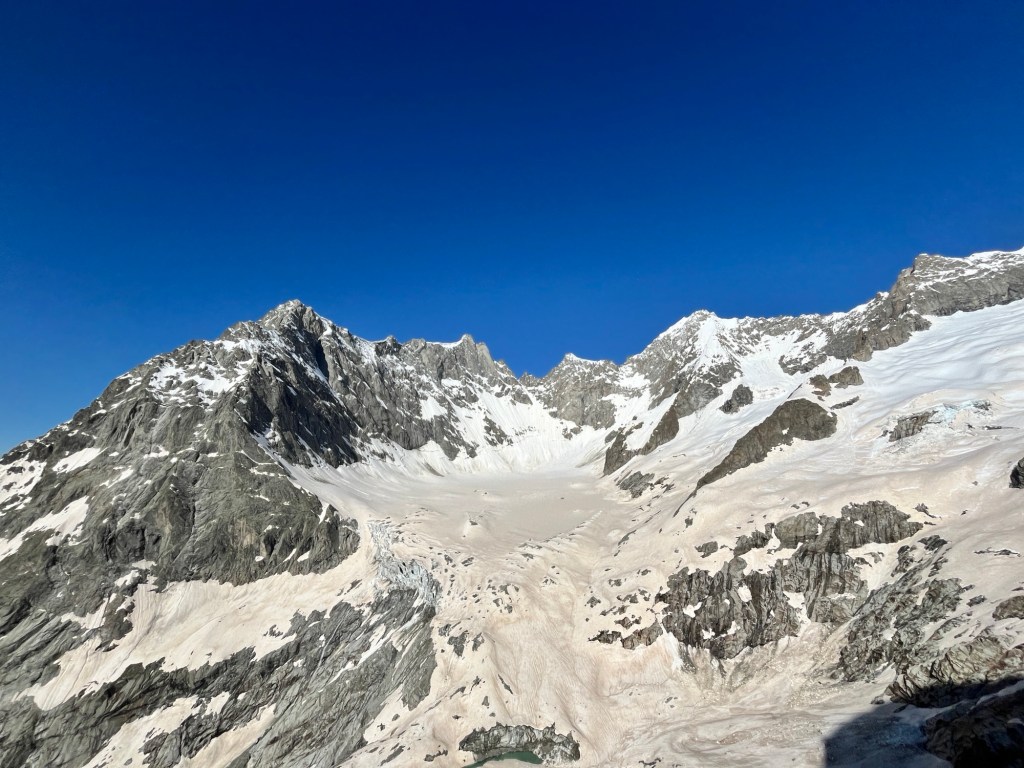
The Dalmazzi is positioned in a magnificent basin, the Leshchuax, Savoie, and Triolet standing guard around a glacial bowl, with sheer and beautiful granite walls climbing straight out of the glacier. Over the last century, giants of Alpinism have left their mark in the range: from Piola routes seeking out some of the finest granite imaginable, to the impenetrable Cassin route on the Leschshuax: a line that will only see a handful more repeats till it is ludicrously dangerous due to glacial retreat. Our objective was somewhat more plasir- Kermesse Folk.
The line follows the shoulder do the summit of the Aguille Rouge de Triolet, an enticing spur that linked the glacier to the summit, but despite following an obvious feature, the climbing itself is rather lineless. The broad shoulder consists of homogenous granite slabs which provide no distinct lines of weakness that lead to the summit – instead – Kermesse Folk links together the best rock on the spur, protecting sections with bolts where required and to show you the way. This is a rather wonderful style of climbing as it enables very rapid movement – assuming one is comfortable at the obligatory grade (a prerequisite for a route this long) – you can make fast progress, often opting to run it out to the next bolt many metres above you rather than wasting time placing gear that is unnecessary in the fear that there will not be opportunities for protection above. This means that, despite its length, Kermesse folk is a rather amenable day and an excellent introduction to longer routes.
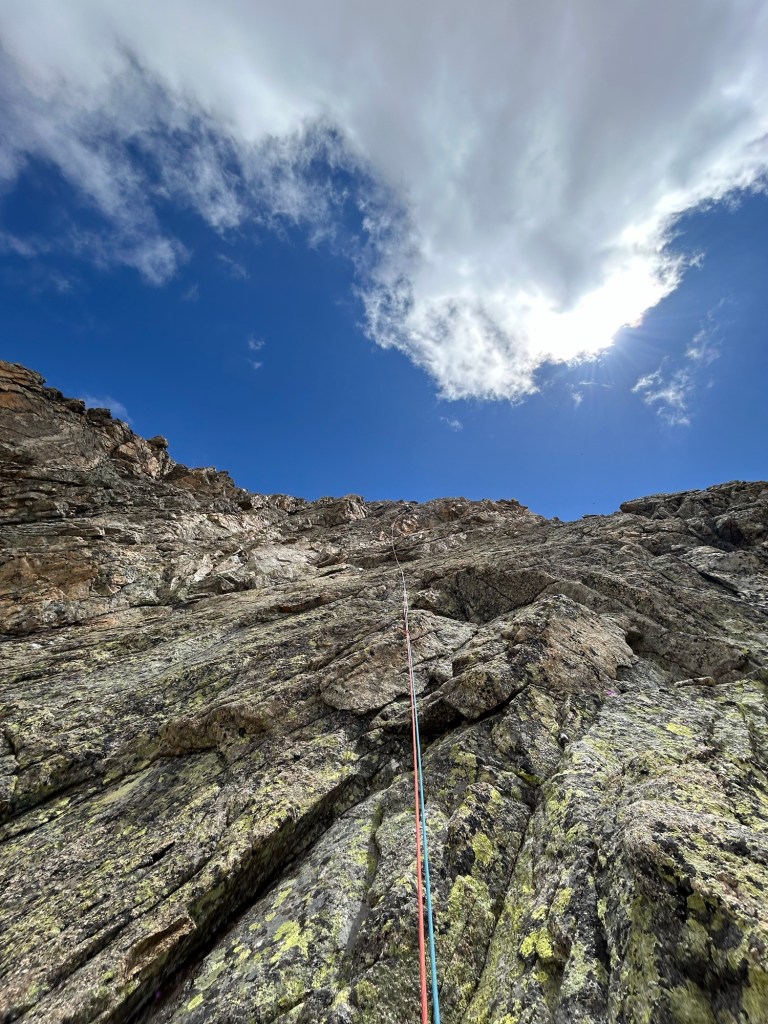
The day started with an alarm at 5, with warnings of rain in the afternoon an early start was essential. After a swift breakfast, and letting the alpine wads Tim and his twin Torrin leave ahead of us, we walked in, filled up water, and plodded up the steep snow patch to the base of the route.
The first few pitches proved to be enjoyable climbing: it’s worthwhile to note that the second pitch is entirely reliant on friends for protection for the first ten metres, and in British equates to steep but juggy VS/HVS 5a. The climbing is that lovely style where one is never left wondering what to do – you can simply enjoy rapid movement over beautiful rock.
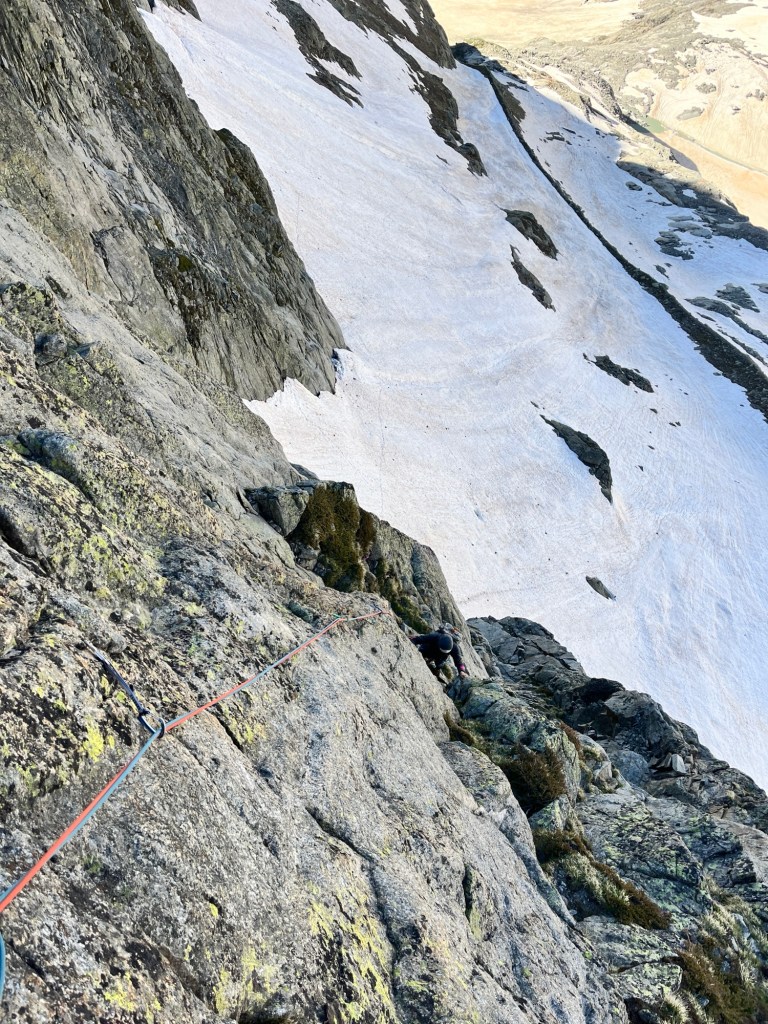
All belays are well equipped with two bolts and a maillon, although I’d be very hesitant to recommend abseiling the line, it is long and easy angled and would surely be a nightmare.
After the first ten pitches, we encountered a large snow patch after the 2a pitch- highly unusual. Boots were required and we kicked steps up this section, marvelling in the extra adventure introduced into what otherwise would have been a pure rock route.
The next pitches were also wonderful – a series of beautiful slabs leading to a belay on a fine ridge. Joe had somewhat of a nightmare route finding here – without glasses (or with them for that matter), the grey and matted colour of the bolts ensured they blended in well with the rock, and thus it was easy to quest in the wrong direction, mistaking some granitic knobble for a bolt.
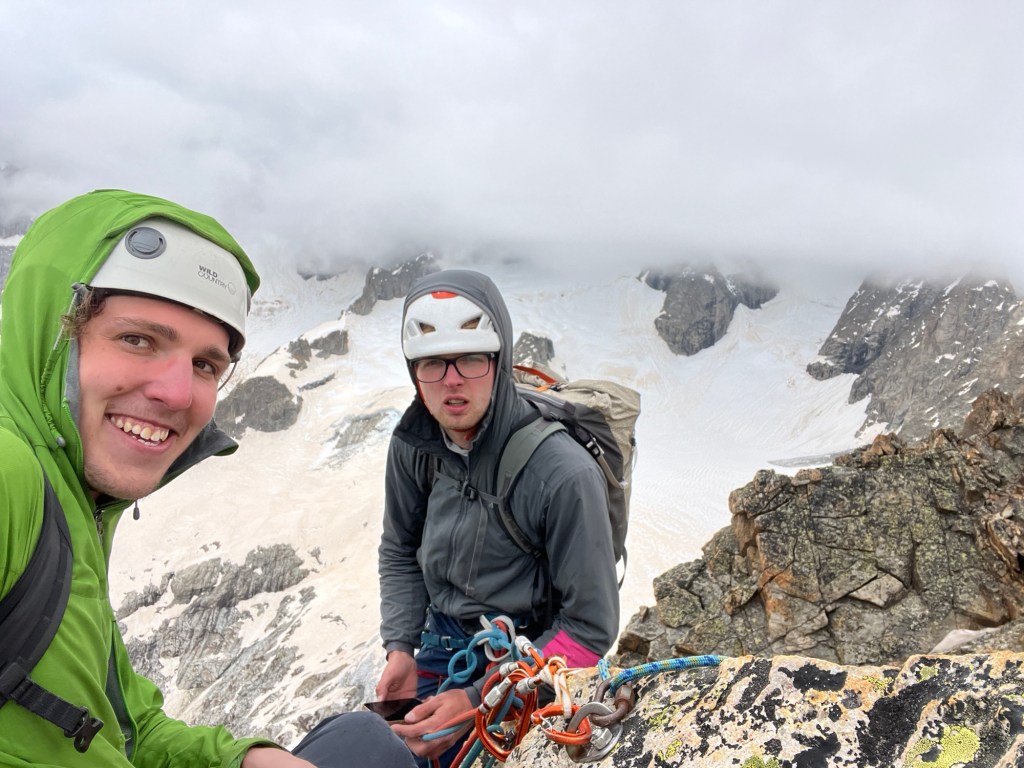
From here, the angle and the grade eased, leaving three wonderful pitches of climbing before the top. Joe and I shook hands, hugged, and took a selfie before beginning the descent.

I will describe the descent we did in detail. I would warn anyone to neglect the advice of Plasir Sud – abseiling the line would be masochistic and result in endless stuck ropes – the pleasure one would gain by climbing without the burden of boots would be soon forgotten when you have to climb up to retrieve a stuck rope for the tenth time. Instead, descend the right spur (route behind you) to a ridge. Here, there is some tat. If you descend straight down from the tat to a ledge, and make a traverse to the right (facing out), including a step at about grade IV, you will see two bolts. These bolts follow a steep but clean abseil line which take you to the base in about four abseils. Three of the stations are well equipped with two bolts – one station has only one bolt but as of June 2024 is backed up with a well placed nut (not placed by us) and new green 8mm tat (placed by us), alongside a thread. I would advise future parties to descend further down the ridge and attempt to find the abseil line of Cristallina, although unless the team is already familiar with this route I suspect that would be quite difficult. I look forward to the Chamonix Granite guide to Val Ferret to see what line they advise abseiling down, and hopefully a more comprehensive description of the descent.
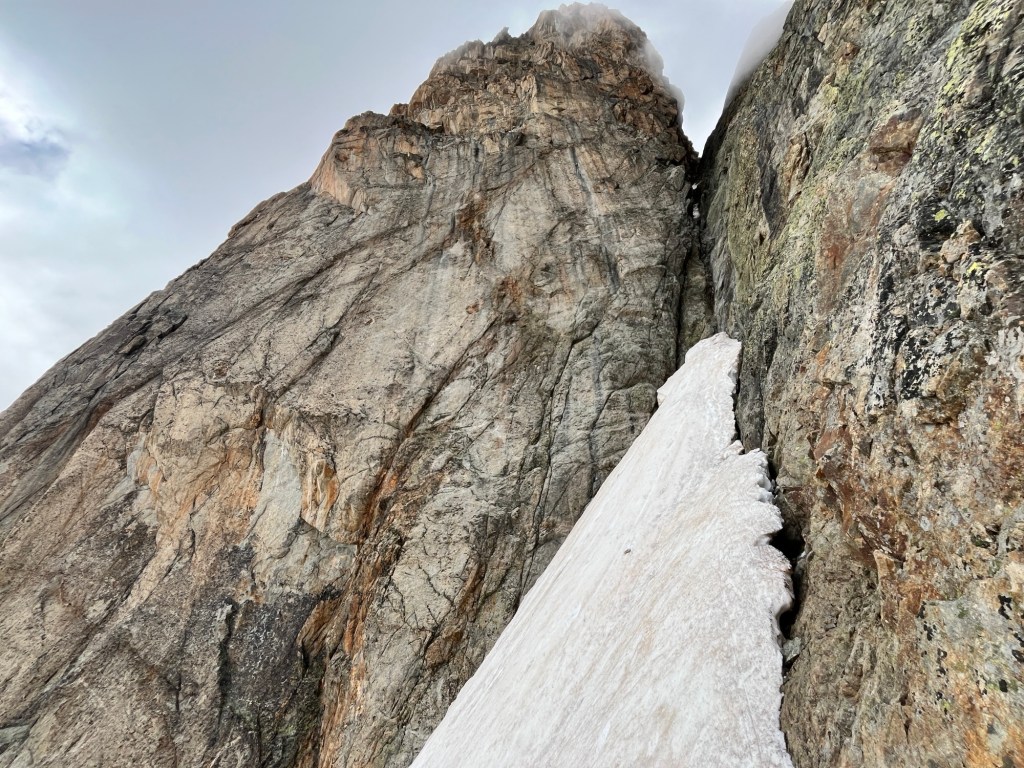
From here, the descent in dry conditions is straightforward – a walk to the so called “access dihedral” , however due to the large amounts of snow, it was made somewhat more technical and had many scrambling sections at about the second degree. A short walk over the snow patch after the access dihedral led us to the rifugio.
Overall – an excellent and enjoyable day out – with a good adventurous feel and fantastically positioned. Although the climbing on Perfumo Prohibito is better, it still had fantastic pitches and provides a more complete feeling day.
For parties reading this as beta before attempting the route, bring about 10-12 quickdraws and a small rack of friends – perhaps silver friend – gold friend. Two ropes of at least 50m are needed to abseil down the line.

 Oscar Outdoors