Some mountains are special. Something about these mountains eats straight to your soul – their shape, line, and raw beauty inspire a mixture of fear and awe that creates that wonderful stomach-churning excitement that surely motivates all mountaineers to climb. For me, Presanella was the first mountain to do that: it’s proud pyramidal shape and imposing and daunting East-Face – Himalayan in scale – standing guard over Trentino. It felt so unattainable, inaccessible, and frankly like a pipe dream for so much of my life. Returning to the Brenta after a few years of obsessive climbing was strange – the grade (somewhat debated, but for me about PD) was now not only achievable but straightforward. So – in the time I was here alone, I decided it would be a suitable objective.
For the solo mountaineer, Presanella presents itself as an ideal objective. Although the mountain is glacial, climate change has shrunk it to the point where it is thin and no longer crevassed. Difficult sections have some equipment in the form of cables and rungs, and even the hardest unprotected steps are well within the grade I’m happy to climb alone. What a fantastic objective!
Without a car – the slog up to the Seganantini Rifugio is long but not ridiculous, comparable to the walk ins in Val Masino. With about 1300m of ascent from the bus station, via a road and then a delightful path, it took me a shade over three hours of walking to reach the hut. Here, I enjoyed an afternoon of watching downloaded YouTube videos (YouTube Premium is worth it for these trips, I find) and trying to read Italian climbing books in Rifugio’s small library (a single bookshelf). Dinner was rather good, and I was advised to start early, perhaps walking by five, as it would take about 5 hours to reach the summit from the hut.
The alarm sounded and I swiftly had breakfast and began walking at around ten to five. Deploying my old man shuffle, I began progressing to the first difficulty – Bochette De Monte Nero at 3000m, just over 800m above the Rifugio. The view was stunning, as was the alpenglow shining from behind the Brenta.
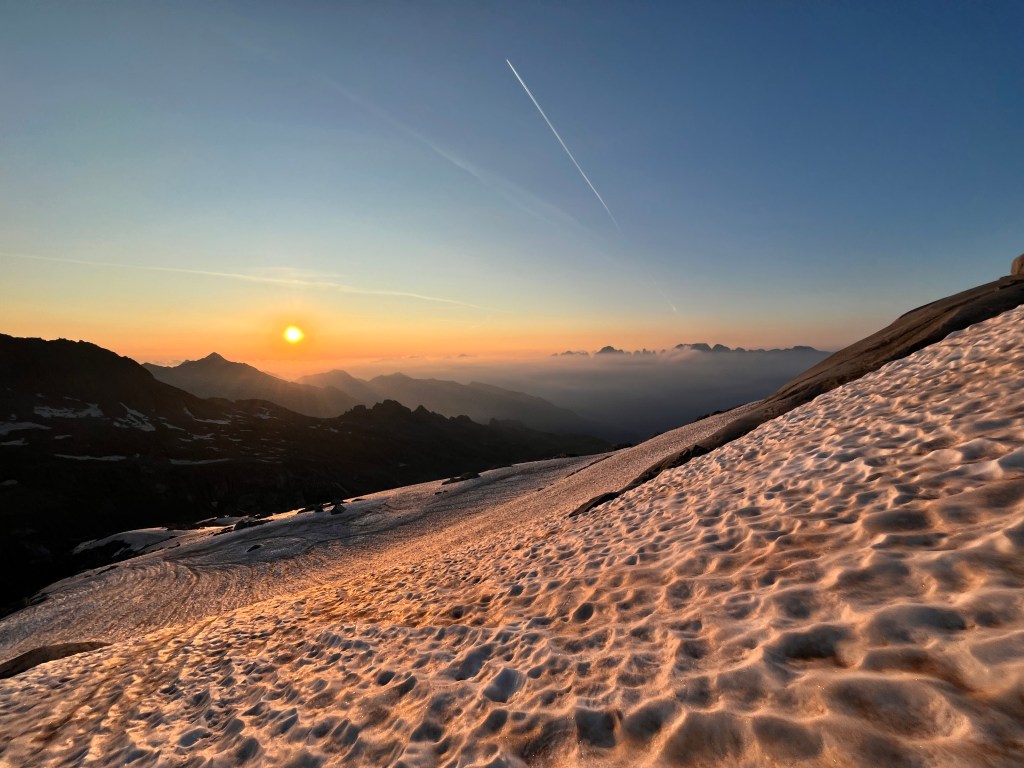
After about an hour of walking, I reached the glacier and put on my crampons and had a small amount of water before setting off. The snow was satisfyingly hard and very much required crampons. I made swift progress up the slope, continuing the old man plod to the Bochette.
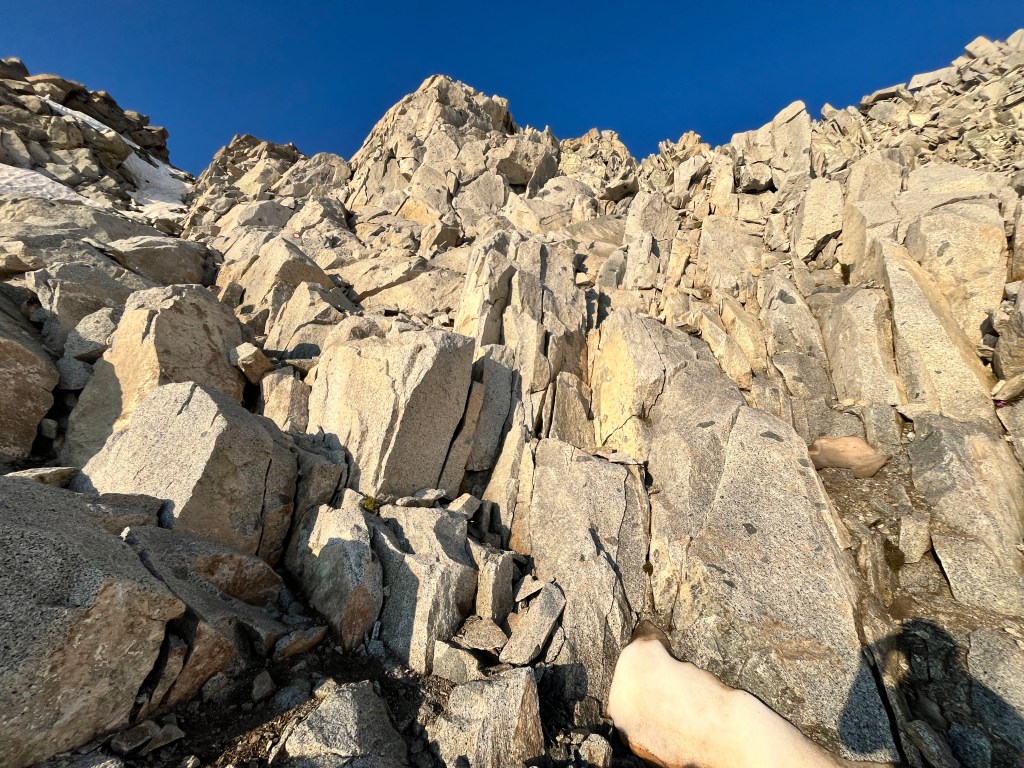
I kept crampons on for this part to save time – although those not confident moving in crampons would be wise to remove them. Furthermore, I feel the need to advise parties that although there are cables here – the primary security they provide is as a handrail. The ledgey nature of the climbing means that for the most part you’d fall to the same point as you would if you were unroped, and at times would be in a worse position as you may be flipped upside down. I’d advise future parties to see it as a way to make soloing safer, and parties not happy moving relatively quickly unprotected over UIAA I-II ground (UK grade 3 scrambling) would be well advised to bring a small rope and make use of the bolts equipped with snapgates that would take a munter hitch beautifully. You can tell this route is popular with guides!
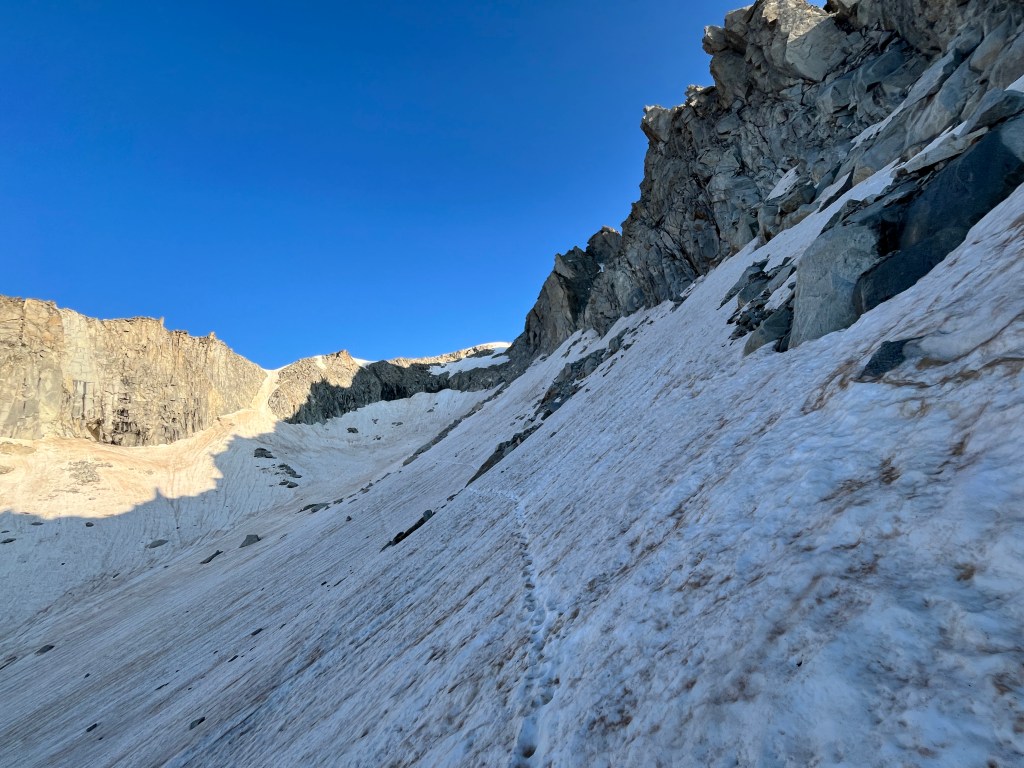
The descent was similarly straightforward and I reached the second glacier. This was a straightforward crossing, with good steps for most if it, with the final section being rather steep at about 35 degrees, but not being consequential. Later in the day, I saw some significant rockfall off the left hand face in the image above – parties would be well advised to stay well to the right (facing towards the summit) and not dilly dally for too long. I suspect the rockfall is worst around this time of year as the winter snows melt, but sadly this coincides with the best conditions for the route! The gully on the image above tempted me greatly too – as it looked like an excellent low grade plod in a fantastic setting!
The route itself instead continued to another small scrambling step, with one fixed line at the start, then a few moves of II which are very secure and straightforward, although the rock is very poor in places, and those inexperienced moving in alpine terrain should be reminded to take immense care, and test every rock before pulling on it, both to safeguard themselves and to prevent throwing rocks on parties below. Luckily, at this point I began to realise I was making very good time and was well ahead of other parties from the hut, so I did not need to worry about this.
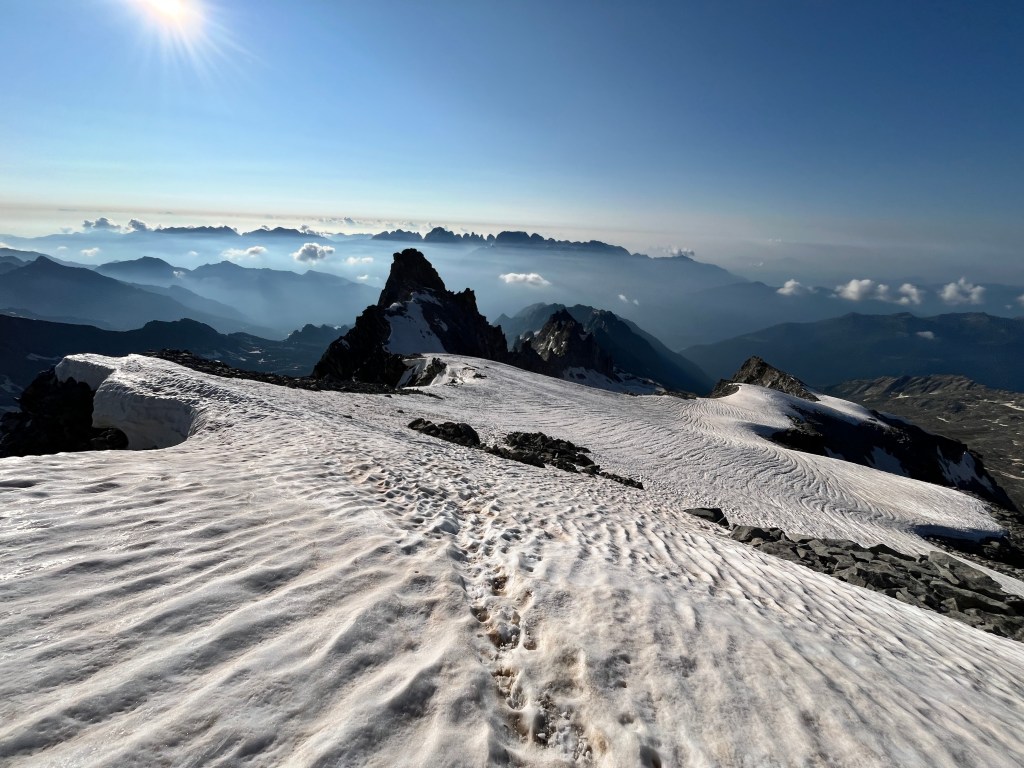
You then gain a broad plateau/ridge. The setting here is wonderful – but the East face has large cornices. Mountaineers should stay well away from the edge to ensure their safety. In places, the cornices were overhanging as much as five metres and are very weak in the sun.
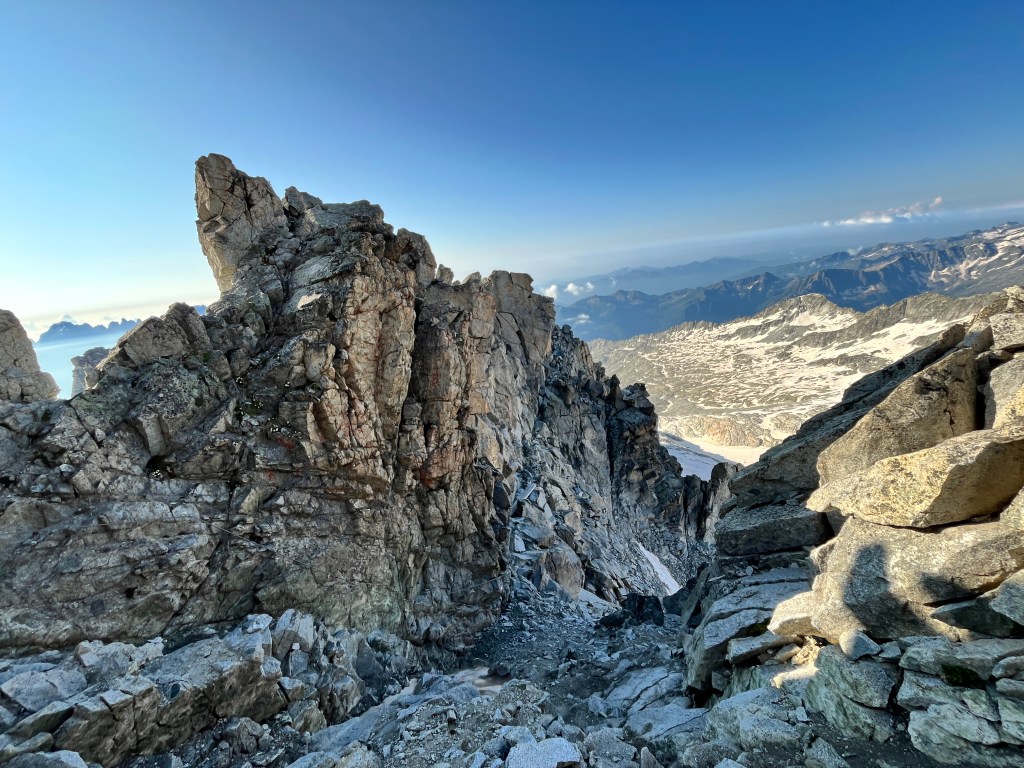
The final difficulties are coming around the Bochette de Monte Nero. Although very straightforward, the rock is very poor: parties should take immense care not to throw rocks onto other climbers. From here, you reach the Bivacco Brigata Orobica, at 3387m. It is a straightforward walk from here to the summit, with a few short scrambling sections.
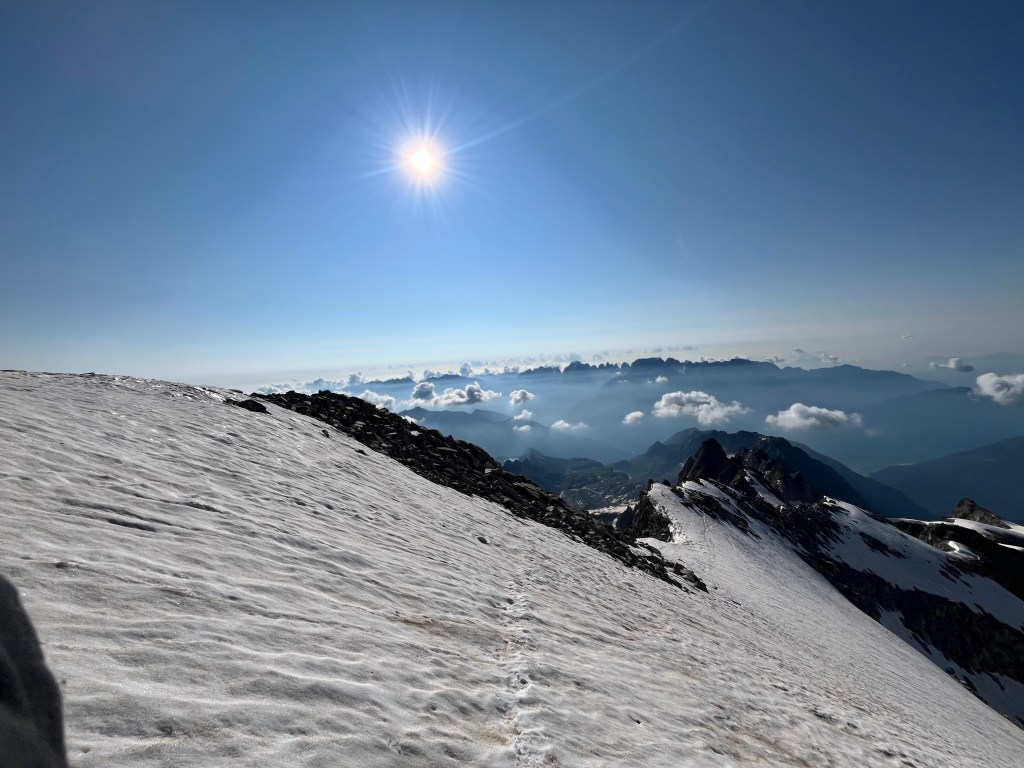
The view was utterly stunning, and the snow was still absolutely bullet-hard and the feeling of plodding up this wonderfully positioned snow slope, with the expanse of the Adamello, Ortles Cevedale, Brenta, and Bernina groups sprawled around you was one of the finest mountain experiences I’ve had. I reached the summit a shade under three and a half hours from the Segantini.
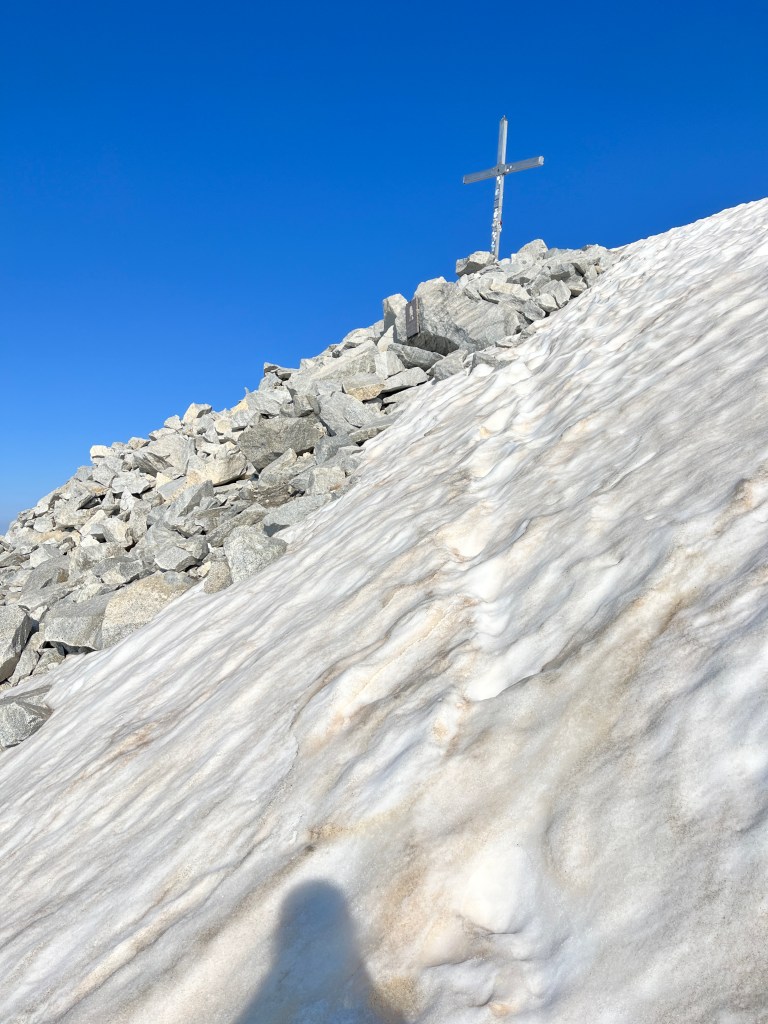
I did not dawdle at the top. Many of the snow slopes were consequential and above large cliffs and I was aware they would be far more difficult to cross safely once the snow softned. So after around ten minutes on top, I began to descend, which was straightforward. I reached the Segantini just after 11, from where I walked to the road and hitchhiked back home.
To me, many British climbers approach the Alps with an appalling and egotstical attitude – flocking to Chamonix, Sass, and Zermatt with the intent of ticking these big famous routes to boast to their mates about in the pub in the valley. To me – this is the sweaty armpit stain of mountaineering culture, and brings out the absolute worst in the community. Routes like this are the antithesis of that culture – a joyus and isolated path up a mountain that leaves no room for ego and makes no allowances for those not willing to get sore legs on the long approach. A wonderful outing that I can not recommend highly enough.

 Oscar Outdoors