British climbers are like sheep. They mostly all flock to the same places each summer – Chamonix, Sass, Ailfroide are all hotspots for Brits – and I daresay there is such an excess of them it’s easy to forget you are actually abroad. It’s true that all of these places have excellent climbing, with stunning routes in exciting positions, but the crowds, especially around Chamonix, are offputting to any climber with a soul. Of the esoteric alpine areas, the Presanella group marks as one of the more esoteric – until a few years ago there was no guidebook, and even now there are few online resources. This, in my eyes, is a great shame. It is an excellent location to go climbing, with outstanding quality rock and absolutely zero crowds. Even shorter routes are full of character, and the locals equipping the routes do so with outstanding style, often only bolting when absolutely necessary.
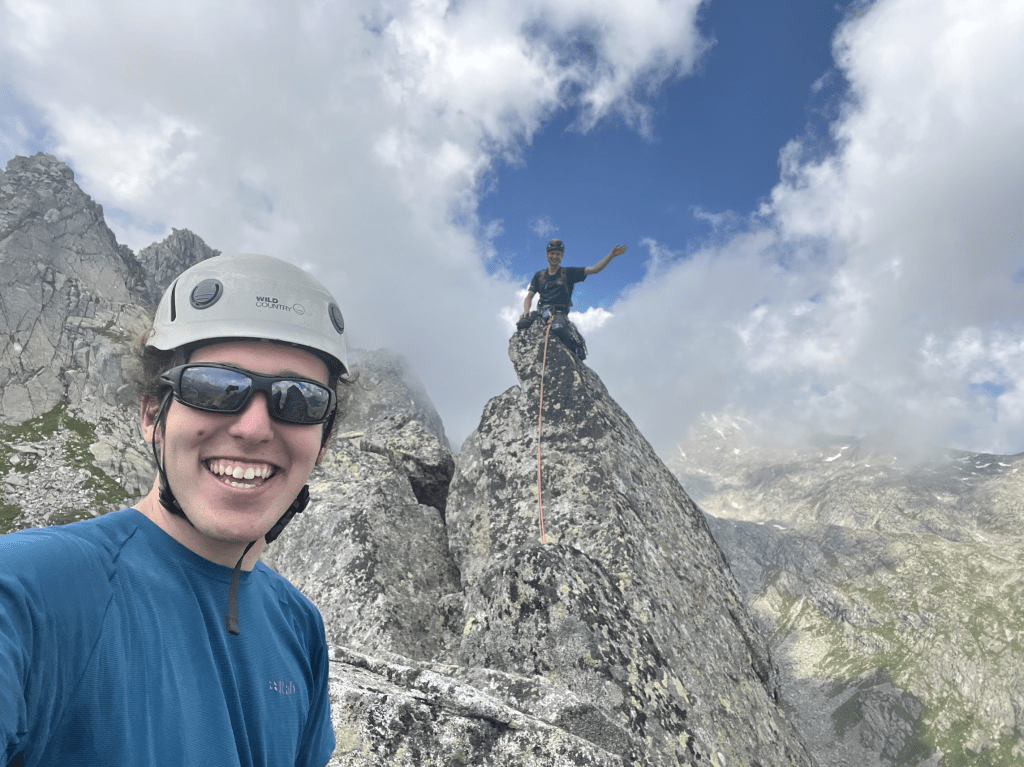
It must be said – the walk-ins are undoubtedly longer than Chamonix (this isn’t the South Face of the Midi), and as the routes have very little traffic, they are at times dirty. There is a minimum of fixed gear and very little information on routes available online – in short – it’s harder work than other areas in the Alps – but this is it’s greatest strength. Lazy folk will go elsewhere, leaving dedicated mountain lovers peace and quiet on one of the wildest and greatest mountain ranges in the Alps.
Guidebooks and Transport
Transport around the Presanella and Brenta is straightforward: although there is a bus leading to several hubs (Val di Genova, Pinzolo, Maddona di Campiglio), the climbing in Val Nambrone and Val d’Amola requires a car for access. This being said: Noah and I didn’t have a car, and always got hitches quickly and efficiently.
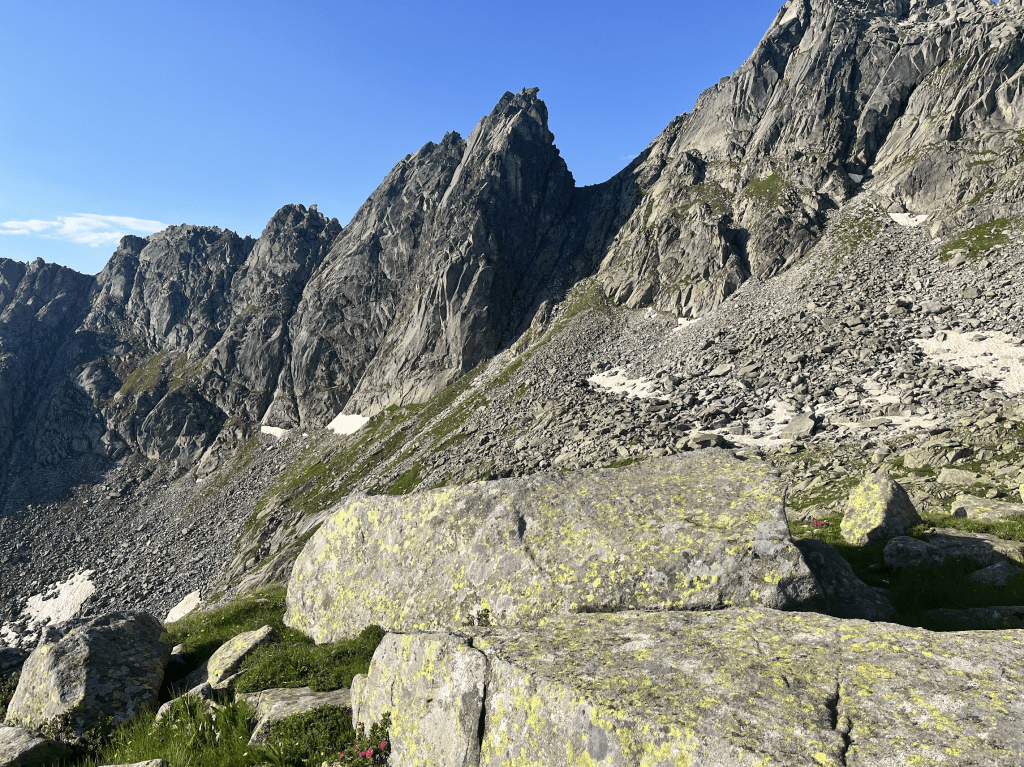
There is only one guidebook (at least that I’m aware of), and it is an excellent one. ‘Climbing in the Presanella’ by Francesco Salvaterra provides detailed and accurate route description. Climbers should become comfortable reading line topos as both in the Presanella and in the Brenta, this is the preference and I’d warn that the grades felt a little stiffer than Chamonix, although the protection rating system (R1, R2, R3) felt a little more forgiving.
Wild camping is banned, but seems to be tolerated as long as you are respectful and sensible. There are bears in the national park – we took no precautions to stow food away from the tent, but I’d commend all future visitors to seek proper guidance on the correct practice. There are also several Malga which are left unlocked – essentially acting as bothies.
Rack and Equipment
Being granitic rock, the Tonalite has a preference towards cams. We felt doubling up the middle sizes was a helpful asset in reducing how bold the routes felt. A minimalist rack of nuts would be wise to bring – smaller sizes often protect section that would otherwise be a little spooky, and on some routes, they could be forgone all together.
The belays are usually bolted – but the style of the bolting is at times a little unusual. One route in particular had just one (new and shiny) bolt at each belay without the opportunity to back it up – a worn bolt here could make the route unclimbable. Some abseils were just on one bolt too. Generally, there is a description of the belays on each route, if only one bolt is described, then don’t expect to be able to back it up.
Pitons are used a fair amount – a hammer could be a useful asset to assess their integrity, but we felt it superfluous to carry pitons in hindsight (although it did make us feel rather cool).
Accommodation
For Val Gabbilo – there is no accommodation aside from under the stars – Val d’Amola and Val Nambrone are luckily better equipped.
Rifugio Segantini provides a comfortable base. The staff are kind and friendly and the views are superb. The area around the Rifugio is grassy and setting up a tent would be straightforward.
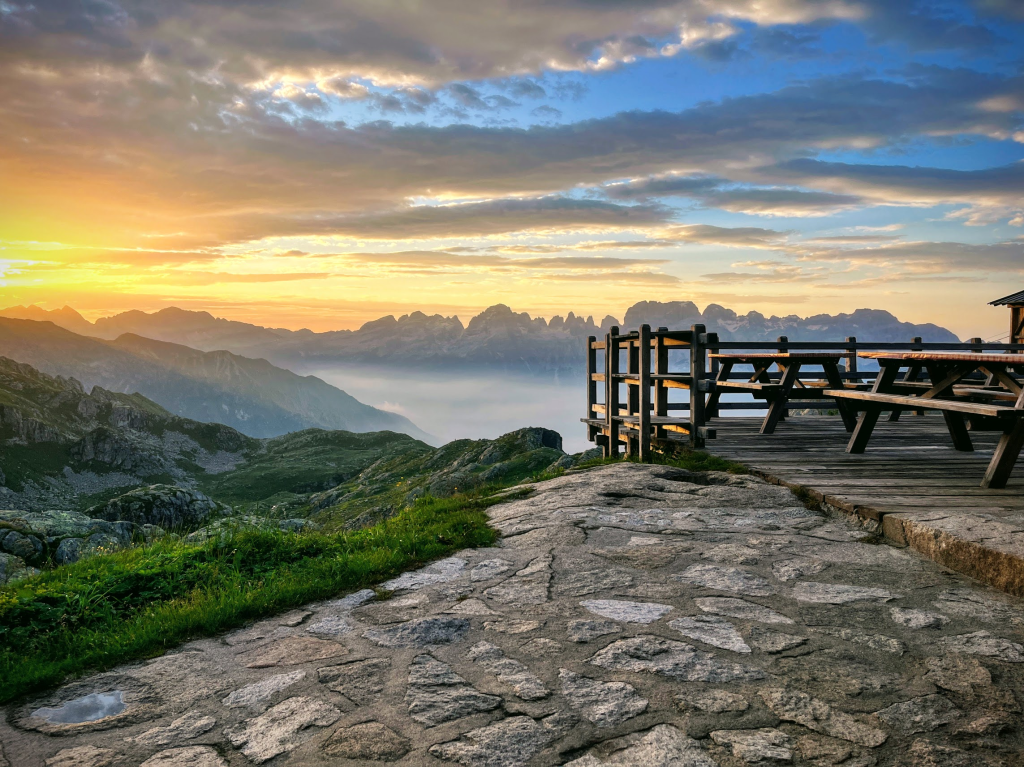
Many folk will chose to day trip the routes in Val Nambrone, but to those of us who do not have the luxury of a car, this is not possible. Luckily, the small Malga Cornisello hut is sort of like an Italian Bothy and provides accommodation to those who are not keen to sleep under the stars.
In both locations, we never filtered any water and had no issues. There are some livestock around, so those not used to drinking mountain water may be advised to bring some means of purification.
Now, onto some route suggestions
Diedro Dell’Amicizia
A beautiful name for a beautiful route—both Noah and I thought P7 especially was excellent. Lower down, the rock is loose and at times vegetated —care is required. Grade wise – we both thought the 6a+ crux pitch felt like steady E3 5c, lots of 5c moves but fairly well protected, and it felt substantially harder than other 6a+ routes we climbed in the area.
Sentiero dei Collibri
A beautiful route, with sustained difficulties at V-V+. The short 6c+ corner is easily aided on in-situ pegs, and we both thought this was an excellent route. I’d warn future ascensionists that the belays are just on one new bolt. As of August 2024, these bolts are in excellent condition, but there is no opportunity to back some of them up. Care may be required in the future.
Circolo dei Mongoli
An excellent crack climb, although we both felt that the grades of 6b+ and 6b for the first pitches were a little generous, and both agreed that the crux of the Corner of Friendship was far harder! The gear is good.

 Oscar Outdoors