To climbers, corners are immensely appealing: they provide joyous movement, excellent rests, and straightforward route finding. Few things bring me as much joy as a grand corner in the high mountains – a natural and organic line to the top of a mountain, guarenteeing a climber a beautiful passage, full of joy and emotion.
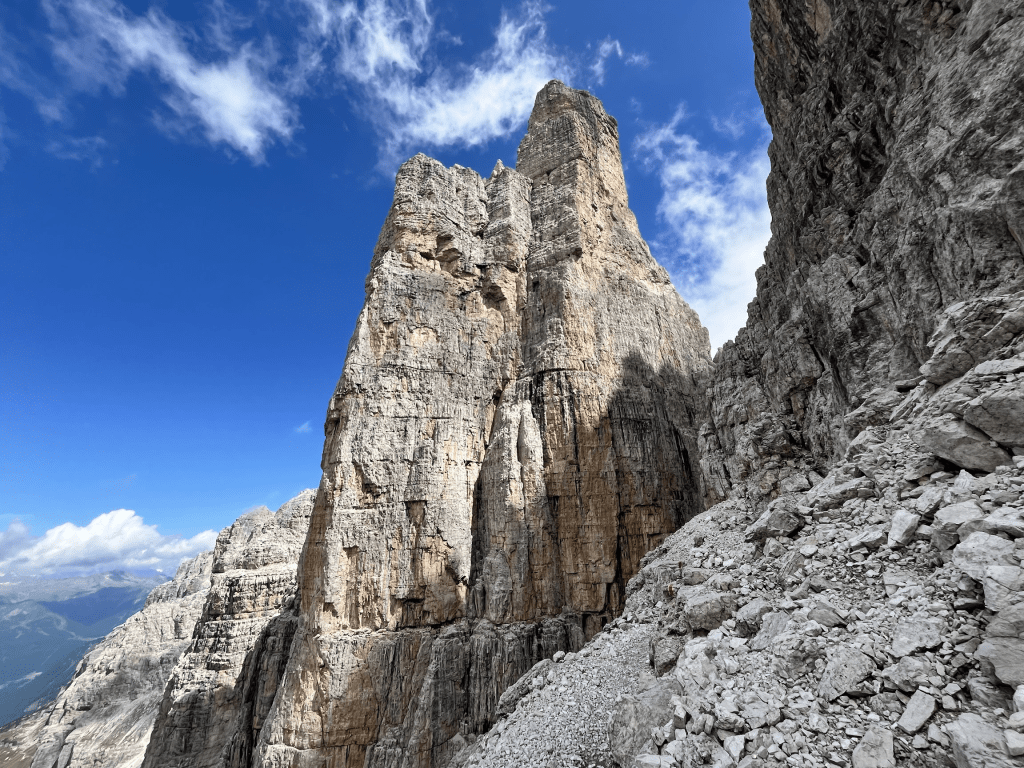
And, of course, there is no finer corner then the Ferhman-Smith route on the Basso – a genuine King Line on a beautiful, elfin spire. A week before Noah and I climbed the route – I gazed at the wall for the first time from the Bochette Centralli – and I was enamoured with it’s scale and grandeour – it seemed like a paradise for the climber. Alpinists were littered across the wall – each one fully engauged with spectacular climbing.
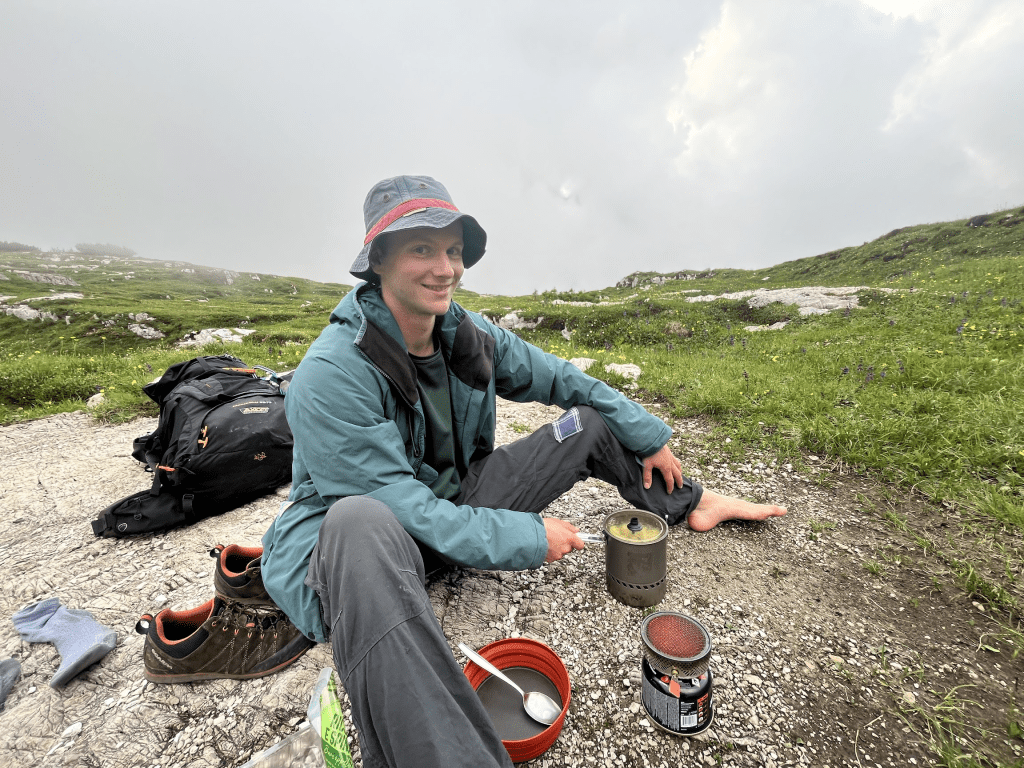
Noah – being a man of taste – was not difficult to persuade. We set off for two days in the Brenta, the first day climbing the stunning Alimonta-Vidi on the Castello Inferiore – a beautiful and direct line following corners and cracks to the summit of the peak. After a brief rest in the Tuckett Rifugio – we strode across to Rifugio Brentei and spent a pleasant evening on the grassy pleateau below the Rifugio. Sadly, a thick fog shrouded the view of the Crozzion di Brenta. This saddened me – whilst I had spent many hours gazing at this behemouth, Noah had never seen it, and I felt it was a real shame that he did not get the opportunity to admire the beautiful peak. After a delicious dinner, we drifted off to sleep.

The alarm sounded early, and by 7:30, we were at the base of the climb. The fog meant the rock was damp, and immediately, the difficulties, although not significant, were a little harder than anticpated. The climbing was traditional in nature – modern rock shoes did not give us much of an advantage over the great pioneers – Rudolf Ferhman and Oliver Smith. As we traced their line – we could not help but be struck with immense admiration for their efforts. To climb at this standard, protected only by a handful of pitons and a hemp rope around your waist is an immense achievement – yes, modern feats of acrobatics performed by the likes of Ondra are impressive, but the pioneers of the past had something more. The immense determination and courage with which they climbed is obvious to anyone, but what struck me is the deep love and passion for the mountains these men had – a genuine inspiration to any and all climbers.
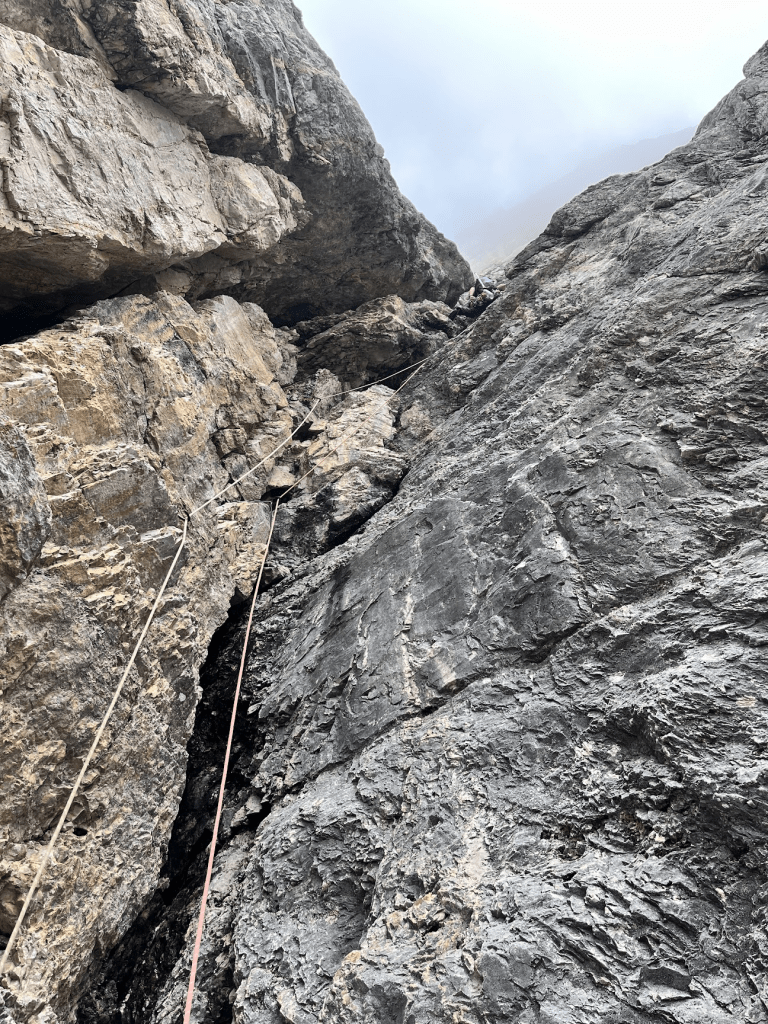
The inital pitches to gain the corner were overcome quickly, but the crux pitch – a 45m corner with some wet passages proved to be difficult. I must admit I was rather gripped at times, finding the climbing thrutchy and insecure, and to my dismay, the pitons were not as abundent as I had been led to believe. Luckily – we had brought a fairly comfortable rack in classic British style – about one and a half sets of nuts and a few doubled cams. This enabled me to protect the pitch excellently, and overcome the difficulties with a sigh of relief. We did not bring pitons – but decided to take the hammer – all belays were on pegs and we deemed it wise to test them…
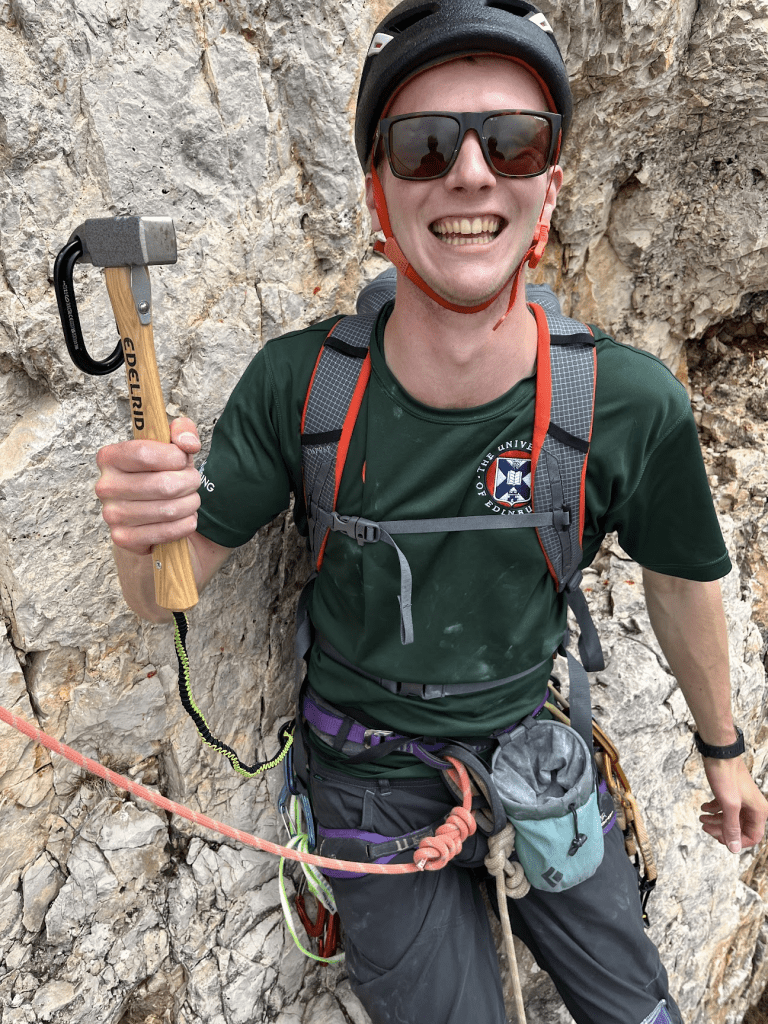
The route continued up the corner until eventually, we reached a prominent belay. I had made the error of stopping about 7m early, seeing three pitons and assuming that it was the belay. This left Noah a long and engaging pitch. Sadly, whilst leading, I heard the clatter of metal…
‘Shit ROCK!’ Noah cried down, but from the metallic clanging, I knew it was no rock. A flash of green passed by, and I realised Noah had dropped a green totem – one of the most expensive items on our rack. It landed on a ledge about thirty metres below me – just out of reach. A great shame for Noah’s wallet and a lesson learned on the dangers of yosemite racking expensive items of kit!
I followed, and we swung leads happily until we reached the penultimate pitches. Here, you leave the corner and experience the very best of Dolomite climbing. The steep juggy rock enables one to freely move wherever you please, without the hinderance of following any feature. Provided you are comfortable with spaced gear, it was joyus and enticing climbing. I marvelled at the exposure and enjoyed the blissful movement over the rock.
Noah led the final pitch to the Stradone Provinciale – the upper terrace of the Basso. We had lunch here and decided to descend rather than carrying on to the top – time was a little tight as we knew we had to return to Patascoss that evening, or face an expensive meal from the rifugio. The descent is straightforward – the local guides have done an excellent job at equipping it, although we did get one stuck rope. It was straightforward to retrieve, but did require reascending a small portion of the normal route.
We reached the Bochette Centrali – and to my dismay, our route was shrouded by cloud. I had wanted Noah to experience the beauty of the face as I had the week before – but instead he only saw the mirky path ten metres ahead before everything became shrouded in cloud. We reached the rifugio and eventually Vallesinella, from where we called a taxi to take us home (which was absolutely extortionately expensive).
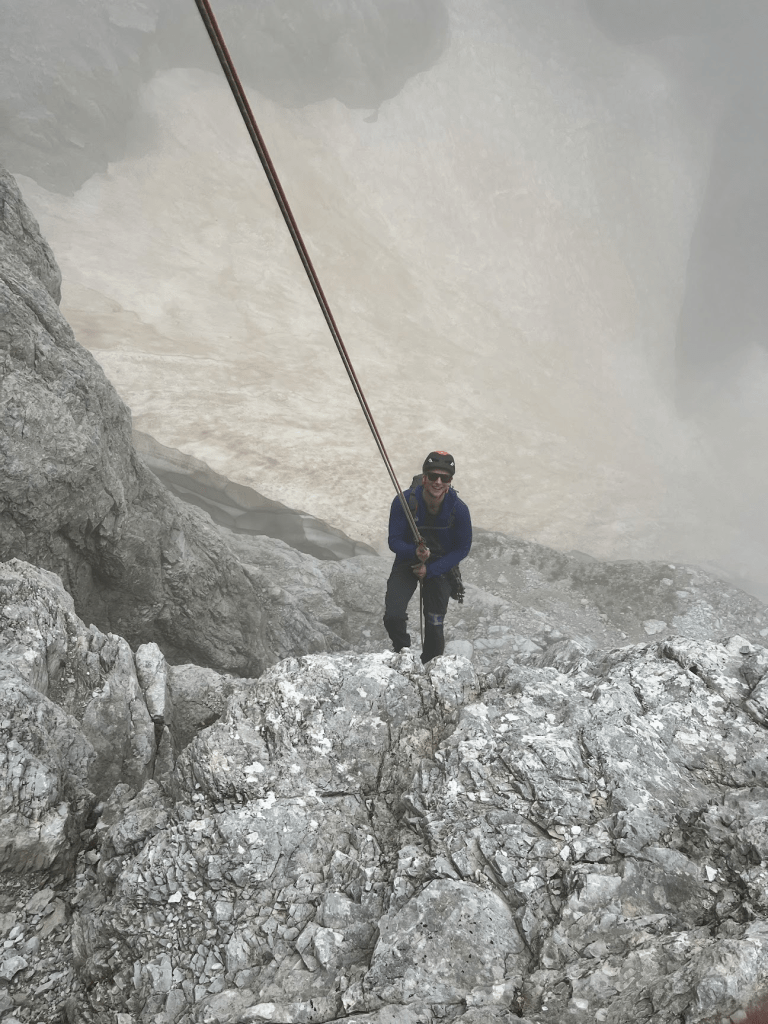
Overall, this was a great day in the mountains with a good friend. The route was full of emotion: visceral joy, fear, awe, and love. It was a great shame not to reach the summit – but I know I will spend many more days on the Basso in the future – for nobody with any love for the mountains could deny themselves the bliss of climbing on this peak.

 Oscar Outdoors