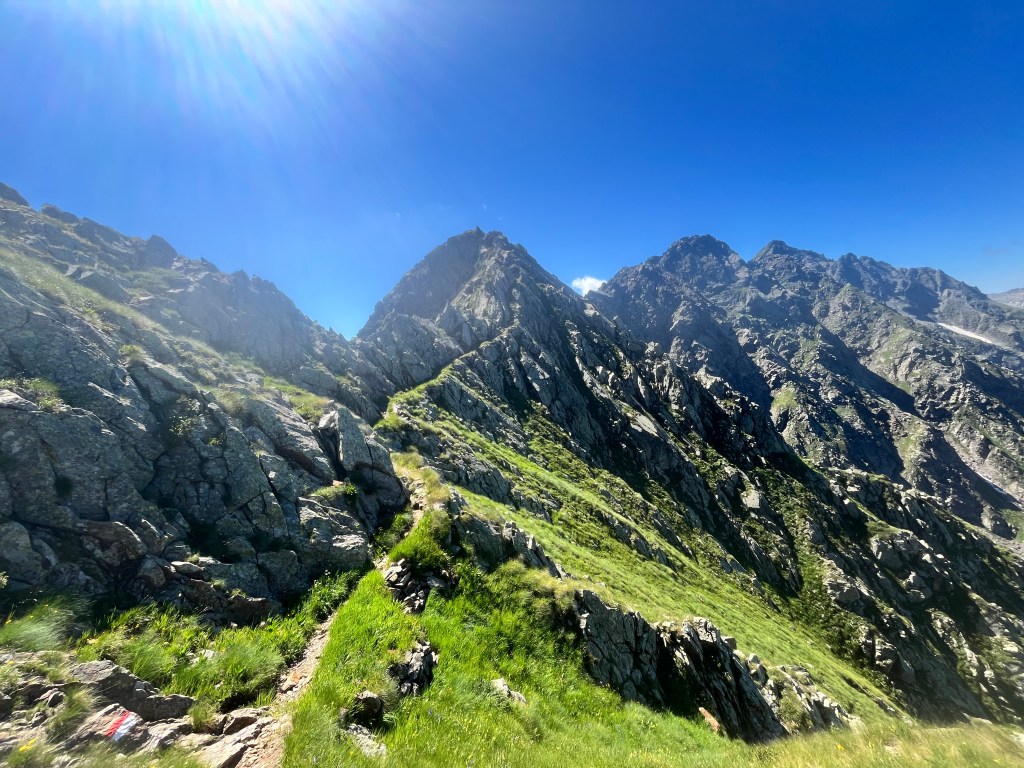
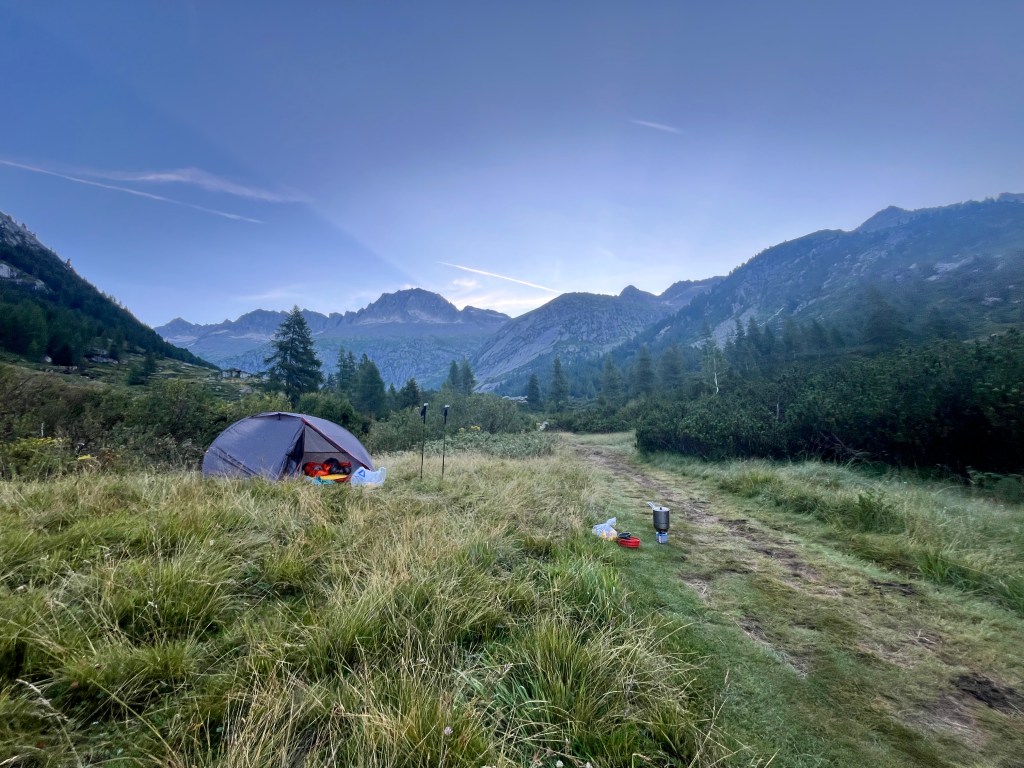
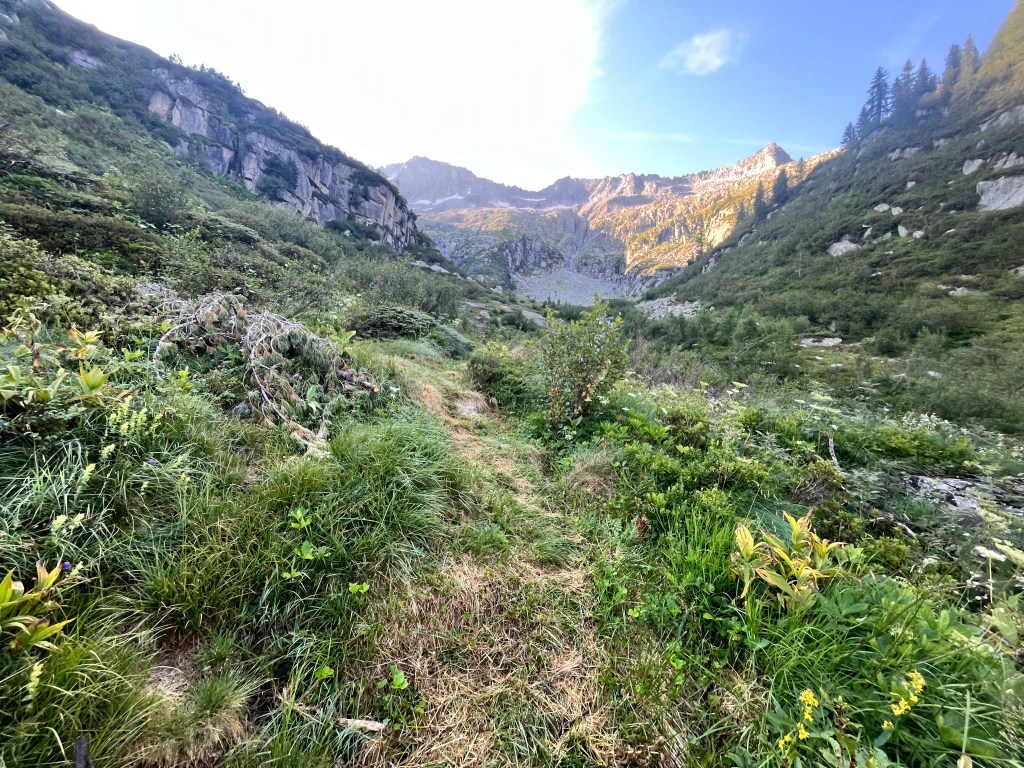
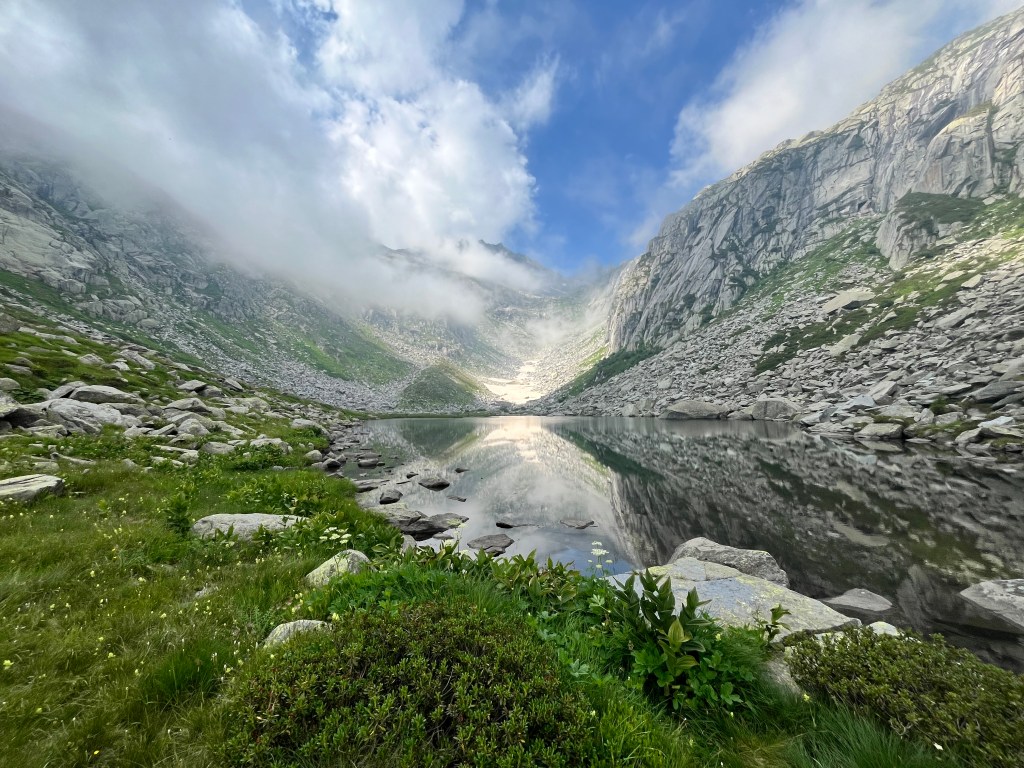
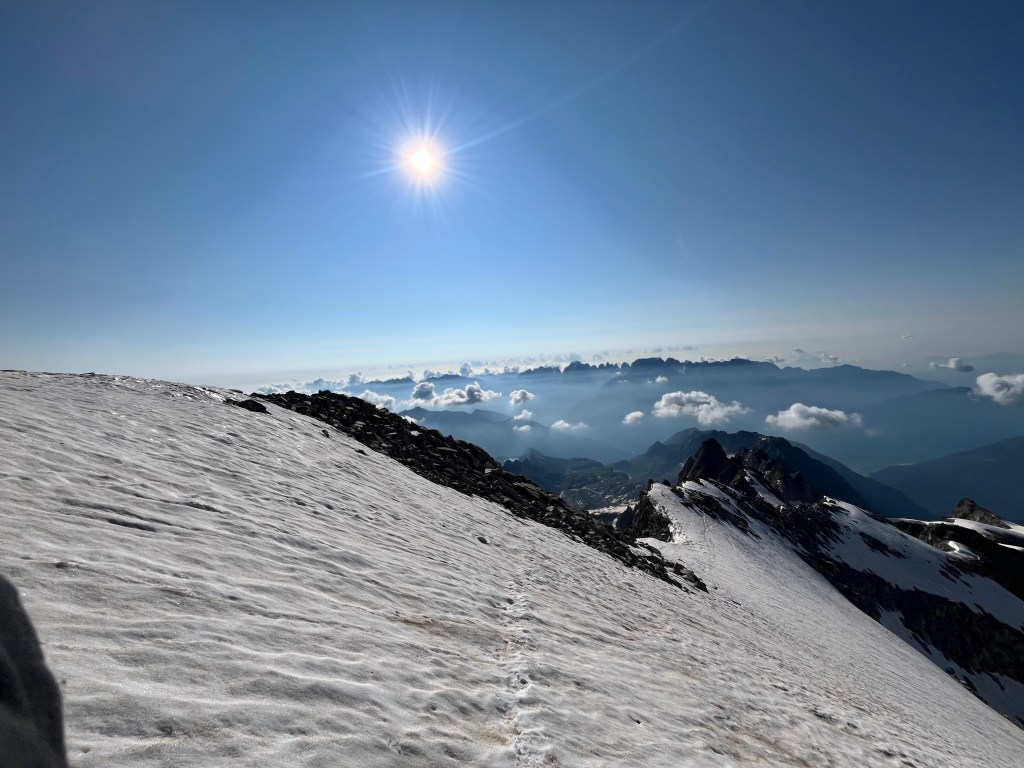
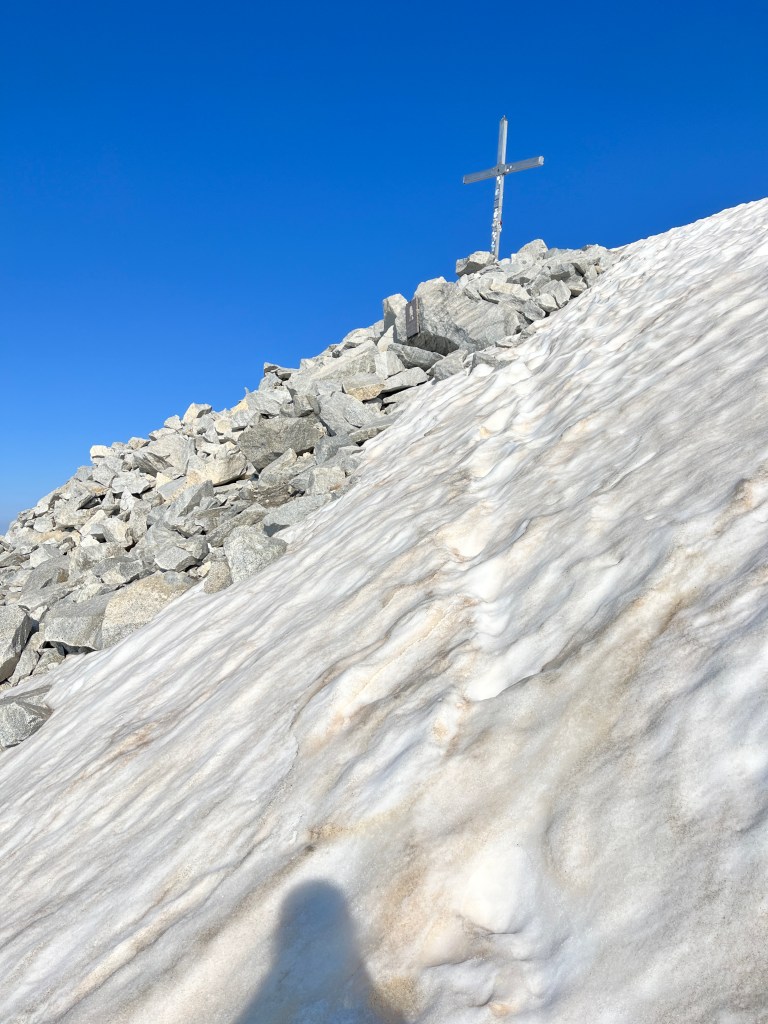
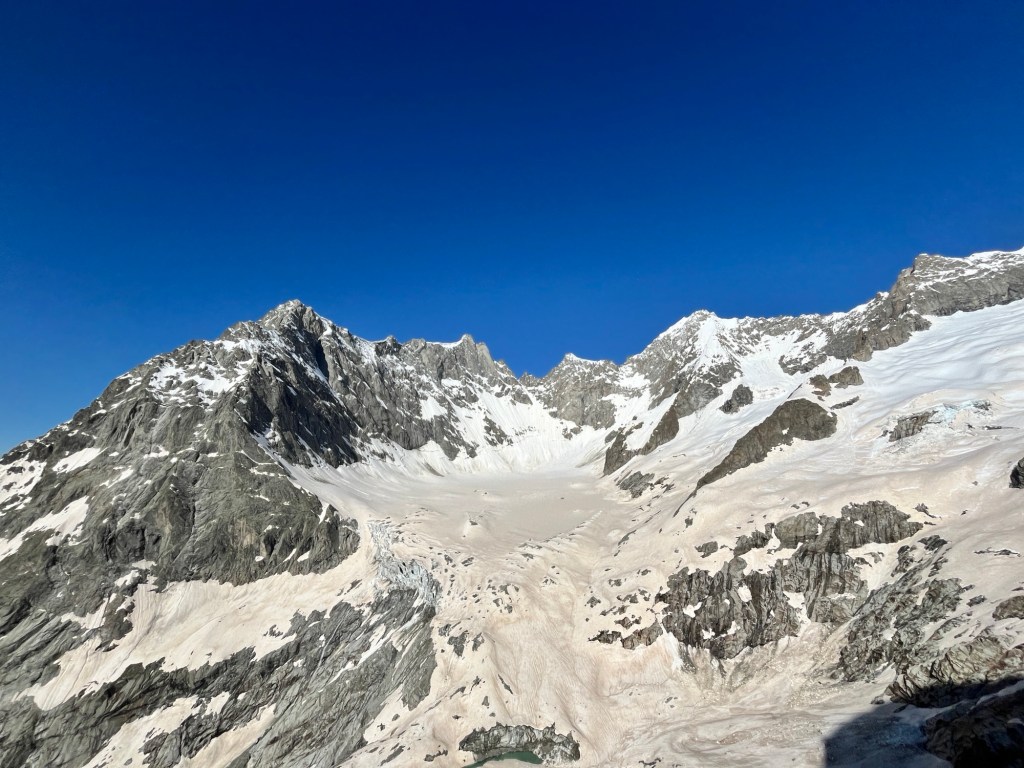
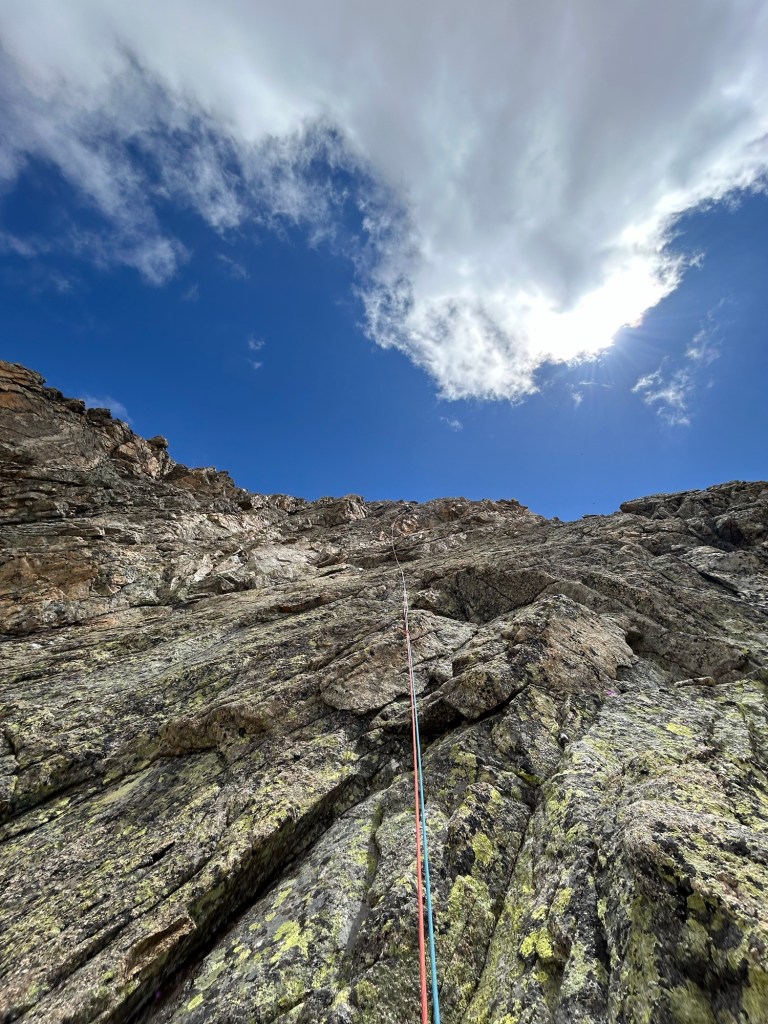
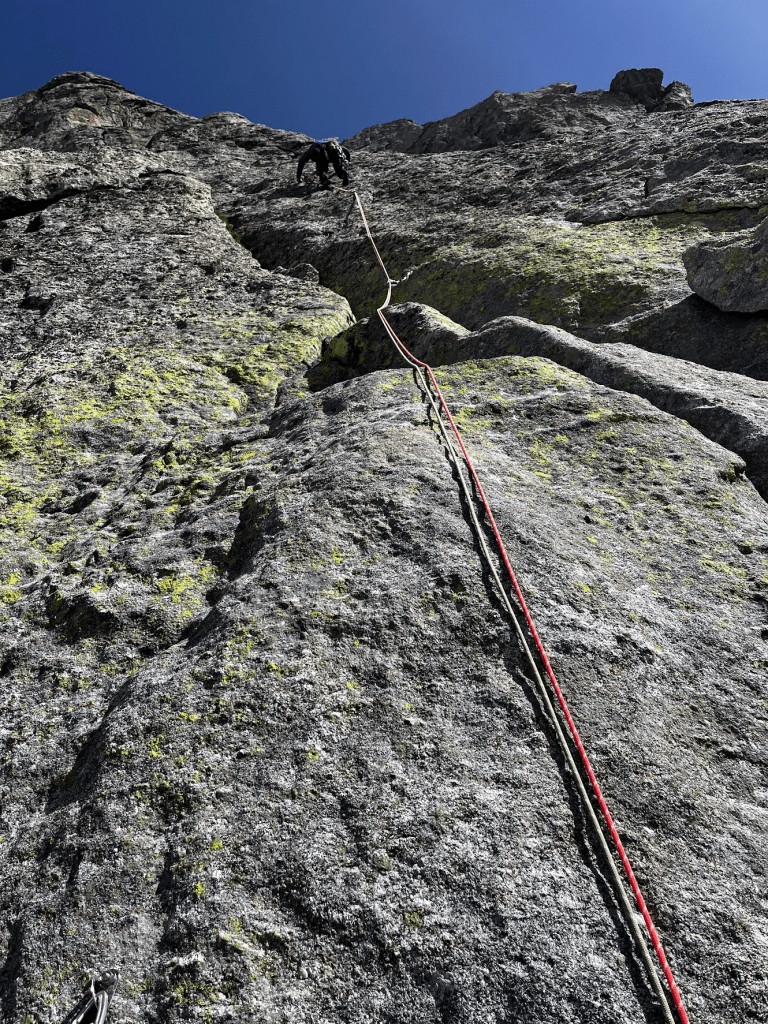
The Skye Trail – to the Ends of the Earth

I awoke to the rattle of my window in the wind. Rain was lashing down, and it looked rather like a November morning (it’s August!). Today, I would be setting off for another walk—the Skye trail—and clearly, Scotland wanted to welcome me back in good style! Signing, I exited my bed and, frankly struggling for motivation, began packing last-minute bits and bobs.

It took some effort to leave the door – the weather was terrible, and I had an eight-hour journey ahead of me: I could stay at home, eat oven pizza, and watch Netflix all week and call it “relaxing”. Getting out of the door, the so-called “doorstep mile,” is always the hardest part of any adventure. The modern world bombards you with quick dopamine hits; things like TikTok provide immediate gratification for no effort and yet don’t leave anyone with any lasting satisfaction or joy. Your house is (probably) quite warm, it’s hopefully dry enough, and there is an excess of food and water. When backpacking, these basic necessities suddenly have a question mark over them; thus, you appreciate them infinitely more! Something as basic as a tap can trigger euphoria (No funny-tasting purified water for me!) and a comfy chair is frankly like a gift from the gods. This reappraisal of the value of things that we take for granted does not disappear immediately upon returning and leaves a lasting impression on one’s day-to-day life.
Enough rambling; back to the trail. The bus journey was long and a little boring. The rain continued all morning and until about midday, but when I left the coach and Broadford, it wasn’t actively raining, although the sky was dark and there was a fresh breeze.


I left the coach feeling a little unsettled. I was anxious about the distance I had to travel today (around 20km) given it was so late (around 5pm). I nipped to the toilet in town and then began walking.


The trail starts with some rather underwhelming road walking. The weather was holding off, and I was glad to be able to make some fast progress. The scenery was impressive but awfully bleak: it reminded me of Rannoch Mor in Glencoe. Quickly, you turn off the asphalt road and follow a dirt track adjacent to it for some kilometres. The ground is boggy at times, and quickly, it became fruitless to try and keep dry feet.


The first time you get wet feet on a long walk is always a strange relief – the anticipation of how awful it will be and the constant dancing and weaving around muddy bogs is far worse then just plodding through them and dealing with soggy socks. On this trip, I was wearing non-waterproof trainers, which worked excellently. I just had to accept wet feet, and then could cross rivers, march through bogs, and jump in puddles without worrying, safe in the knowledge that once sunny, the shoes would dry out and water would drain out quickly.


You cross over a pass and walk alongside an absolutely beautiful coastline. It felt like such a treat and such a beautiful place to be—I was very happy. It was also at this point that the shackles of social normality began to ease off—chaotic singing and dancing imminently began. On the bus up, I’d discovered a rather groovy song, “I Guess Time Just Makes Fools Of Us All,” and I wandered along the coast, bobbing and dancing happily.
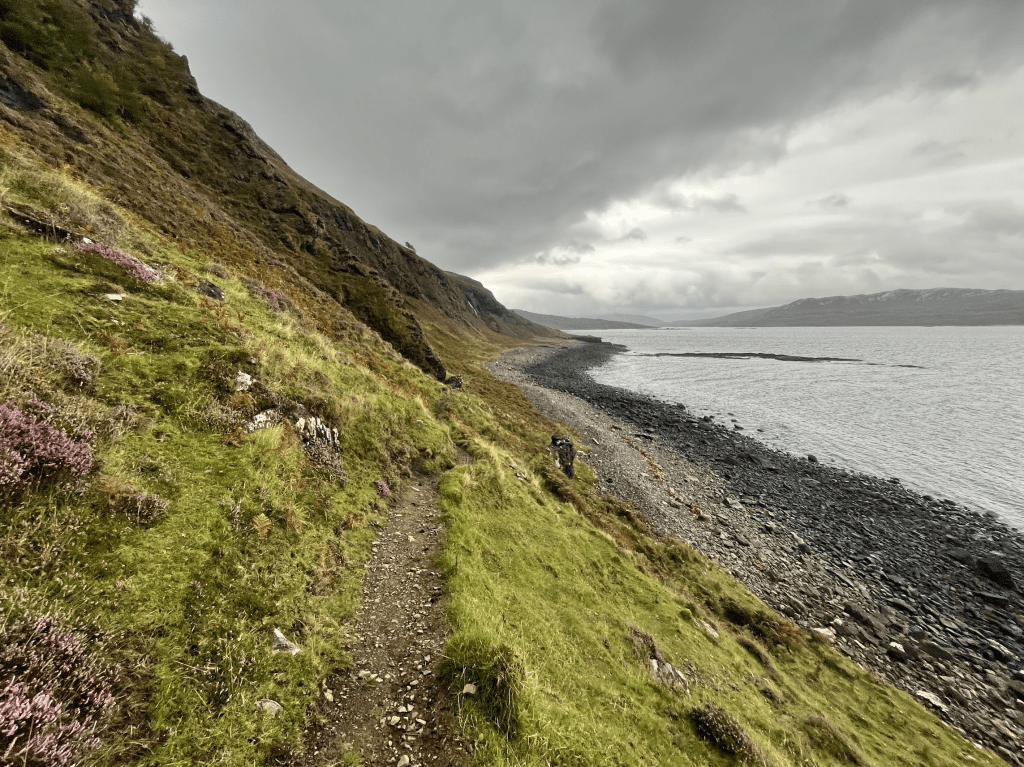
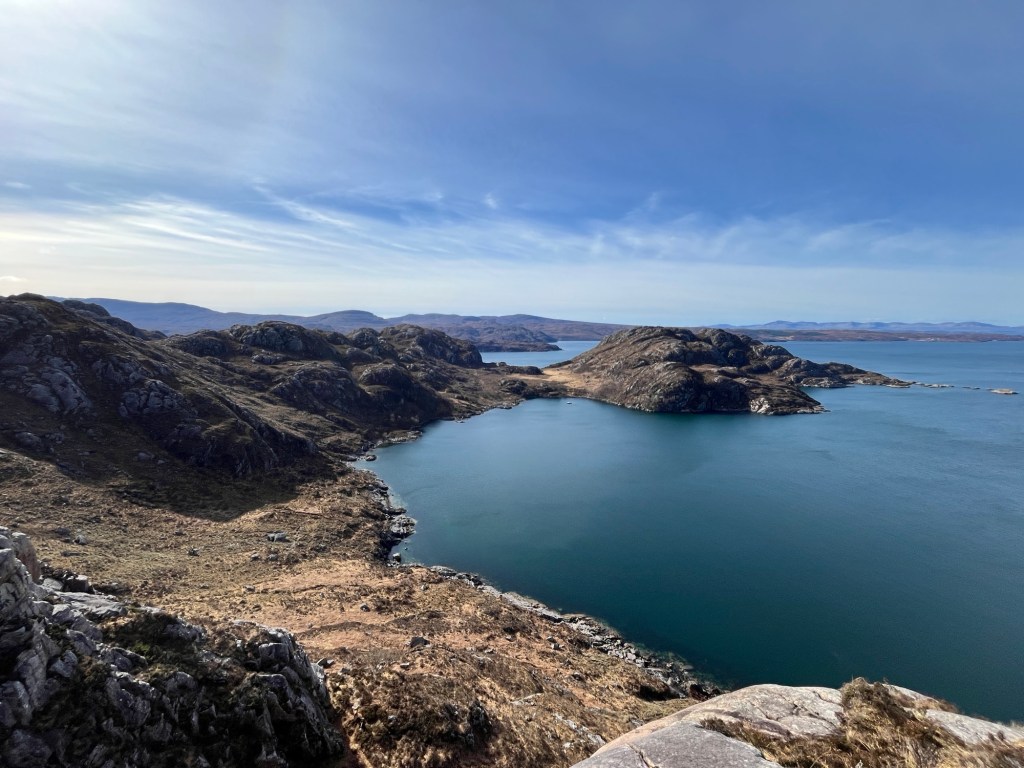
The coastline


I also began conversing with the sheep. This is a crucial step in becoming a Man of the Wilderness. As usual, to begin a conversation, imitate the BAHHHHHSSS in varying tones of aggression and affection based on the reaction you wish to achieve. This is like bowing to a Hipogriff – it establishes respect and makes them aware of your sheepy soul. The next step is talking to them. You can say what you want – tell them your troubles. They may run away, but short of that they’ll listen dutifully, despite having rather bland responses.
After the beautiful coastal section with many sheep, a few more kilometres of easy tracks brought me to a lovely coastal camp just before Torrin. It was an excellent little camp spot.
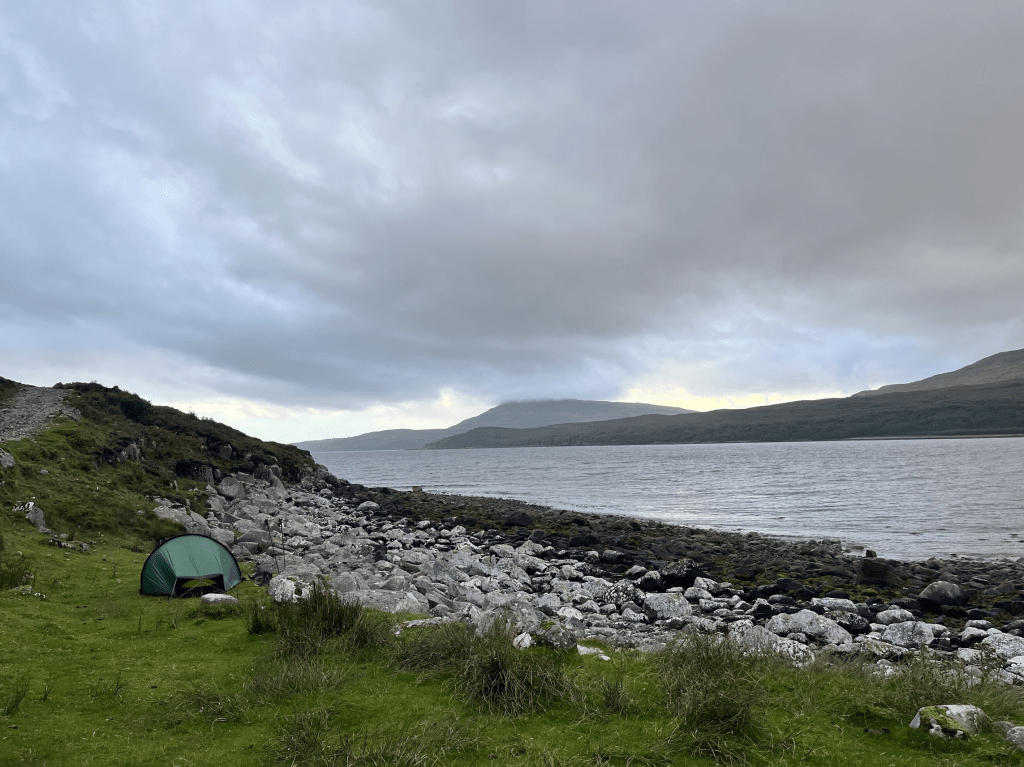
The camp on night 1


Day 1 distance: 19km


I awoke early with the sun and enjoyed a cup of tea looking out across a sea. The clouds were dark today, and heavy rain was forecast from mid-morning onwards. After some oats, I packed up my tent and began plodding along a road (there was an awful lot of road bashing on this trail) to Torrin and beyond towards Elgol. The scenery here is stunning and quintessentially Skye—with dramatic black gabbro outcrops sticking out from a lush green mountainside. What a beautiful sight!
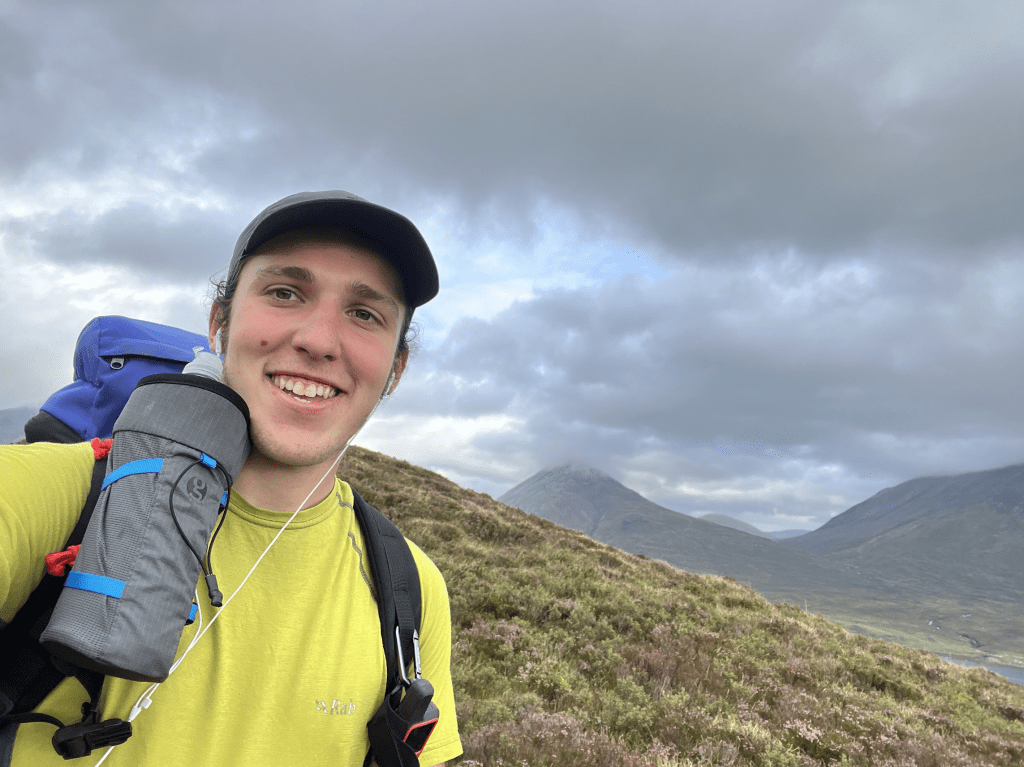
Happy before the rain started


Then, I found a toilet – a highly convenient stop. Regular readers will know I take great pleasure in a nature shit – but there is a time and a place. Scotland is becoming increasingly overrun (I blame bloody youths and Instagram!), and many of these people are not conscientious shitters. Its not uncommon to see toilet paper and literal shit completely out in the open, and even respectful shitting (and of course, carrying out toilet paper!) puts a strain when there are a lot of people. The Cairngorm National Park authorities are encouraging wild campers to carry out shit – the Snow White Project. The project started originated as lots of Winter Mountain Leader courses run from the Cairngorms, all involving a night or two in a snow hole. Participants would dig a hole in the snow, bury it, carry out toilet paper, and leave. Sounds ok, right?


Well, keep in mind, there are only a few areas on the Plateau that regularly have enough snow to dig multiple snow holes close together, thus, over the course of the winter, many people would stay in these places, bury their shits in the snow, and move on. Sadly, this meant that when the snow melted, these places would be littered in excrement! Shocking! The Snow White Project (originally Cairngorm Poo Project) is run out of the ranger station. If you ask for it, you will receive a PVC tube with some dog poo bags and kitty litter – I’m sure you can figure out the rest (although our ML provider felt the need to demonstrate how he pooed in his tent every morning…). This is a rather extreme measure and isn’t always necessary, especially away from crowds, but the impacts of nature shit should always be considered, especially when in a large group, and if in doubt, carry it out!


At long last, I left the road and began walking along a singletrack path in the woods. The views were stunning, but soon, the driving rain started, and headphones were deployed to keep me entertained.

“Gore-Tex – Guaranteed to Keep You Dry.” What an absolute load of nonsense. Anyone who thinks a jacket can be waterproof has never actually spent a day walking in proper rain and should not be taken seriously. Over the course of the next couple of hours to Elgol, the rain penetrated through every layer of protection – at first seeping in through the wrist and neck holes, then the zip, and eventually, dampness from sweat just means you are wet all over. I hate the fact that modern jackets have these daft waterproof zips. Yes, they look cool and ‘alpine’, but they don’t work, and I’d happily carry a few extra grams for proper storm flaps. Alas, aesthetics matter more in outdoor gear design than functionality for the majority of customers.
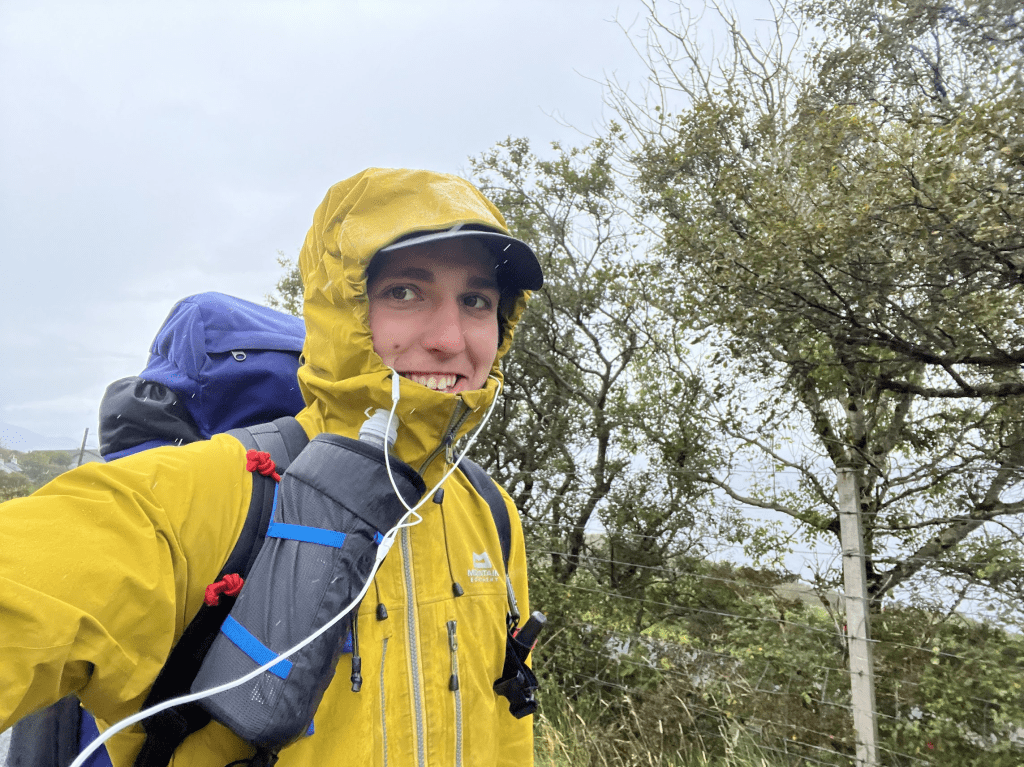
Soggy, but still happy!


Originally, my goal for the day was to reach Courusk Bay and camp there, but that seemed very unappealing—instead, I decided to stay at the Camnusary Bay bothy. I plodded North up the coast towards Camnusary Bay, crossing several rivers and often literally walking in one. I was utterly soaked and relieved to pass through the door indoors.


I met some lovely folk in that bothy, deploying the tried and tested friend making strategy of making tea. The two folk I was trying to befriend (Charlotte and Owen) didn’t have a stove, so the offering of warm tea was the social equivalent of a critical hit! Great success!


The evening passed uneventfully until two English lads, wearing dress shoes, trench coats, and kilts poked their heads in. They had very very posh accents and gave of pretty poor energy – they’d carried in only sleeping bags, beer, and vodka and clearly were just here for a piss up. Luckily, they moved to the old bothy (which they broke into – it’s closed!), and I didn’t see them again.
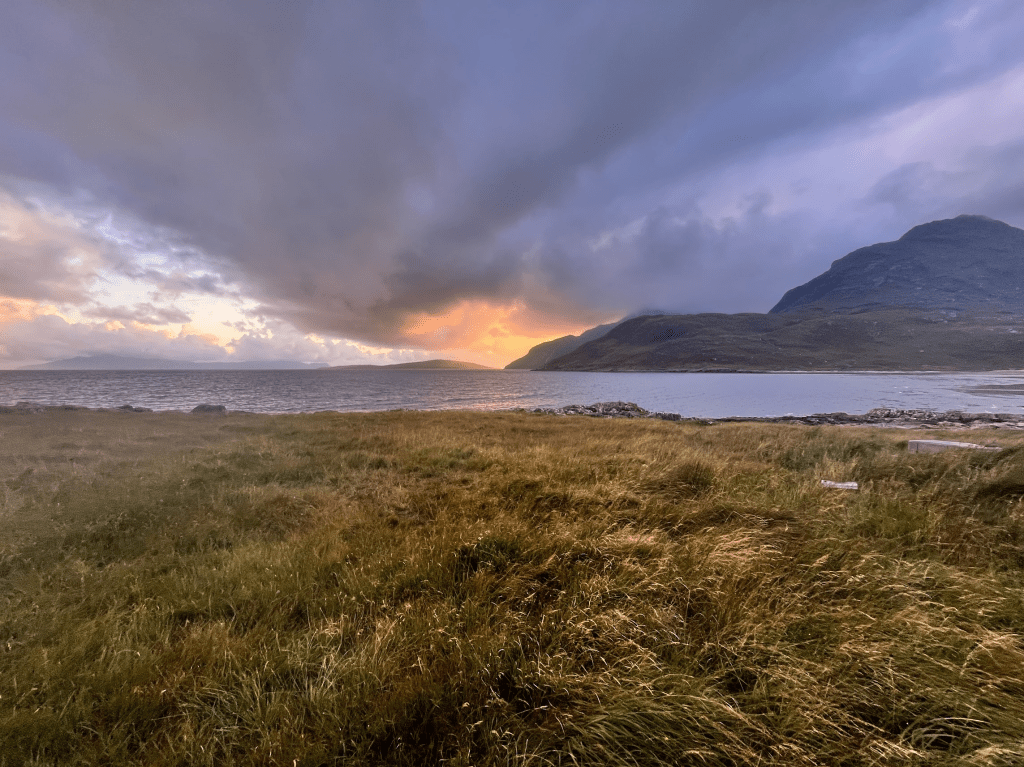
A brief pause in the rain that evening


Day 2: 27km

It was meant to be dry today. It was not. In fact, it was absolutely pissing it down, and I was rather pissed off about it. My planned route around Courisk was a no-go – the river was too high to cross, so I went directly to Sligachen. This was a beautiful valley, Sgurr Nan Gillean on one side, Marsco on the other, and shitloads of river to ensure that I was absolutely saturated. Many were knee-deep, and one proved particularly challenging.
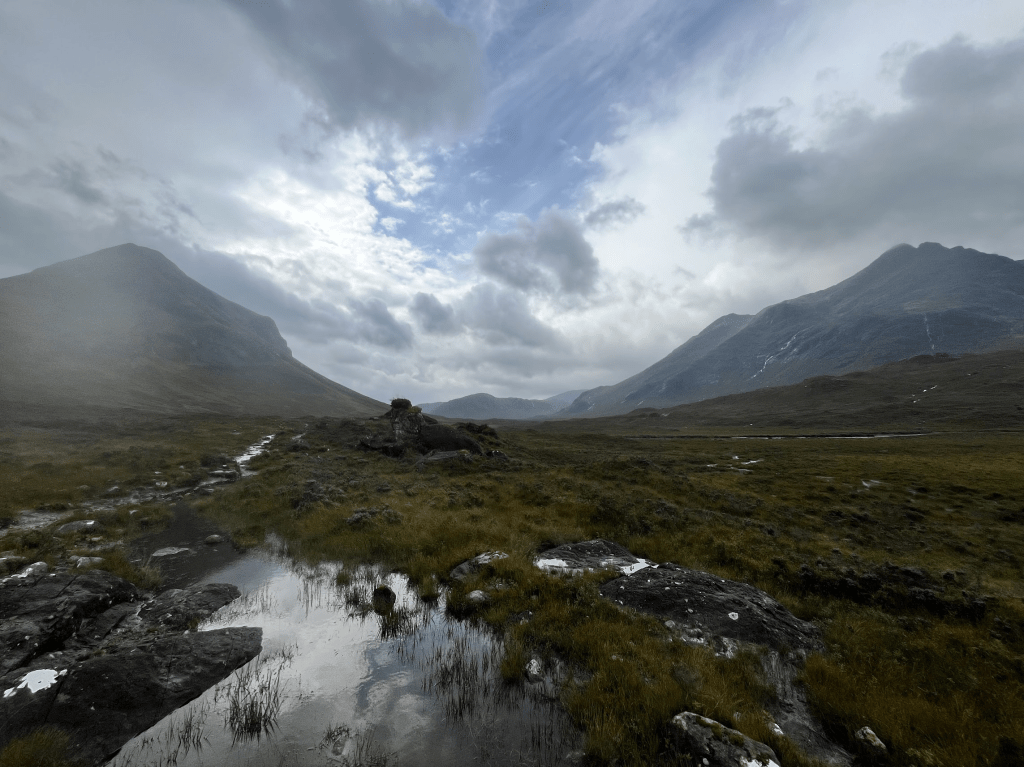
A dramatic break in the rain

Confident in my skill at fording rivers, I began crossing the raging torrent and was quickly up to my upper thighs – it was still getting deeper. Retreat was required, and upon returning to the bank I pondered if the river was crossable at all in it’s current state. Further upstream, the river fell into a gorge, so was not possible to cross at all, so against intuition, I headed downstream, hoping to find a widening. After ten minutes of debate, I found a suitable crossing point. An initial channel that was relatively deep (upper thighs) had to be forded at it’s widest (and therefore shallowest) point, before it became shallower in the middle (knee deep). Walking downstream along this shallow bit for twenty or so metres brought you to the second channel, which was deeper (waist deep) and swift-moving. Facing up stream, and taking immense care, I forded the river and performed a mantleshelf on the far bank (which turned into the old classic beached whale manoeuvre) to cross safely. I was rather damp but glad to be across – any more water, and I’d have deemed the river unsafe to cross, and as it was, it was cutting it very, very fine with what I felt comfortable doing alone.


The route to Sligachen became more busy, with bloody tourists and day walkers walking towards me. I disliked the crowds immensely (crowd is a strong word for ten or so walkers), and I opted to avoid the busy and likely very expensive pub and have lunch in the drizzle instead. From here, you carry along next to the coast before a long road walk to Portree.
There was a very large-looking river to cross along the coast, and I must admit, I was a little nervous. I’d heard this one was difficult at times, and given that the river that nearly turned me back wasn’t mentioned, I assumed it must be much worse. Luckily, it proved straightforward—ankle-deep at most, although the ground was very flooded. I was glad for trail runners: Goretex boots would be acting like buckets at this point.


The coastline was beautiful – a nice path and great views, and the weather was finally starting to improve a little. Incessant rain had turned to showers, and I was starting to dry out. Soon enough, I reached the road.
Road walking is never enjoyable, but it can be a satisfying way to clock up miles quickly. The flooding and spate conditions this morning had meant the first 15km of the day were difficult and took me around five hours or so with a lunch stop. I still had 20km to go before I reached my camp spot, so it was nice to be able to put on an audiobook and race along the coastline on easy terrain.
The traffic, although there wasn’t loads of it, irritated me a lot. I’ve become very anti-car nowadays: I think that racing through the highlands and seeing it from the safety of a metal box is a really crap way to explore. It makes places to easy to get to, and means that people focus on the tourist spots alone and race through the beautiful scenery. Spoilers: the tourist spots are a bit shit. They are always busy, with clear stamped out paths, noisy, and polluted. To see the best of the highlands you need to leave all that behind and travel at a much slower pace.


The accessibility of certain regions of Scotland has changed massively in the last hundred years. One hundred years ago, cars weren’t a commodity, and the most accessible areas of the highland were places like Knoydart, which could be accessed by train to Mallaig, then by boat. Modern hillwalkers always talk about Knoydart with superlatives: it’s the roughest place, the most inaccessible, but it’s worth casting your mind back to the likes of WH-Murray, for whom travelling to Glencoe for a few days of climbing would take him a few days from Glasgow. There has been almost a flip-flop: the places that were once inaccessible are now busy and overcrowded, and the most accessible places for mountaineers in the past are now seen as ultra-remote. In many ways, this is a good thing – it means we can access the highlands readily and easily, but any mountaineer and hillgoer worth their merit is surely disgusted when looking down at the A82 from the Buchallie? I appreciate that economically, these roads are essential nowadays, but holiday makers should not be driving along them if possible: if fewer people drove and made use of the excellent and affordable bus services, the highlands would be far more enjoyable and there would be a lot less road noise and pollution.
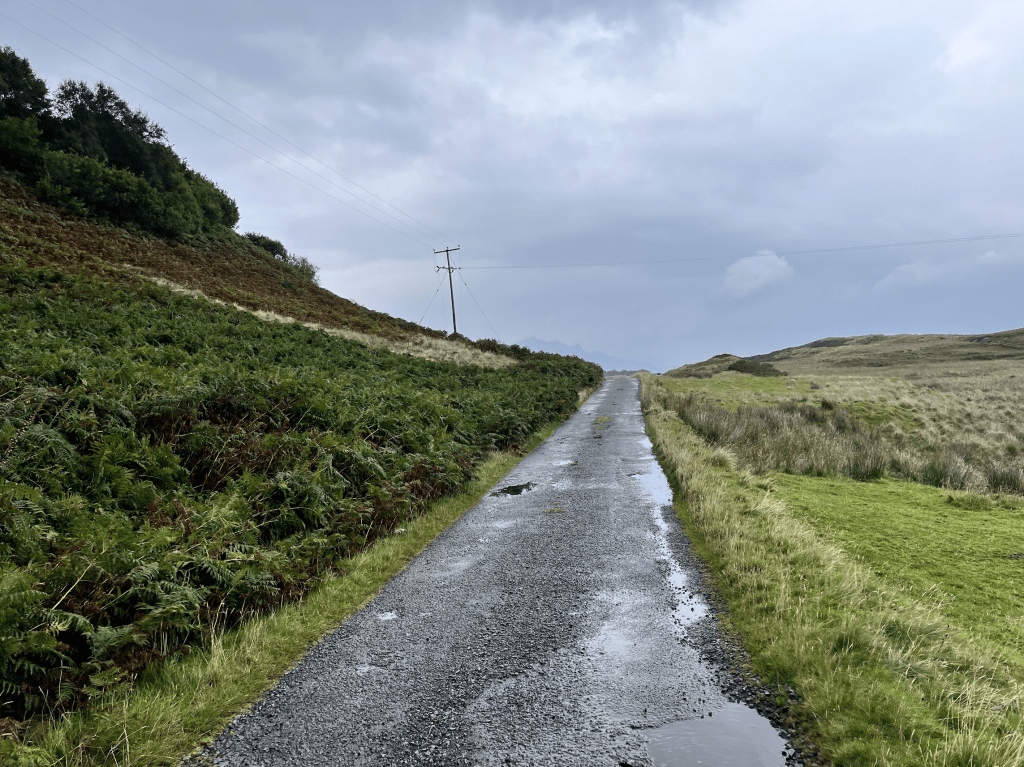
My afternoon…


Ok, old man rant over. I made it to Portree and enjoyed an excellent fish and chips, then carried on for another two or so kilometres to camp (the driving rain had started again).
Some days are not meant to be. And upon pitching my tent in the pissing rain and having the zipper break, today certainly felt like one of those days. I felt like crying: there was nowhere I could stay in Portree (without selling my kidney), and sadly it’s not the kind of place you can get away easily with sleeping in the bus stop, so I knew it would mean an expensive taxi or hitchhike to Broadford or Kyle, and then an uncomfortable night sleeping rough. WIth this on my mind, I fiddled and faffed until I managed to get the zip on again and crawled in side. I was glad for my pea bottle – I was not going to leave the tent until I absolutely had to for fear of the zip failing again.
I really wanted to watch some telly that evening, and worked out an excellent solution to camping binge watching. By looping two hairbands through the washing line of my tent, I could suspend my phone from the ceiling, and enjoy Brooklyn Nine Nine whilst lying down – great success!
Distance: 35km
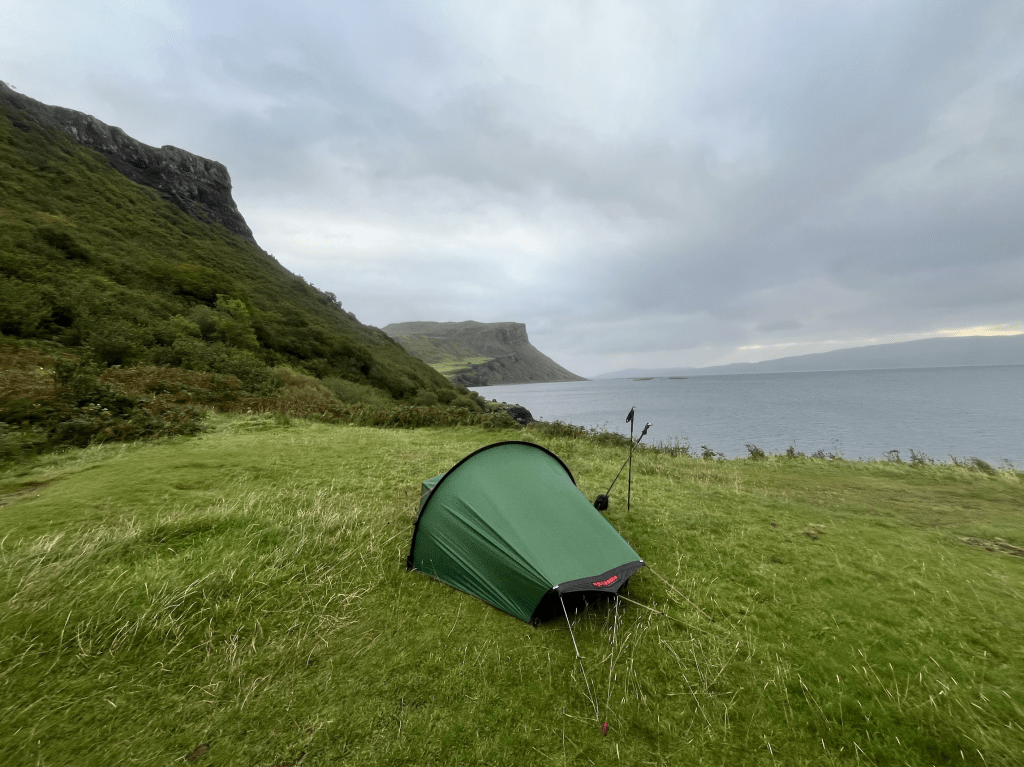
Campsite – what a spot!


Today was due to be a big day. I wanted to cover a relatively modest distance of 20 miles, but I had just under 2000m of climbing to overcome in that time. I also woke up feeling pretty unwell – a nasty bug I’d caught before the trip had finally sunk it’s teeth into me. Today would be a little tough!


One of the beautiful things about long distance walking is it’s like teleportation. It’s hard to put into words, but it feels surreal to look at something in the distant horizon, to put the head down, and then before you even notice it you’re there. Sometimes this is because you’re listening to music or an audiobook and loose yourself in the story, conversation with a good friend can do the same. One of the most remarkable ways this can be achieved is because in walking, one becomes exceptionally aware of the sounds of the world and sensations of the body. You become fully aware of the present moment, in an almost meditative fashion, allowing you to simply focus on putting one step in front of the other without thinking about the previous step, or the thousands more required to reach your goal.

Good weather, and brilliant views!

Along this beautiful section of the walk, I deployed the teleportation mentality. I’d focus on some distant rise or hill that looked impossibly far away and then simply focus on the present, and as if by magic, I’d appear on the distant hill and look back with a smile on my face. It was a beautiful morning, and by the time I reached Storr, I felt far better, although disgruntled and angry and the crowds.
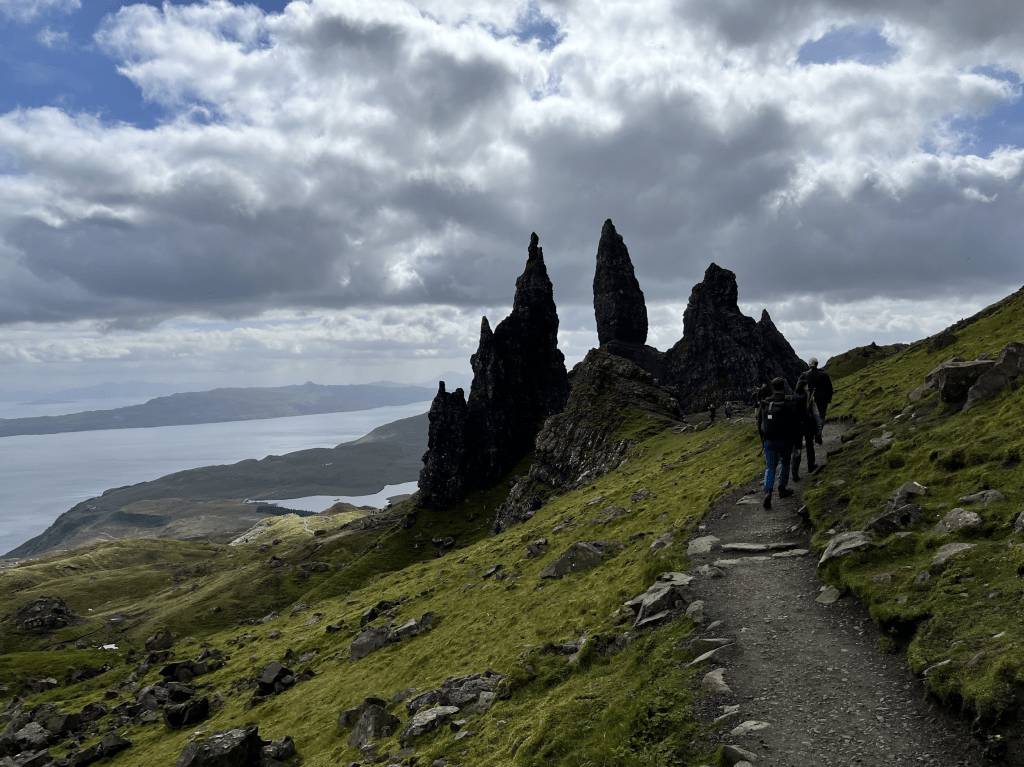
Busy…


I had lunch by a stream, purified some water, and then pushed onto the Trotternish ridge. This is an absolutely beautiful part of the walk. Huge cliffs cut through the hillside, and the views out to sea were spectacular. At last, the weather had turned good, and I was in a state of bliss.

The Trottenish ridge isn’t just a beautiful walk. 175 million years ago, dinosaurs roamed the landscape: fossils have confirmed that both carnivorous and herbivorous dinosaurs lived here, and it’s easy to see why. I think if I was a T-Rex, this would be a nice place to settle down, although I must admit I’d rather somehwere with a bit more sun!

Stunning!

Despite the views, the going was tough and I was noticing the harsh elevation changes. I was glad to set up camp, although a little upset when the zip of my tent failed completely. Luckily, it was forecast to be sunny and I was glad to have the door open so I could gaze and the stunning sunset.
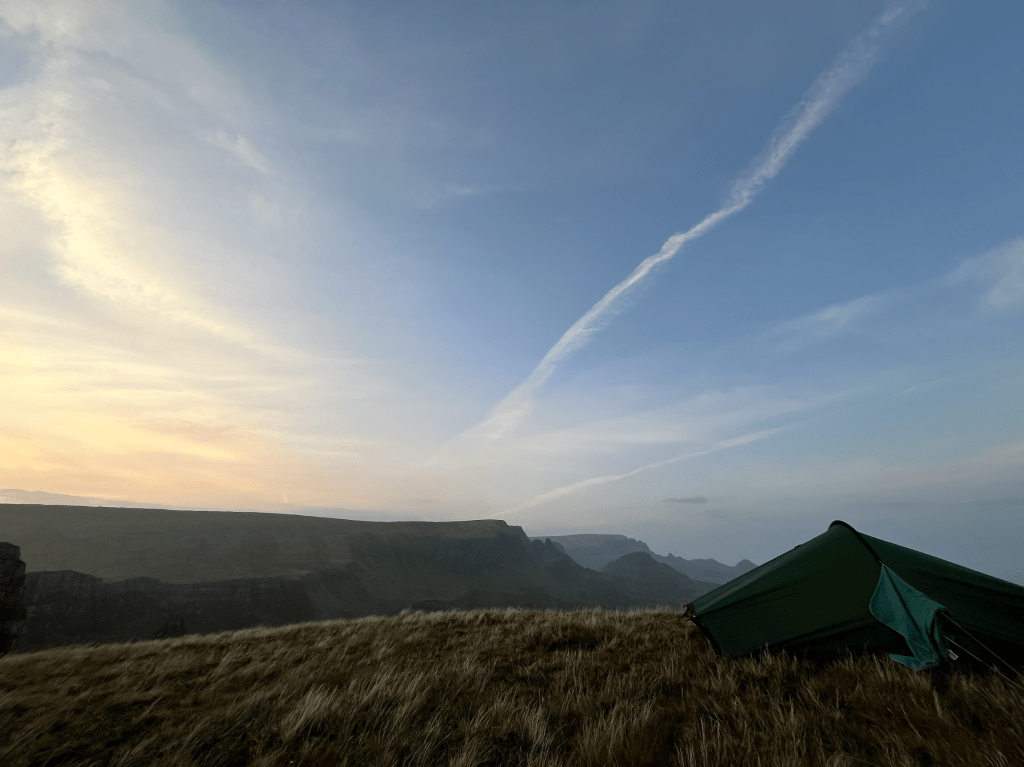
Quite a spot!

Totals: 30km
I woke up and was a little sad – today I had a mere 25km to cover before I would be finished. I’d been carrying a can of Northern Monk Faith – on of my favourite beers – since Portree and I was looking foreward to having it at the Lookout bothy.
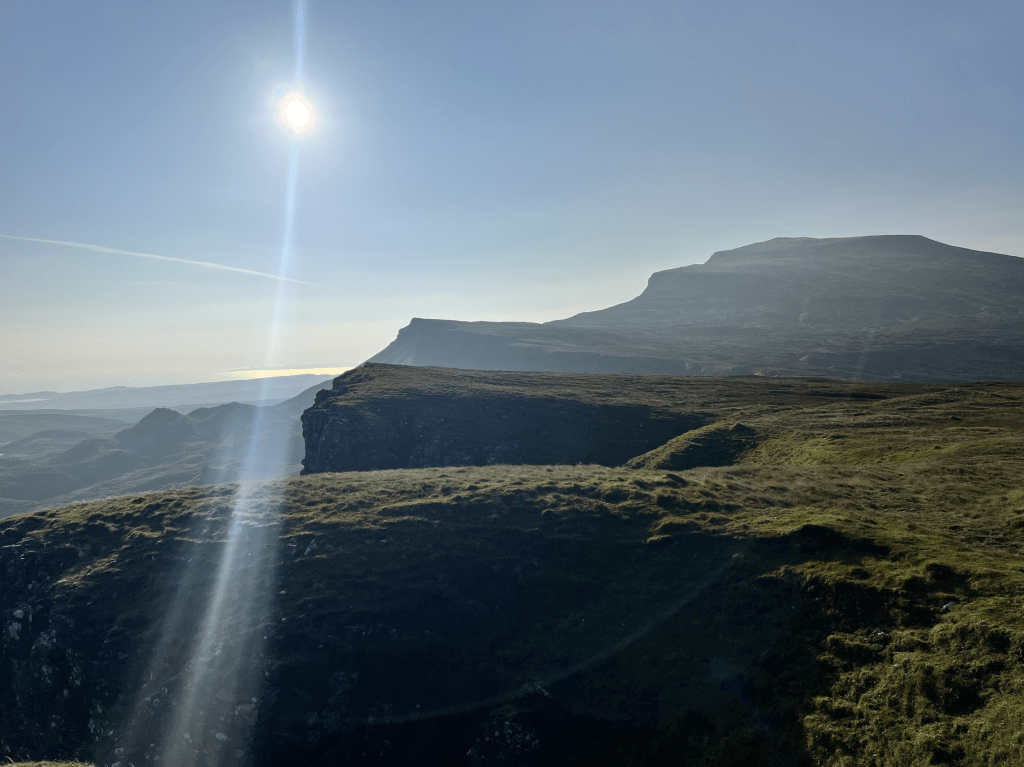
The final morning!

First, I had to cover the final section of the Trotternish ridge, just one short climb and descent led me to the Quirang, a beautiful section of walking, if a little busy. I stopped and gazed back at the view – the Old Man of Storr was now far far in the distance and I couldn’t even see the Cullin where I’d been just 48 hours earlier. The views across and out to see were amazing, and I had plenty of food left so enjoyed feasting on a few packs of MnMs in the sun.
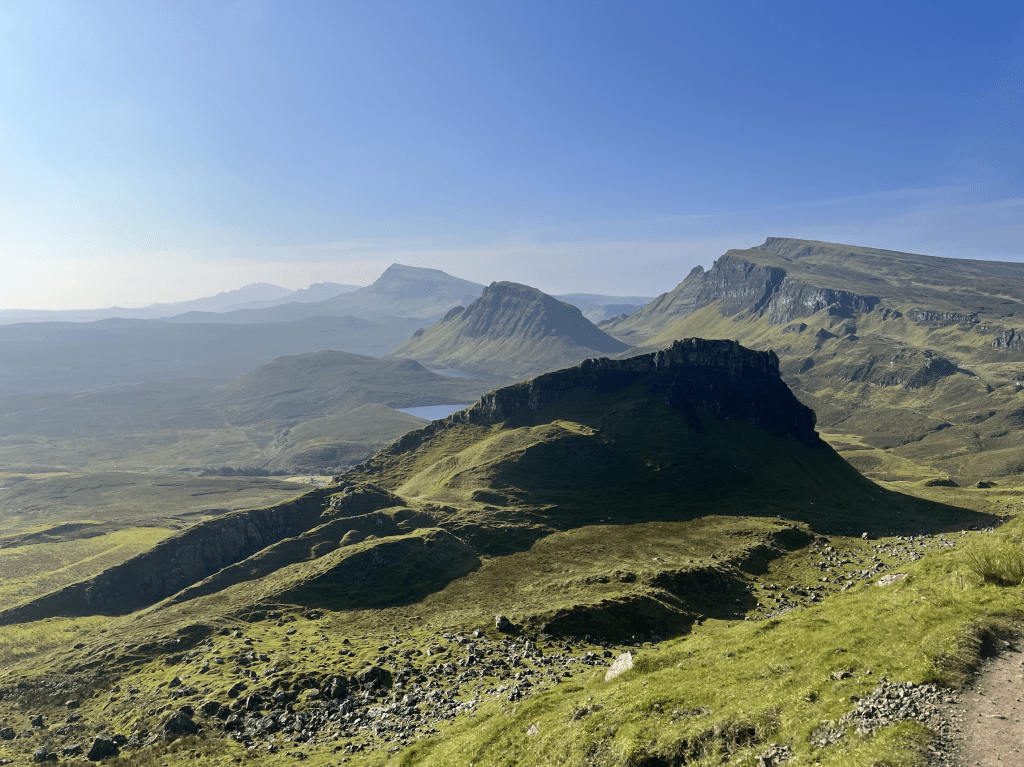
Hard to believe!

As I reached the road, I began fantasizing about a cooked lunch in Floodigarry: I even took an swim to try and clean myself. When I reached the hotel, I plugged in my phone and went up to the bar.

“Could I have a pint of coke please mate?”

“Man, you don’t want a coke – it’s £9. I’ll give you a tap water for free and you can charge your stuff anyway, don’t worry”.

Kind of him to warn me – but I was still upset at the cost. It goes without saying, I did not ask for the food menu, and made do with wraps with very sweaty cheese. Guests started at me in disgust as this unshowerd hiker covered in mud and grime sat in the corner of their fancy £400 a night hotel, but I felt no remorse for these people: they were rude to the staff and were driving around the highlands in big Bentley SUVs. I hope they enjoyed my smell, I only wish I could have thrown one of my socks at them to see their reaction, but alas, I did not have the confidence for that.

The final coast

This left just one short section of trail before the lookout bothy. The walk along the coast was beautiful, and I was sad this trip (my last big trip before Uni starts) was over. I stopped to collect water a couple of times (there is none near the lookout bothy) and enjoyed the warm Scottish Sun and the views out to sea. With a heavy heart, I reached the bothy, left my bag, and made the final one kilometre journey to Rubbha Hunish, the very northernmost point on Skye.

When I returned, I had my can of Faith looking at an amazing sunset. Long distance walking is a beautiful, beautiful thing. At times, it’s crushingly difficult, and at times, it’s superbly blissful. You miss the most basic things – a chair seems like the height of luxury, as does water that doesn’t taste of chlorine, but you also realise how much you don’t miss. It clears the head of distraction, and leaves you with a lasting sense of serenity. The Skye Trail was a beautiful journey and is one I’d commend anyone and everyone to do. A wise man (Hazey) once said, “Getting to the start is the hardest part, and if you make it there, you’ve already won”, and to me, he is spot on. Book the bus, pack your bag, and just go, and after that, the trail will provide everything you need.
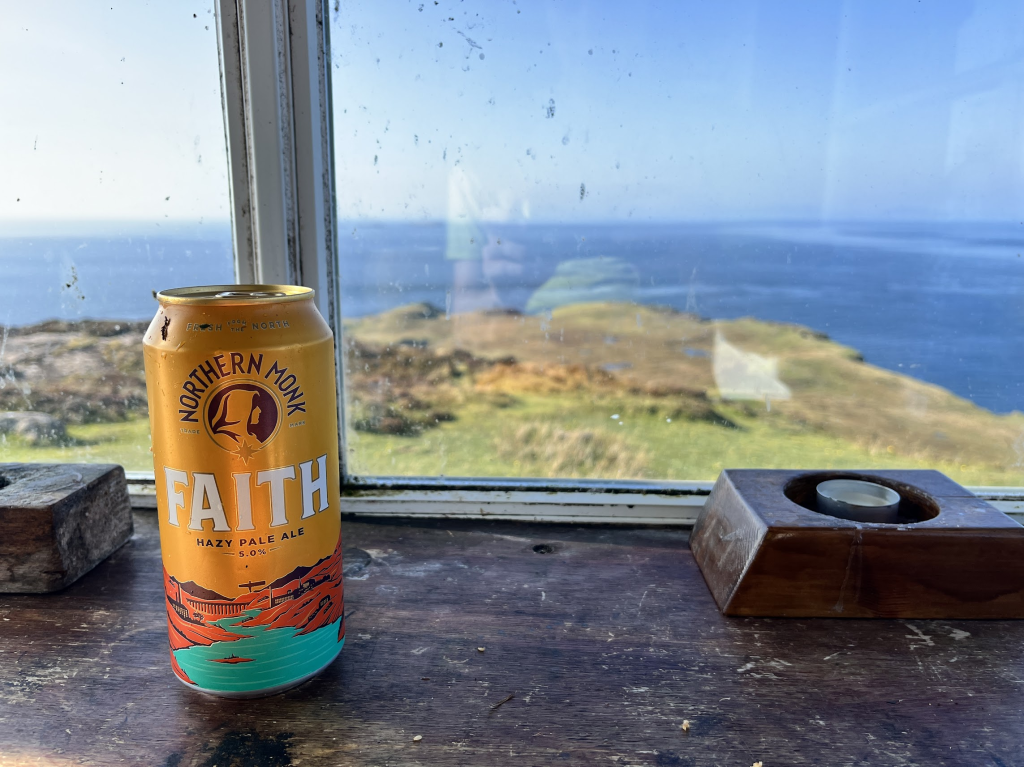
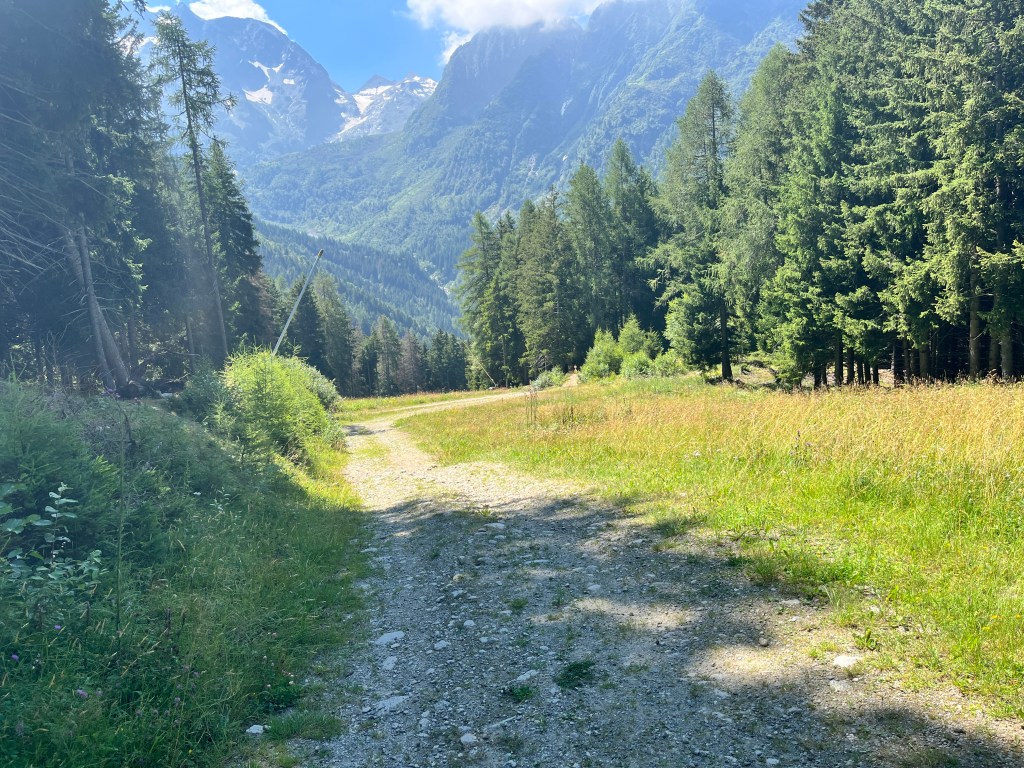
Some times all you need is a bit of faith

Adamello Circuit

As the Italians would put it – this was a journey full of emotion. The Adamello range is stunning in wild in a way that I have never encountered before. Each day I met fewer people than you would in the midst of the Cairngorm Plateau, all whilst walking beneath glaciers, swimming in high alpine lakes, and crossing passes at near 3000m. This is a journey I implore you to undertake – it starts on the Alta Via Delle Adamello, then loops around towards Care Alto through surely the wildest part of the range, but I think it would be hard to have a disappointing journey here, regardless of the exact route you choose.

Some logistical stuff first. There are no re supplies and the terrain is not straightforward, with exposed sections of scrambling and passes that will remain snow covered well into the hiking season – potentially not the best route if your of uncertain footing and not happy on exposed ground (it’s never that bad – I think the hardest steps are probably UK grade 2/3).

You can either stay at the rifugios or (illegally) camp. No one seemed to mind me camping, but it was just me and it was quite obvious that I wasn’t really going to leave much of a trace or make lots of noise. I always camped near the Rifugios as a bear precaution, and one night in a particularly bear prone area I stored my food away from me, but I don’t think that was a necessary precaution – these bears are shy and have little interest in people.

The weather is the biggest issue with this route. I fell into a “two pass a day” rhythm, which meant I was crossing one high pass mid afternoon. I was lucky with the weather, but afternoon thunderstorms are frequent here and would make it unwise to walk late. If this is the weather you get, I’d advise early starts and early finishes….

Now, on to the journey.

Day 1 – Passo Tonale to Temu 

I’d been climbing for two weeks and scarcely had a rest day. I however am not one to sit still, and decided to walk rather than bus from Passo Tonale to Temu.

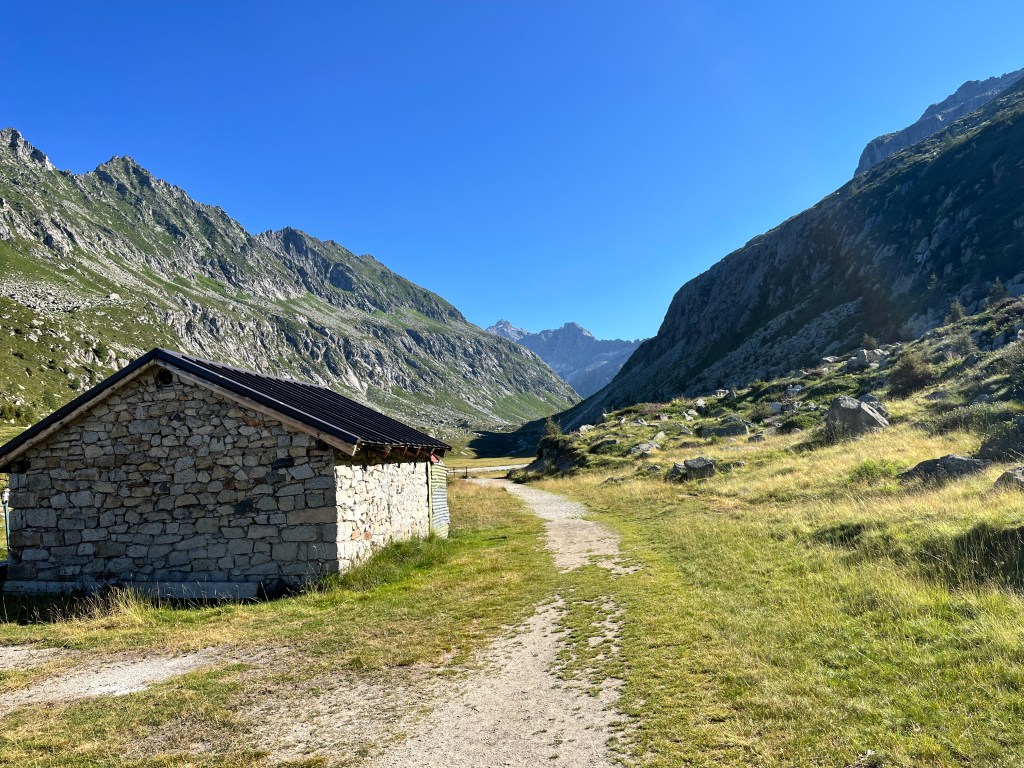
Honestly – the photos will speak for themselves. The views were good, but it was just walking on paths and trails near the road. I could always hear the road noise. I was also appalled at the condition of Passo Tonale. Skiing is an industry that heartlessly ravishes the countryside – I think it’s appalling and disgusting and frankly unjustifiable. It reeks of immense disrespect for the mountains, and for me there is nothing worse. Those who partake in this defiance of nature on a regular basis have no grounds to call themselves mountain folk or nature lovers – descents should be earned by swear and toil, and contributing to this industry should take a good long hard look at themselves…

Rant over.  After a somewhat disappointing lunch stop (the super market had run out of Focaccia!!!!!) I made it to Camping Presanella. A wonderful – if expensive – campsite where I spent a delightful afternoon resting and reading.

Day 2 – Temu to Garibaldi

The day, whilst only 15km or so in distance had an intimidating elevation profile with such a heavy bag (my baseweight was only 7kg or so, but the weight of six days of food was crushing). I began early and took an old man plod up the road towards Lago d’Avio – relishing the excellent views and steady but consistent gradient. The first thousand metres of climbing flew by and I found a lovely spot to have lunch and dry my tent.

Sadly, mid tea, I heard the ominous sound of thunder and thought it wise to get moving. As the thunder grew ever closer, I started to push myself to move up the hill faster and faster, eventually practically running up it as it started raining. Alas, I was too slow. 

I see the air ionise to plasma just fifteen metres in front of me, followed by a crushing and brutal thunder clap that made me shiver in fear. Some scorched fragment of the structure the lighting struck fell from the sky. Never in all my life had thunder struck so close. More bolts surrounded me, this was a bad place to be and the only thing to do was run. The rifugio was just five minutes away at this point, I sprinted up the hill as fast as my legs would carry me, ignoring the burning pain in my legs and lungs. I was scared: thunder and lightning are a serious hazard and should not be underestimated.
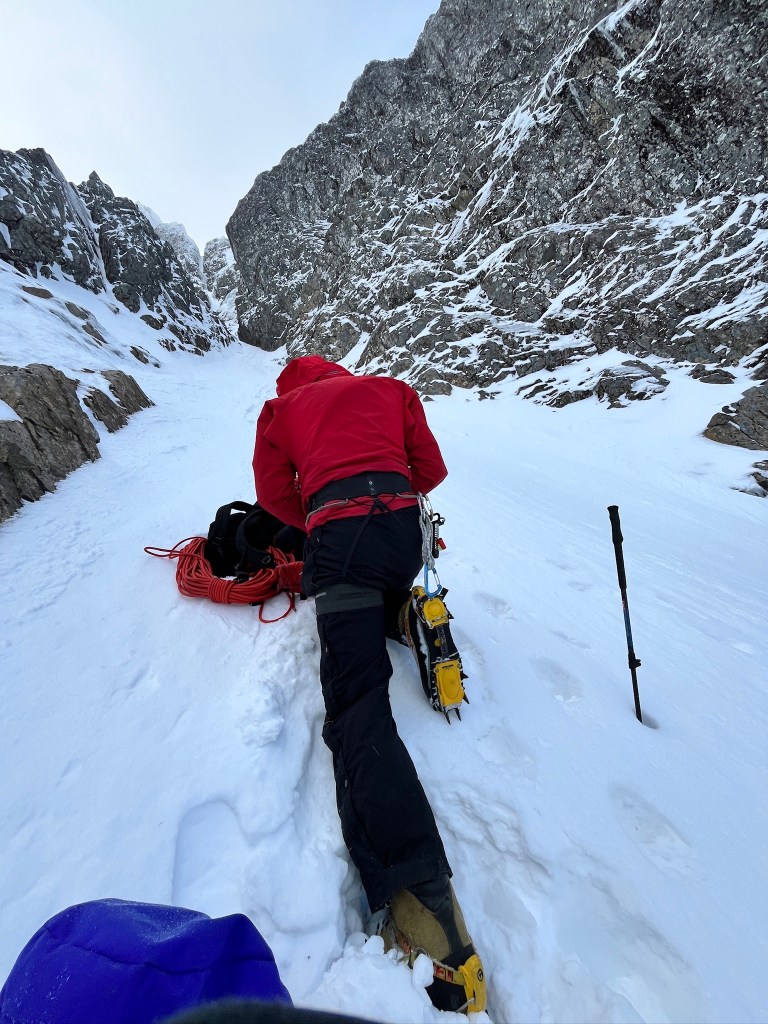
I reached the safety of the Rifugio, panting. That was an exciting end to the day! A quick Fanta and the rain began to die down after an hour or so. I went outside and found a secluded and beautiful spot to set up my tent.

One ominous note, I was camped on the remains of a World War One barracks, and as I went to collect water just before bed, I saw something rather spooky. Bones. Lots and lots and lots of bones. They were large bones, of beings about human or deer sized, but there was nothing identifiable about them. At the time, my mind jumped to this being some sort of burial ground or hospital in the war, but later I realised it was more likely that it was a kitchen, and the bones discarded belonged to dear and game – but I’ll never know for sure. Maybe the fact that I made it through the night without being attacked by an army of ghosts confirms the latter hypothesis.

Day 3 – Garibaldi to Gnutti

After a good nights rest, I awoke to jaw dropping views. A cup of tea and bowl of porridge later, I was on the move. A quick descent was followed by an arduous climb, which I made short work of by deploying my signature old man plod. The top of the pass had a short equipped section, but it is nowhere near difficult enough to require any kit for all but the most nervous hikers.
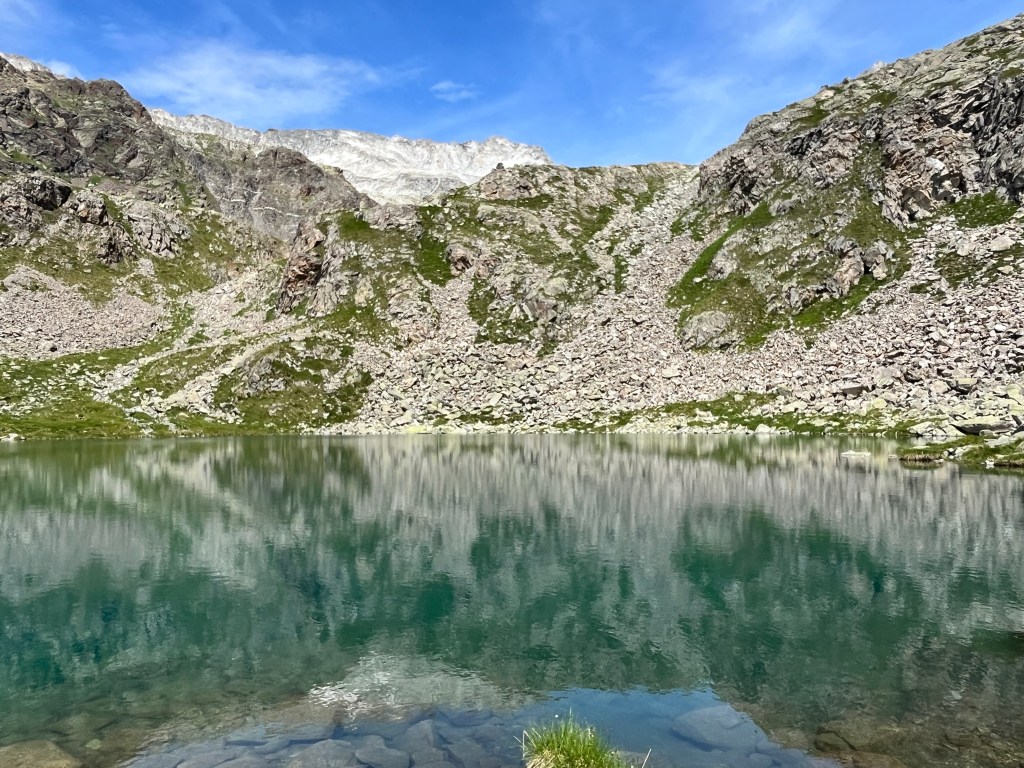
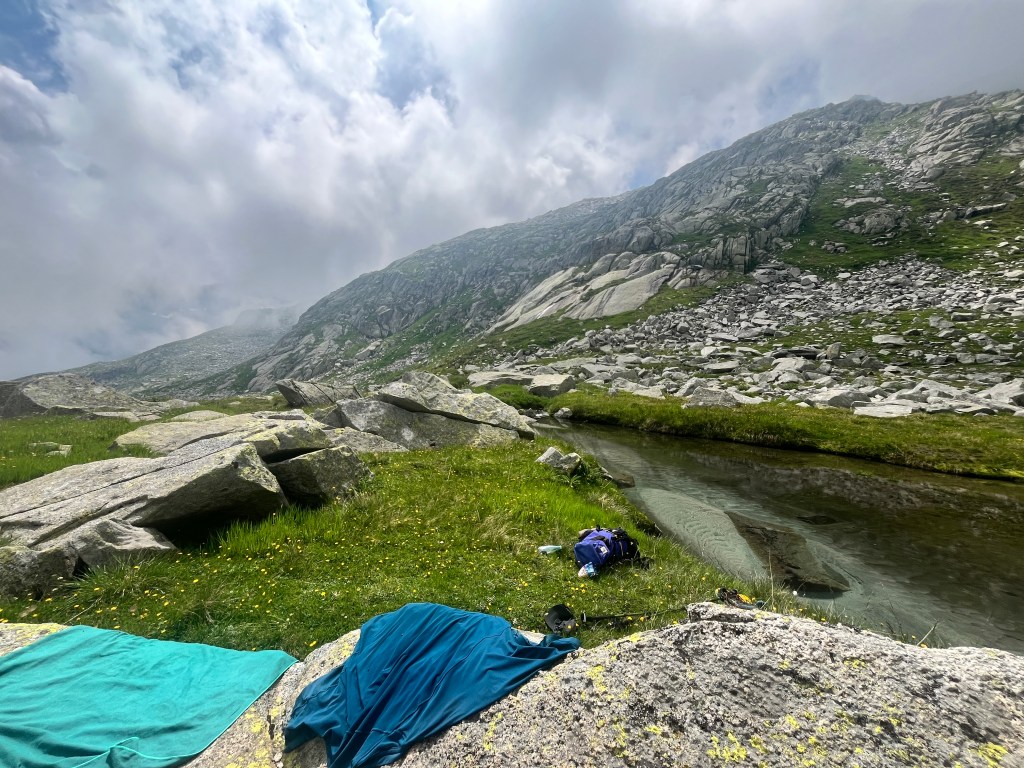
In this valley, I descended to a stunning lake, where I went for a freezing cold dip. As per usual, I spent several minutes talking myself into it, then the second I submerged myself I shrieked wildly (any bears listening – I do apologise) and ran back to the safety of my towel. An excellent swim!

I had some tea (mid day tea will be a staple of my backpacking hear on out) and my rather depressing and boring lunch (they don’t do wraps in Italy…makes life harder to have nice lightweight lunches). I even got a wee nap in before continuing the easy walk to Gnutti.

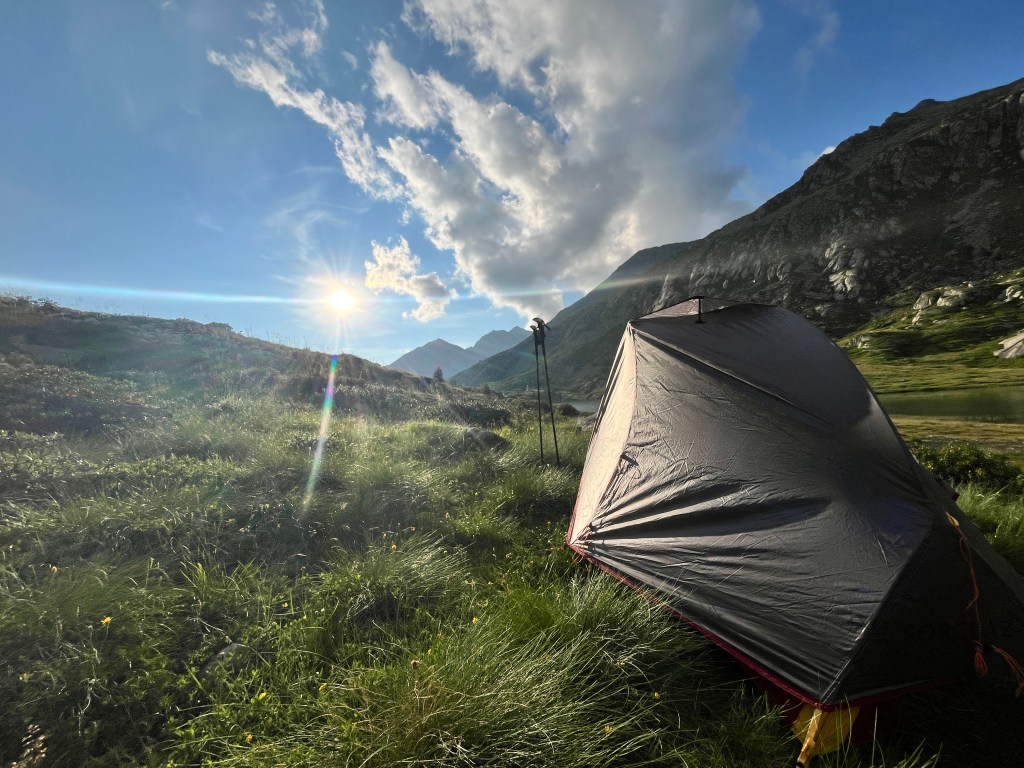
The lake here called for another swim (the same self hype shriek regime was repeated here), and then I set up my tent and prepared dinner. Just as I was reading my book, a large group of Italian youths decided to set up camp rather near to me – bloody young people 😉 ! Initally I was rather frustrated that the peace and quiet of my wild camp would get disturbed, but they were quiet enough and seemed to be having a lovely time! I slept excellently that night.

Day 4: Garibaldi to Adame

The first climb toward Rifugio Prudenzini felt like hard work – I was feeling a bit tired. I slowly plodded up for about half an hour when I came across something rather exciting. 

There was a large footprint in the park – as if it were from a very very large dog. Surely, this had to be the footprint of a Bear. I’ve been coming to these mountains for twenty years, and I’ve never before seen so much as a trace of the beats. How exciting!

I realised it was fairly recent, and it was possible the bear was still close by. To alert it of my presence, I began singing the old classic “Tie a Yellow Ribbon”. Those of you who know me are well aware that, at the best of times, my singing is more of a series of lyricised groans, and I can’t say the steep incline made it any better.

The poor goats walking heard something like:

“I’m coming ho” *wheeze *

“I’ve done” *stops for breath*

“My time” *takes a tactical view stop*

Even the goats were looking distastefully at this point. I suspect they were rather confused and frustrated that this strange man was coming and shrieking like some sort of deranged lunatic on their land, but their stares also carried some sympathy, perhaps they deemed that I was having some sort of breakdown and felt sorry for me. Alas, my hypothetical beard was not yet long enough to allow for good goat based communication methods – this feat requires a few more days of backcountry travel.

The descent to Prudenzini was absolutely knee breaking. I’d reverted to singing my version of “Because he lives” (he being Dave Macleod). The goats just started avoiding me at this point….

I had a short lunch break at the Rifugio, and faced the next brutal climb, nearly as large as the first and now in the desperate heat of the day. Luckily, the old man plod never fails, and carried me to just below the crest. 

As I was about to go over the crest, for the first time this season, I realised something was going to happen. Something…exciting. Beshitment! What is a trip to the Alps without a good beshitment! I found an excellent natural toilet and had an outstanding nature poo with stunning views all around me. Some folk try to avoid nature shits, but that is the sole reason I go out backpacking and climbing – searching for the ultimate Nivarna shit (a thousand metre drop straight through a granitic crack into a bergschrund below???!!). Alas, this shit only brought partial Nivarna, but nonetheless, a joyous and noteworthy crap (7/10).

A long and knee shattering descent brought me to Valle Adame, where I camped. Here I also realised some replanning was required. I’d found the day quite tough, and it was a relatively short day (only 1200m and 15km), but the terrain was brutal, more akin to the approaches to climbs then a long distance path. The next day was due to go over rougher terrain for much longer over much more ascent, and with the possibility of snow that I was not at all equipped for. I’d need to rethink. I opted to extend the trip by one day, and reroute via a much longer but lower altitude (just marginally) path and this provided to be an excellent choice. 

Day 5 – Adame to Val Di Fumo 

I slept well but I felt knackered when I woke up and decided to have a slightly slower morning. I went for a very speedy dip in the river had had TWO cups of tea (an excellent Earl Grey and a cup of mountain flower tea). An excellent start to the day. I put on an audiobook and began the beautiful plod out of the valley, passing through various hordes of animals as I went (horses, then pigs, then…other hikers 🤢). It was the weekend, and this was a pretty valley, what else did I expect… 

Luckily, I was soon returning to the esoteric, and turned off and ended up on a neglected and rather difficult equpped section. It seemed to be set up entirely illogically, with the cables stopping just as the difficulties began and the difficulties were not insignificant. After several passages of interest, I began the long plod up the hill, sadly in the scorching and brutal heat. The audiobook kept it fun, and I was having a really enjoyable morning.

Soon, I joined an excellent ridge, which provided invigorating exposure and spectacular walking. Along the ridge, old World War One battlements were everywhere – a crushing reminder that these mountains were once a battlefield. Passes were key strategic positions to hold, and were the scenes of much combat. War truly is dreadful and daft, and I can’t even imagine the conditions those poor men had to endure.

I descend in silence, in shock and awe of the conditions those men endured…

My tummy however decides that now is not the moment for silent appreciation. It’s hungry! I spot a lake – what an excellent spot that looks to be! I happily jog down the hill, the prospect of a swim on my mind. What I did not realise is that the path did not meet the lake, and soon, it was about two hundred metres above me (don’t judge me – I was engrossed in audiobooks). Did I walk back up for a swim? Fuck no. I Made do with a stream, where this irritating black bea/wasp thing kept trying to sting me and I shouted wild threats.

“Try that once more and I’ll squash you you little fucker”

The creature was undeterred. It had called my bluff and sensed my pacifism. My lunch was cut short, the thing had won. A great failure.

What was also disappointing was Val di Fumo. Don’t get me wrong – it’s absolutely beautiful – PAINFULLY so, but, tragically, it’s terribly busy, and at this point, I had become more adept at communicating with goats than people (goats gossip terribly!). I was taken aback by the crowds, and the lack of friendliness from the day trippers. They’d rarely acknowledge you or say hello, poor form. There was litter (not enough to be obvious, but when you look closely, it was everywhere), and just general disrespect for the environment. I was frankly appalled and rather frustrated. If my beard was not mearly hypothetical, I’d have given some old mountain man rants to the tourists damaging the wild places, but as a very smelly and dirty twenty year old I don’t quite have the authority needed to bollock an old Italian man for leaving a cigarette but. Give it a few more days…then I’ll start being able to speak bear.

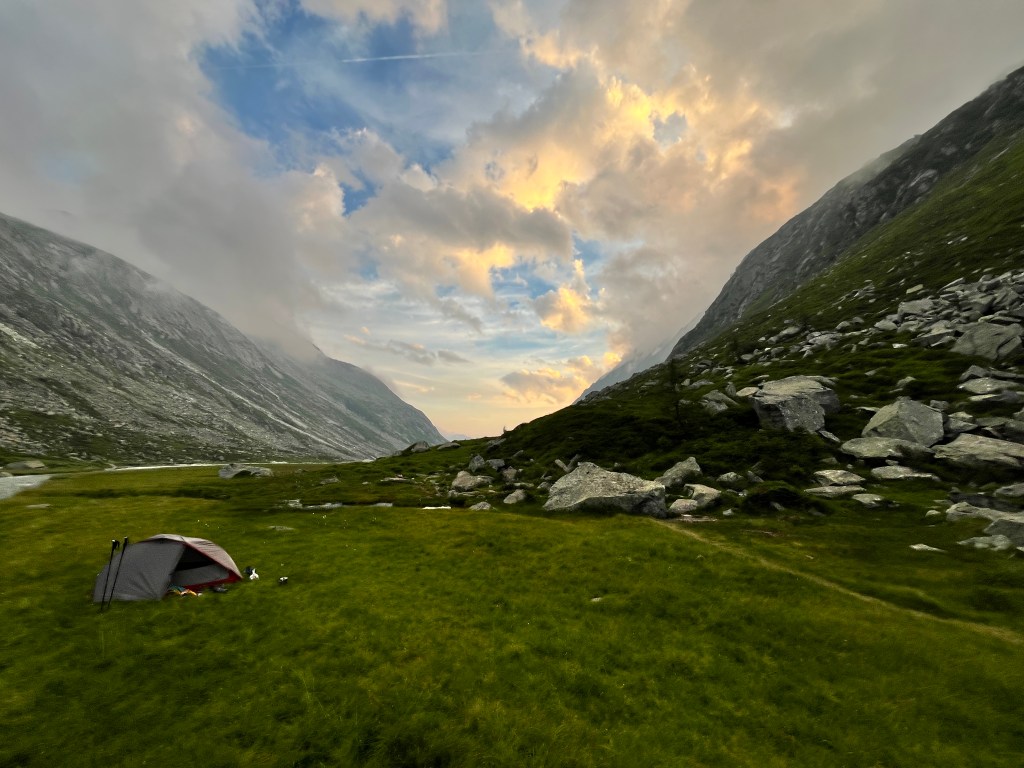
The camp was, however, beautiful. The views up to Care Alto were stunning and the views down the valley were also brilliant. This was the only night I opted to take a bear precaution and store my food away from the tent – there were a few signs warning of bears in the area and it seemed like exactly the place they’d like.

Day 6 – Val di Fumo to Care Alto

This was a big day. From my camp, I had to climb one thousand metres straight up – a brutal affair early in the morning. I certainly struggled, I was running a little low on food at this point (well, not low as such, but the lower-than-ideal calorie diet that this trip necessitated for weight-saving reasons was seriously catching up to me), and despite my hypoglycemia, I had to push through the hunger until I was well established on the climb.

Despite the pain, the climb was beautiful, and upon having my mornings allocation of MnMs, I was a new man, and found the second half much easier. The pass was beautiful – it nearly moved me to tears. Two of the most stunning and wild valleys conceivable on either side. Above Val di Fumo is the ‘Riserva Integrale’ – which essentially means it’s the most protected area of the national park, and god it shows. There was no one else, and few signs of people (except for the ruins of buildings from the war). As I sat, utterly mind blown by the views, I saw a wee marmot just below me. What a sight, and what a treat.

Ahead of me there was a long and rather faffy descent. The ground on this trip was rough, and care is often required. In my sights below, a stunning lake. Small, but strikingly blue, I knew this would make an ideal lunch spot.

I reached the lake, and jumped straight in. Despite the bracing cold, I’d become more adpet at ‘getting on with it’ and enjoyed my brief tip immensely. I treated myself to my final rice packet for lunch (rice packets and tuna were now the highlight of my day). That night, I was to stay at a Rifugio and for the first time in many days, eat a proper meal. How exciting.

After lunch, another 800m climb awaited me (joyus!). The slog was hot and sweaty, past the Cassina Dosson – a sort of Italian both. There was a man here with a very barky dog, so I did not hang around, and instead opted to move on to a secluded spot up the valley, with a little river where I went for another swim. I looked at the South Face of Care Alto in awe.

By a very long way, these two valleys were the most beautiful I’ve ever had the pleasure of walking through. To all intents and purposes, truly wild, deserted, glacial bowls which are full of beautiful alpine flora and fauna – no mountain lover could fail to be moved. I sat and stared for a good while around me – I felt so lucky to be able to go to places like this, and just pondered my life in an absolutely amazing setting.

The final bimble to Care Alto had a bit more uphill (300m or so), then a long soggy walk across. At this point, my socks (cheap alpkit ones) were struggling. They’d become very abrasive and uncomfortable for my feet, and as I trotted along a waterlogged path it became really grim. I was glad to reach the rifugio, despite the concerned looks from the all too clean Germans that were enjoying the mountains in a more luxury fashion.

For dinner you ask? Ribs, Gnochi with Ragu, and Strudel. Quite good

Day 7: Care Alto to Carisolo

Last year, some Swiss gave Lara and I a bollocking about making noise in a rifugio in the morning. Although it annoyed me at the time, they were actually really polite about it and gave some useful advice about how to be quiet. I wish the Germans in the rifugio with me met these swiss. The racket they made when they woke up was very poor hut etiquette indeed, and once again, had my real beard been as long as my hypothetical one, I’d have gone full angry old mountain man on them.

In my head, it went something like this:

“Scoundrels! Fools! How dare you make so much noise in the hut? I’ve never had such disturbed sleep since those bivies with Jefferson. I’ll write to London about you if I ever here such a racket again, and the gentlemen, well they’ll take good care of you. Edmund is not a man that likes disturbed sleep before interesting moves, and Franz’s birds will be right on you too!”

(Those of you who climb with me regularly will be familiar with all these characters, and their associated accents. Those of you who don’t…consider yourselves lucky. And coil your ropes carefully. Franz is always watching).

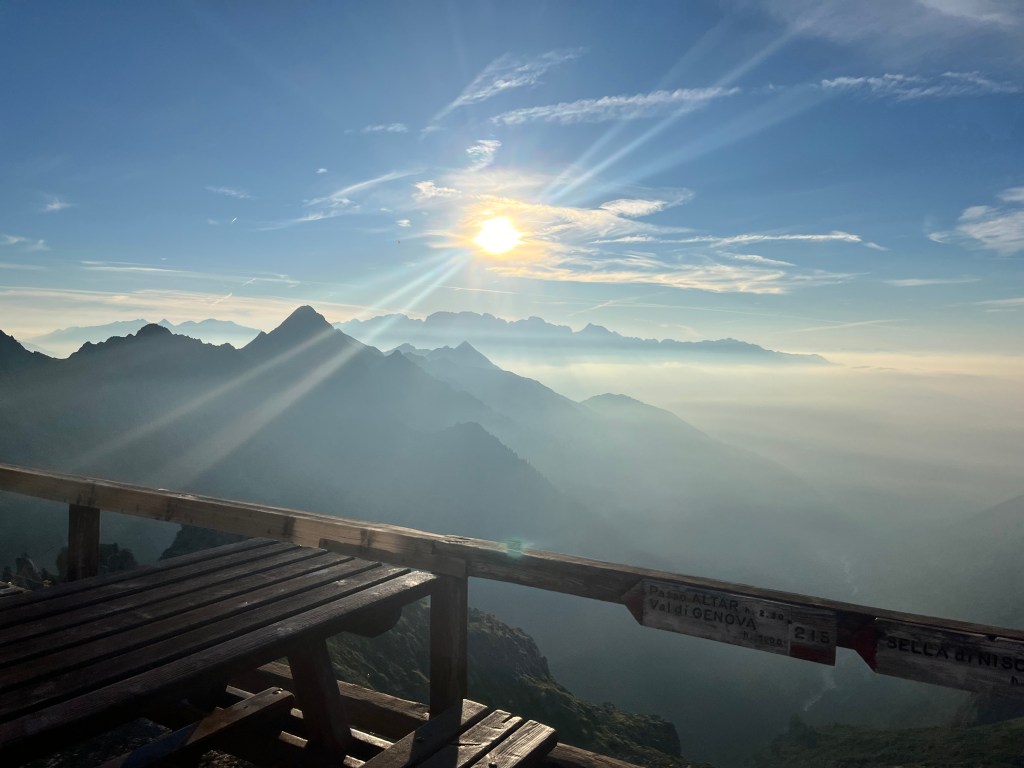
The day really started with the usual slightly underwhelming breakfast in huts (a sort of shitty buffet that is better suited to a day exploring Milan than proper mountain walking). As per, I was to descend eight hundred meters down one side of a valley, then immediately climb up it. The climb was not fun, but the stunning views and some good music made it pass trouble-free. I was essentially out of food at this point and was bonking hard. After I reached Passo Altar, I had a brief swim then put the head down to get to a supermarket, just 15km away from where I stood. I raced down the hill, softly singing to alert the bears (I was back in prime bear land) until I reached Val di Genova, and hordes of old people walking terribly slowly. I felt very out of place, and quickly found a quieter path to bomb it all the way down to Carisolo where I had some crisps and a fanta.

What a journey. Surely one of the most beautiful treks in Europe, if not the world? A beautiful journey, and an excellent week.

Presanella at Last

Some mountains are special. Something about these mountains eats straight to your soul – their shape, line, and raw beauty inspire a mixture of fear and awe that creates that wonderful stomach-churning excitement that surely motivates all mountaineers to climb. For me, Presanella was the first mountain to do that: it’s proud pyramidal shape and imposing and daunting East-Face – Himalayan in scale – standing guard over Trentino. It felt so unattainable, inaccessible, and frankly like a pipe dream for so much of my life. Returning to the Brenta after a few years of obsessive climbing was strange – the grade (somewhat debated, but for me about PD) was now not only achievable but straightforward. So – in the time I was here alone, I decided it would be a suitable objective.

For the solo mountaineer, Presanella presents itself as an ideal objective. Although the mountain is glacial, climate change has shrunk it to the point where it is thin and no longer crevassed. Difficult sections have some equipment in the form of cables and rungs, and even the hardest unprotected steps are well within the grade I’m happy to climb alone. What a fantastic objective!

Without a car – the slog up to the Seganantini Rifugio is long but not ridiculous, comparable to the walk ins in Val Masino. With about 1300m of ascent from the bus station, via a road and then a delightful path, it took me a shade over three hours of walking to reach the hut. Here, I enjoyed an afternoon of watching downloaded YouTube videos (YouTube Premium is worth it for these trips, I find) and trying to read Italian climbing books in Rifugio’s small library (a single bookshelf). Dinner was rather good, and I was advised to start early, perhaps walking by five, as it would take about 5 hours to reach the summit from the hut.

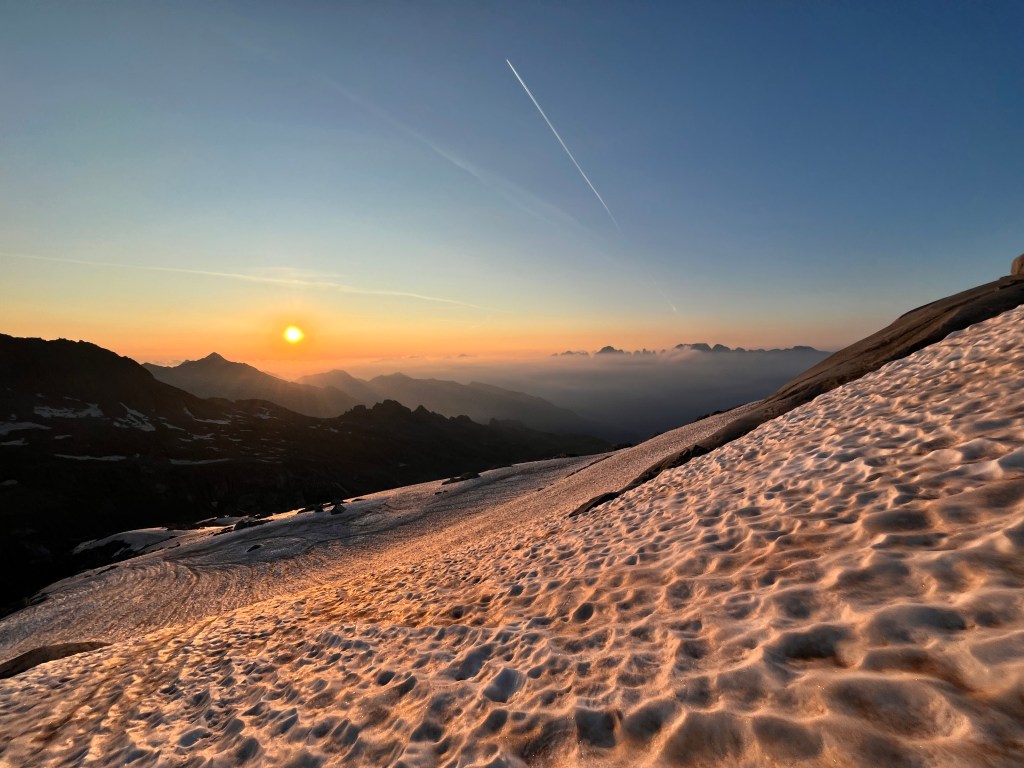
The alarm sounded and I swiftly had breakfast and began walking at around ten to five. Deploying my old man shuffle, I began progressing to the first difficulty – Bochette De Monte Nero at 3000m, just over 800m above the Rifugio. The view was stunning, as was the alpenglow shining from behind the Brenta.

Beautiful Alpenglow

After about an hour of walking, I reached the glacier and put on my crampons and had a small amount of water before setting off. The snow was satisfyingly hard and very much required crampons. I made swift progress up the slope, continuing the old man plod to the Bochette.

Looking up the Bochette

I kept crampons on for this part to save time – although those not confident moving in crampons would be wise to remove them. Furthermore, I feel the need to advise parties that although there are cables here – the primary security they provide is as a handrail. The ledgey nature of the climbing means that for the most part you’d fall to the same point as you would if you were unroped, and at times would be in a worse position as you may be flipped upside down. I’d advise future parties to see it as a way to make soloing safer, and parties not happy moving relatively quickly unprotected over UIAA I-II ground (UK grade 3 scrambling) would be well advised to bring a small rope and make use of the bolts equipped with snapgates that would take a munter hitch beautifully. You can tell this route is popular with guides!

The second glacier

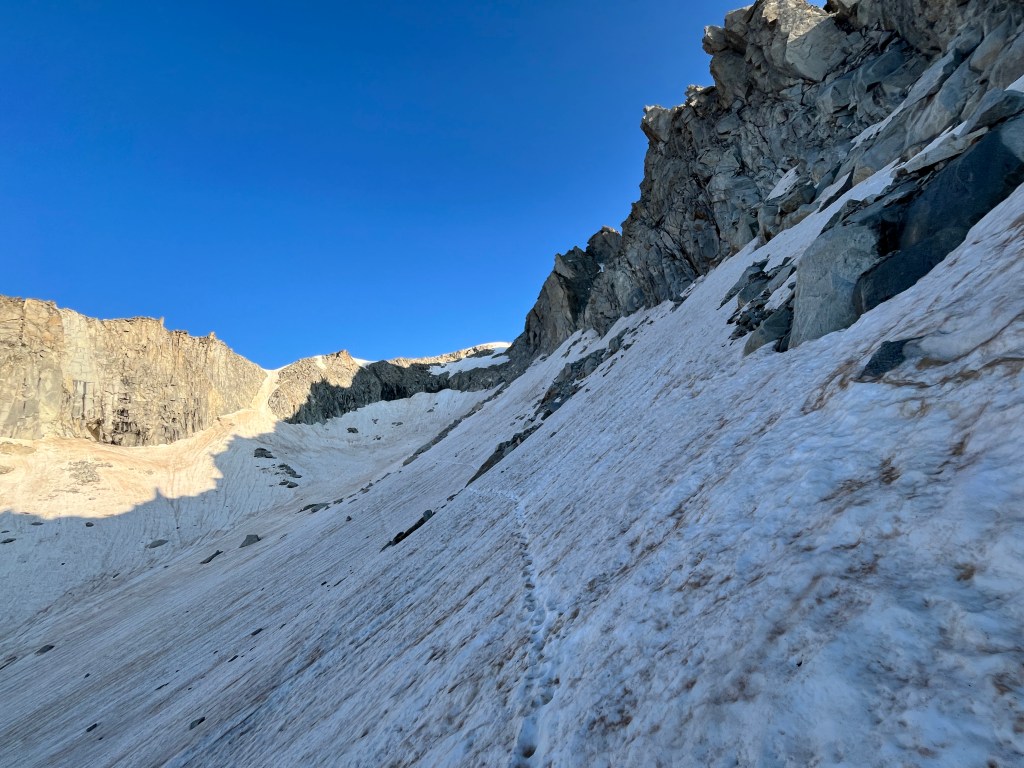
The descent was similarly straightforward and I reached the second glacier. This was a straightforward crossing, with good steps for most if it, with the final section being rather steep at about 35 degrees, but not being consequential. Later in the day, I saw some significant rockfall off the left hand face in the image above – parties would be well advised to stay well to the right (facing towards the summit) and not dilly dally for too long. I suspect the rockfall is worst around this time of year as the winter snows melt, but sadly this coincides with the best conditions for the route! The gully on the image above tempted me greatly too – as it looked like an excellent low grade plod in a fantastic setting!

The route itself instead continued to another small scrambling step, with one fixed line at the start, then a few moves of II which are very secure and straightforward, although the rock is very poor in places, and those inexperienced moving in alpine terrain should be reminded to take immense care, and test every rock before pulling on it, both to safeguard themselves and to prevent throwing rocks on parties below. Luckily, at this point I began to realise I was making very good time and was well ahead of other parties from the hut, so I did not need to worry about this.

The ridge

You then gain a broad plateau/ridge. The setting here is wonderful – but the East face has large cornices. Mountaineers should stay well away from the edge to ensure their safety. In places, the cornices were overhanging as much as five metres and are very weak in the sun.

A final scrambling section coming around Bochette de Monte Nero

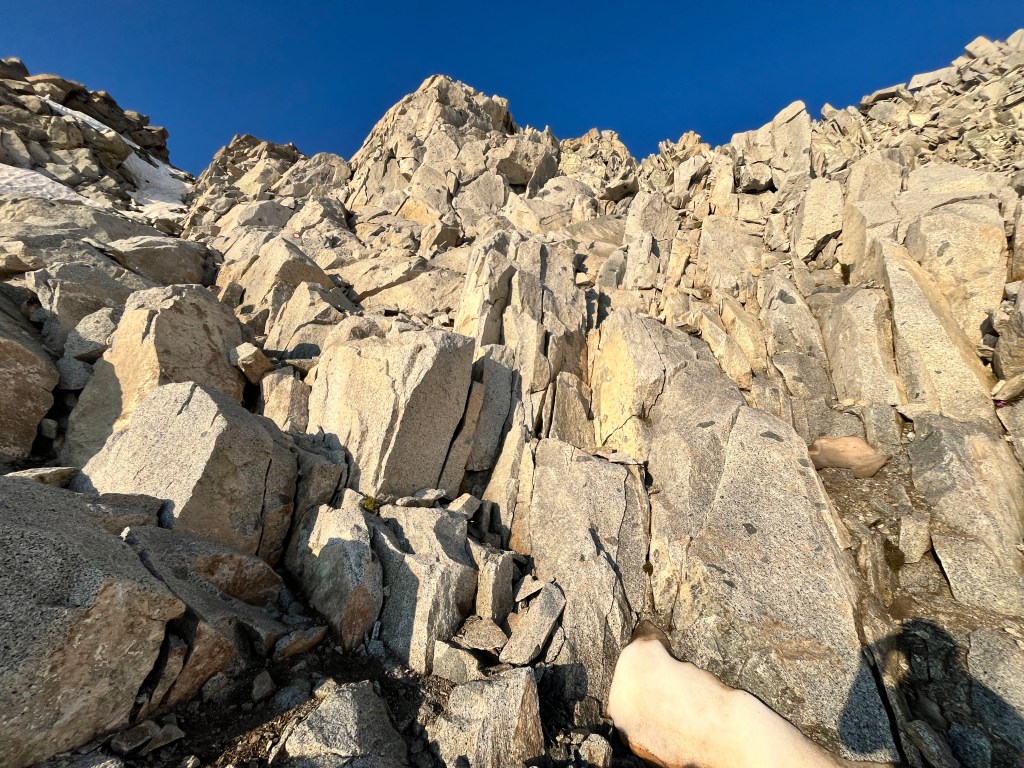
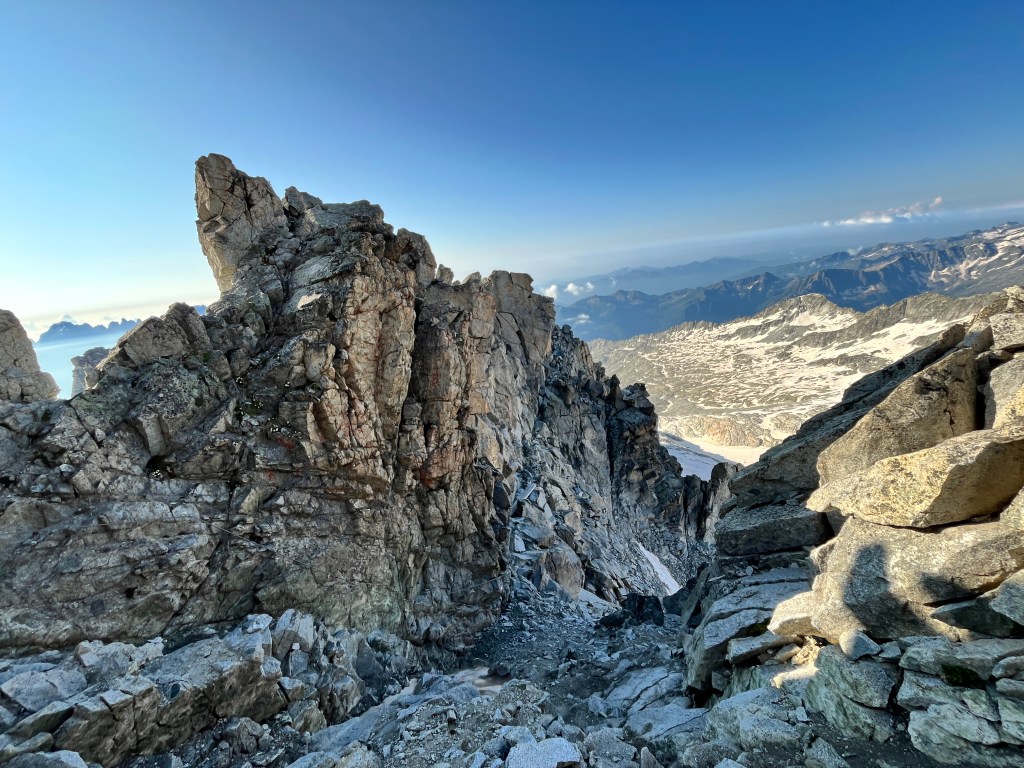
The final difficulties are coming around the Bochette de Monte Nero. Although very straightforward, the rock is very poor: parties should take immense care not to throw rocks onto other climbers. From here, you reach the Bivacco Brigata Orobica, at 3387m. It is a straightforward walk from here to the summit, with a few short scrambling sections.

The final snow slopes, with the short scrambling section visible.

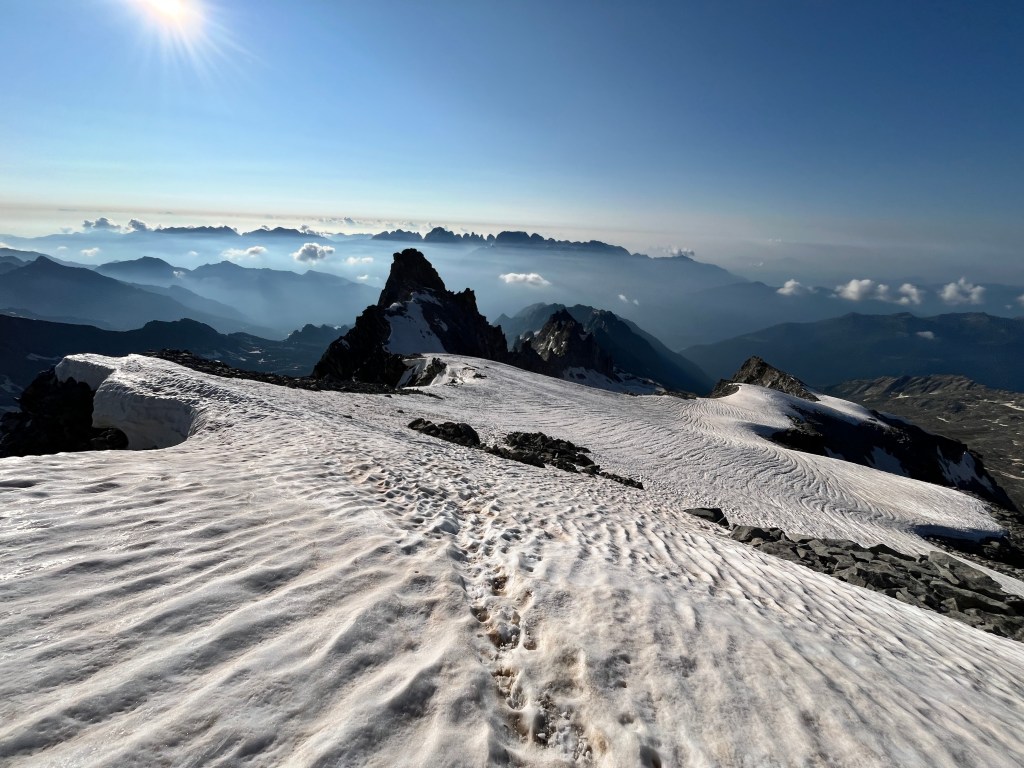
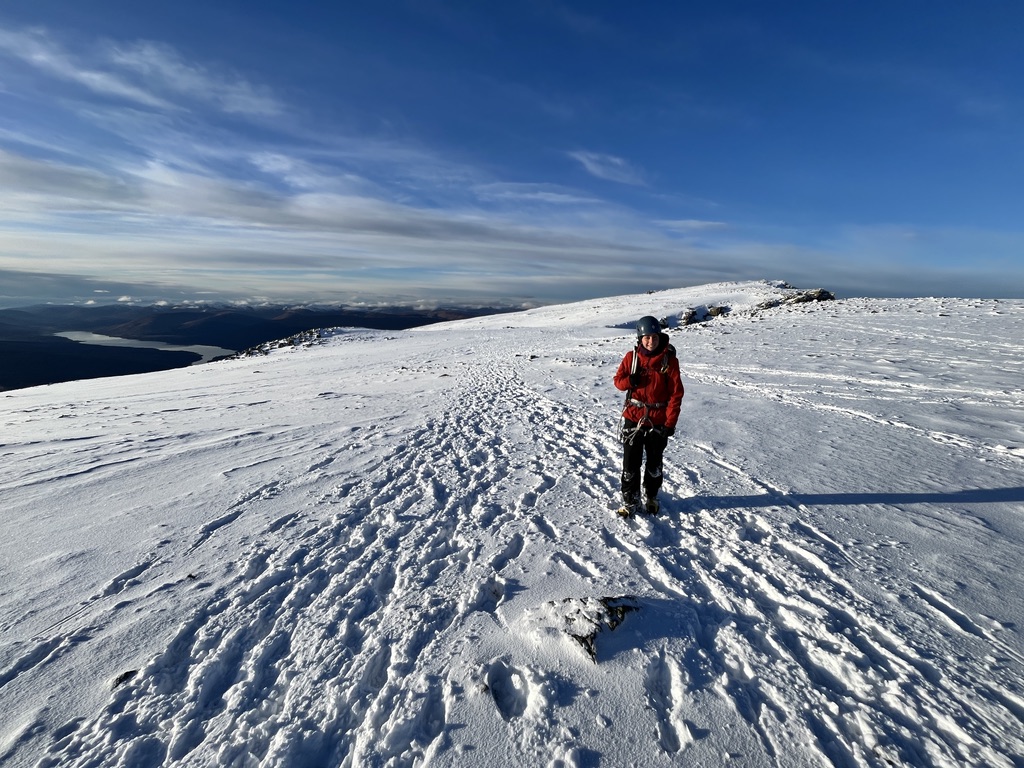
The view was utterly stunning, and the snow was still absolutely bullet-hard and the feeling of plodding up this wonderfully positioned snow slope, with the expanse of the Adamello, Ortles Cevedale, Brenta, and Bernina groups sprawled around you was one of the finest mountain experiences I’ve had. I reached the summit a shade under three and a half hours from the Segantini.

The top

I did not dawdle at the top. Many of the snow slopes were consequential and above large cliffs and I was aware they would be far more difficult to cross safely once the snow softned. So after around ten minutes on top, I began to descend, which was straightforward. I reached the Segantini just after 11, from where I walked to the road and hitchhiked back home.

To me, many British climbers approach the Alps with an appalling and egotstical attitude – flocking to Chamonix, Sass, and Zermatt with the intent of ticking these big famous routes to boast to their mates about in the pub in the valley. To me – this is the sweaty armpit stain of mountaineering culture, and brings out the absolute worst in the community. Routes like this are the antithesis of that culture – a joyus and isolated path up a mountain that leaves no room for ego and makes no allowances for those not willing to get sore legs on the long approach. A wonderful outing that I can not recommend highly enough.

Kermesse Folk

The Dalmazzi rifugio is one of my favourite places in the world: a hidden gem for many British climbers, who are hypnotised by the quick hit, lift served alpinism available from Chamonix, which to me lacks the authenticity and purity of experience that one gains walking up from the valley. The Dalmazzi rifugio provides some respite from this culture – the longer walk in and esoteric nature putting off those who tick routes simply to fuel their egos.

The basin

The Dalmazzi is positioned in a magnificent basin, the Leshchuax, Savoie, and Triolet standing guard around a glacial bowl, with sheer and beautiful granite walls climbing straight out of the glacier. Over the last century, giants of Alpinism have left their mark in the range: from Piola routes seeking out some of the finest granite imaginable, to the impenetrable Cassin route on the Leschshuax: a line that will only see a handful more repeats till it is ludicrously dangerous due to glacial retreat. Our objective was somewhat more plasir- Kermesse Folk.

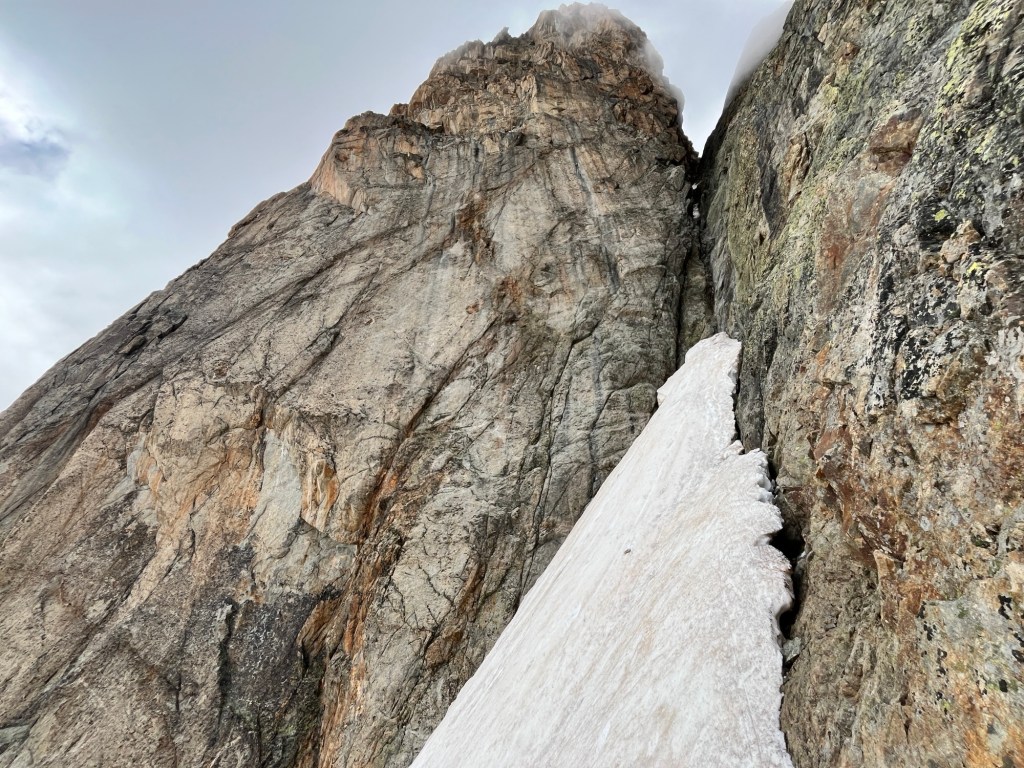
The line follows the shoulder do the summit of the Aguille Rouge de Triolet, an enticing spur that linked the glacier to the summit, but despite following an obvious feature, the climbing itself is rather lineless. The broad shoulder consists of homogenous granite slabs which provide no distinct lines of weakness that lead to the summit – instead – Kermesse Folk links together the best rock on the spur, protecting sections with bolts where required and to show you the way. This is a rather wonderful style of climbing as it enables very rapid movement – assuming one is comfortable at the obligatory grade (a prerequisite for a route this long) – you can make fast progress, often opting to run it out to the next bolt many metres above you rather than wasting time placing gear that is unnecessary in the fear that there will not be opportunities for protection above. This means that, despite its length, Kermesse folk is a rather amenable day and an excellent introduction to longer routes.

Enjoying the climbing

The day started with an alarm at 5, with warnings of rain in the afternoon an early start was essential. After a swift breakfast, and letting the alpine wads Tim and his twin Torrin leave ahead of us, we walked in, filled up water, and plodded up the steep snow patch to the base of the route.

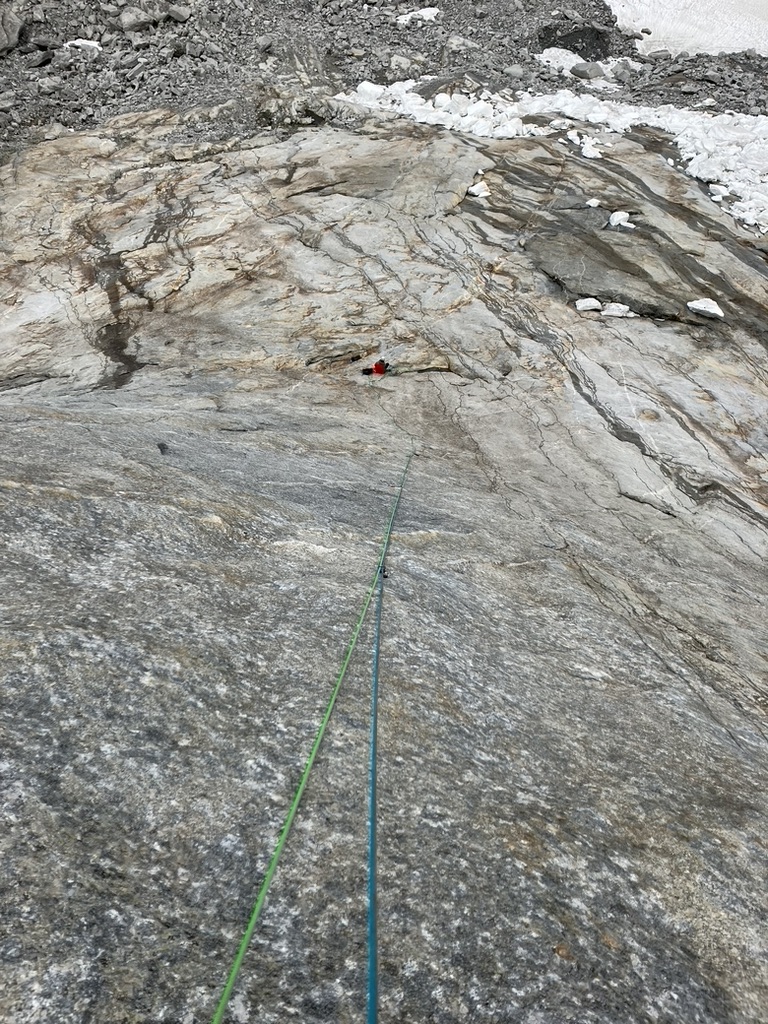
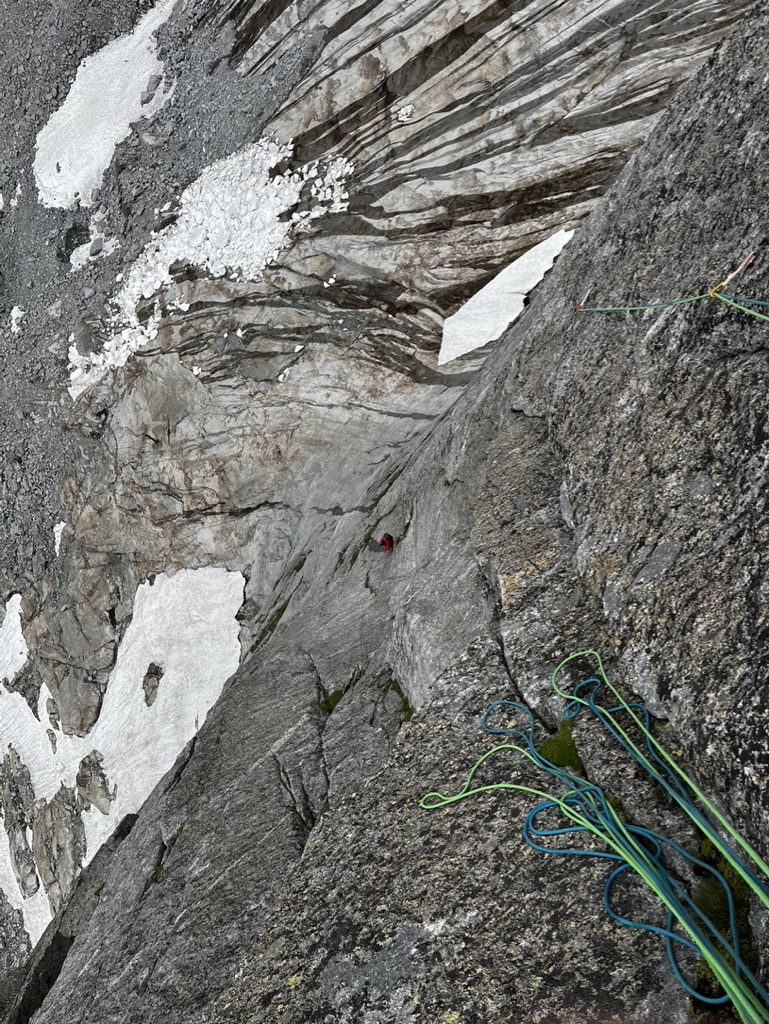
The first few pitches proved to be enjoyable climbing: it’s worthwhile to note that the second pitch is entirely reliant on friends for protection for the first ten metres, and in British equates to steep but juggy VS/HVS 5a. The climbing is that lovely style where one is never left wondering what to do – you can simply enjoy rapid movement over beautiful rock.

Looking down P2

All belays are well equipped with two bolts and a maillon, although I’d be very hesitant to recommend abseiling the line, it is long and easy angled and would surely be a nightmare.

After the first ten pitches, we encountered a large snow patch after the 2a pitch- highly unusual. Boots were required and we kicked steps up this section, marvelling in the extra adventure introduced into what otherwise would have been a pure rock route.

Making progress up the snowfield

The next pitches were also wonderful – a series of beautiful slabs leading to a belay on a fine ridge. Joe had somewhat of a nightmare route finding here – without glasses (or with them for that matter), the grey and matted colour of the bolts ensured they blended in well with the rock, and thus it was easy to quest in the wrong direction, mistaking some granitic knobble for a bolt.

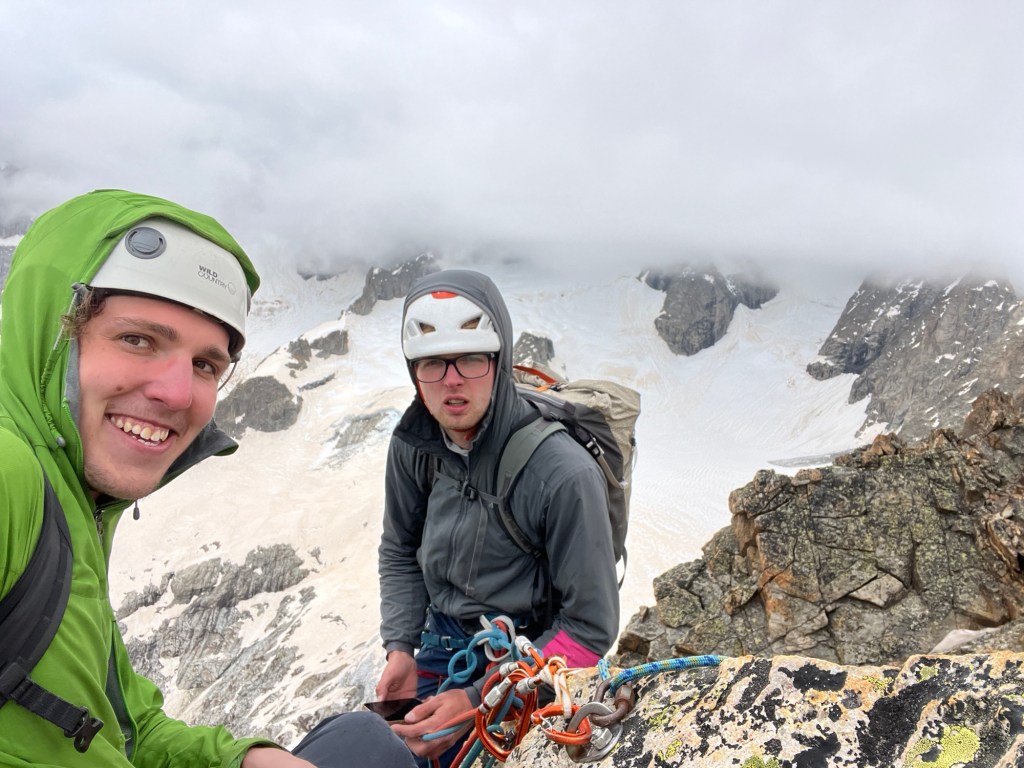
From here, the angle and the grade eased, leaving three wonderful pitches of climbing before the top. Joe and I shook hands, hugged, and took a selfie before beginning the descent.

Enjoying the exposed summit ridge, despite the poor rock quality

I will describe the descent we did in detail. I would warn anyone to neglect the advice of Plasir Sud – abseiling the line would be masochistic and result in endless stuck ropes – the pleasure one would gain by climbing without the burden of boots would be soon forgotten when you have to climb up to retrieve a stuck rope for the tenth time. Instead, descend the right spur (route behind you) to a ridge. Here, there is some tat. If you descend straight down from the tat to a ledge, and make a traverse to the right (facing out), including a step at about grade IV, you will see two bolts. These bolts follow a steep but clean abseil line which take you to the base in about four abseils. Three of the stations are well equipped with two bolts – one station has only one bolt but as of June 2024 is backed up with a well placed nut (not placed by us) and new green 8mm tat (placed by us), alongside a thread. I would advise future parties to descend further down the ridge and attempt to find the abseil line of Cristallina, although unless the team is already familiar with this route I suspect that would be quite difficult. I look forward to the Chamonix Granite guide to Val Ferret to see what line they advise abseiling down, and hopefully a more comprehensive description of the descent.

A poor photo of the beautiful face you abseil down

From here, the descent in dry conditions is straightforward – a walk to the so called “access dihedral” , however due to the large amounts of snow, it was made somewhat more technical and had many scrambling sections at about the second degree. A short walk over the snow patch after the access dihedral led us to the rifugio.

Overall – an excellent and enjoyable day out – with a good adventurous feel and fantastically positioned. Although the climbing on Perfumo Prohibito is better, it still had fantastic pitches and provides a more complete feeling day.

For parties reading this as beta before attempting the route, bring about 10-12 quickdraws and a small rack of friends – perhaps silver friend – gold friend. Two ropes of at least 50m are needed to abseil down the line.

Summit selfie

Delightful Diabeg

Diabeg is one of those places – it feels surreal. Beautiful slabs of gneiss rise out of the sea, with beautiful fine cracks running up these walls, making for excellent, relatively safe climbing. The quality of the rock, combined with the stunning outlook over the peninsula, make it undoubtedly one of the finest ‘non-mountain’ crags in the UK.

I’d climbed here once before last summer, where Charlie and I had an ace day on the 4* classic Route Two, and the Black Streak. Lara however had never been.

Neither of us had done much trad over the winter, so we thought an appropriate warm up would be to repeat Route 2! The first pitch has a slightly necky start in my opinion, but then you quickly gain the crack line that is filled with absolutely bomber gear and lovely holds. The top pitch follows an even more defined crack, and makes for some really excellently enjoyable climbing, all in a good position. I must admit, although excellent, I do not feel this route warrents 4*.

A social day out

Next we moved on to Route Three – a nice little route just to the left of Route Three. Lara led the first pitch, and underwhelming and blocky 4b pitch, then I took the second pitch – an E1 pitch with a tricky pull leaving the belay without particularly good gear (although I think you’d just hit the grassy ledge below unscathed so it is not particularly stressful), then a smeary traverse. I really enjoyed the climbing on this pitch – it was much more ‘face focused’ than other routes I’ve done at Diabeg.

Lara took pitch 2 – a streneous steep crack. The gear was good, but it did involve a steep and hard pull to overcome a small buldge. I thoroughly enjoyed the struggle, and we abseiled down for a very quick dip (we put our heads under, shrieked wildly at the cold, and promptly exited the sea).

On Sunday, we returned. Lara cruised up the Pillar in an exceptionally slick lead- a 4* E2 – not being deterred by the wet initial section. The climbing was really rather excellent – with plenty of gear where you need it and seemingly the perfect amount of holds to ensure sufficient interest whilst allowing for a relatively straightforward (in that it has no definite crux), if sustained, climb.

We them moved back to the main wall – where I eyed up the Garry Latter Special – Perfect Day. This was an excellent direct on Route Three, and involved climbing a challenging and bold section off the belay, before gaining twin cracks at the top and finally a challenging and awkward offwidth. The gear was good, although not quite as good as you’d want given the climbing was fairly challenging for E2. I was somewhat gripped transferring from the left to the right crack, with a shallow but good green totem providing the sole gear to protect me from some significant air time. Luckily – I did not fall, and gained the offwidth and began a short, but extremely inelegant struggle to gain the top.

An excellent end to a brilliant two days of cragging, and a good start to the trad season!

Comb Gully

The forecast was not ideal: despite the sun, the wind would be blasting across the summit of Ben Nevis at 55mph, not conducive to climbing.

What a beautiful mountain!

Plan A was Tower Scoop into Good Friday climb – supposedly a lovely link-up of two fantastic ice routes. On the walk in – we were surprised and somewhat disappointed by how windy it was even at the CIC – some replanning would be required. It was cold…and Charlie was faffing with his layers and putting on his boots whilst I’d walked in in mine. I was quickly getting cold – and was keen to get moving.

From the CIC we saw pummels of spindrift being blown town Gardyloo gully – just next to where we’d be climbing: indicative of high winds and generally a pretty grim time. Corrie Nan Ciste looked like it was in better condition – far more sheltered and in excellent condition. As we walked up the corrie – the wind died down, and we were glad with our decision – it was going to be a fantastic day!

The easy start to the gully

We headed towards Comb Gully Buttress, but upon seeing many parties already established on the route, we decided that Comb Gully would be a better choice. We soloed up to the narrows – and Charlie set off on the main pitch – a wonderful pitch with steep snow ice steps – but very minimal protection.

He cruised up the snow ice and arrived at the belay on rope stretch in an excellent lead. I had an excellent time belaying: watching Iain Small work his way up a fantastically hard mixed route with inspiring levels of skill and composure. Upon hearing Charlie’s loud bellow from above telling me I was on belay – I set off and enjoyed the wonderful climbing. I led the easy exit pitch and then we arrived on the summit plateau and navigated to the summit.

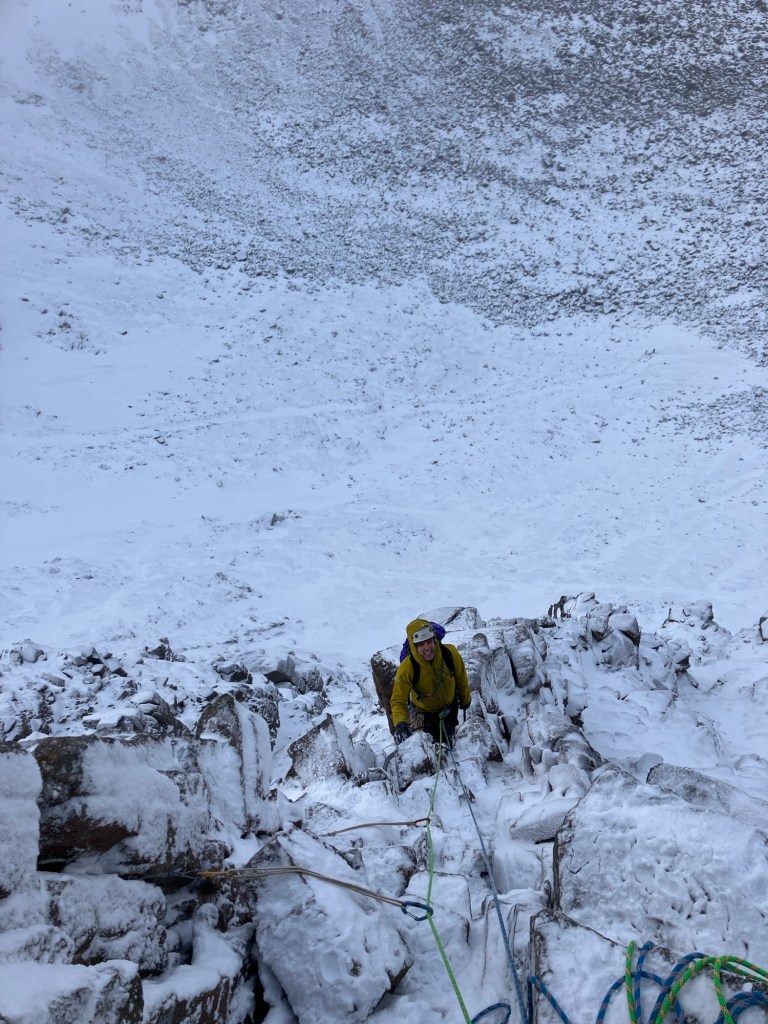
Enjoying the last steep bit

It was nearly a white out: care was required to stay on track. We reached the summit, and turned around. As I was taking bearing at Gardyloo gulley, and planning how to get to No4 – an inexperienced hiker said “First time lads”. We agreed he was a bit of a knob, and set off, following our bearing.

Just a few seconds later, we walked past him, looking rather disorientated, and continued to the 1200m contour where we would leave the cairns to reach our descent route. As we reached the contour, him and his partner sheepishly asked us for directions – we suggested he gets out his compass and follows a bearing we gave him – he did not, and began walking towards five finger gully, just a hundred metres or so away from our left and an accident black spot.

“It’s not that way mate.” Charlie said – at this point slightly concerned that these folk would get themselves into trouble. We made sure to give them robust directions to head pretty much straight down the slope, and were glad to see they eventually listened and (hopefully) made it down safely.

We swiftly navigated to no4 gully and made a fast descent – with the added excitement of seeing a very skilled skiier drop in and cruise his way down it in pretty sub-optimal conditions. Sadly for us – the snow was too hard and consolidated to allow for a safe bum slide, so we walked down the gully this time.

Chodd Guiding / Badd Expeditions

We had an enjoyable lunch at the CIC, and were down by 4:30. Dinner was cooked, and a beer was enjoyed – what an excellent way to spend my 20th Birthday!

No 3 Gully Butress

The Ben is a mountain of two sides. Every year, tens of thousands of tourists make the slog up the benign and boring tourist track – a wide path, never steep, and of minimal interest to the climber. The North Face feels entirely different – home to the biggest cliffs in the UK and some of the best winter climbing in Europe. At the mountaineering club’s Ben meet, Lara and I spent a day sampling the climbing on this immaculate mountain.

The day started early: unlike the Cairngorms where you can drive up to 700m, here you start at sea level and every metre of altitude is hard earned. At just before 7am, we left the North Face car park and began the long slog to the CIC hut. There was some gentle snow in the air, and the mountain looked spectacular! Exciting stuff!

Happy on the approach

After a brief rest at the CIC, we continued slogging up to Corrie nan Ciste. The original plan was Green Gully, a 3* IV 3 that looked utterly brilliant, but upon seeing a party on the first pitch with absolutely no protection on a 40m ice pitch, we opted for a different route. In the current conditions with lots of snow-ice, the climbing on Green Gully was straightforward (Meg and Charlie had an ace day on it), it was unprotectable as the snow ice did not yield any worthwhile screw placements, and often belays were on the marginal side and unlikely to hold a factor two fall. In essence – the leader is always soloing, and at times in a position where a fall would scupper both them and their partner. This was not a day that Lara and I fancied, so we opted for No 3 Gully Butress instead: another 3* mixed route but with some rock gear meaning it was far better protected in current conditions.

The first pitch was straightforward and easy angled ice: highly enjoyable. Lara made short work of this pitch – glad of a peg on the side to provide some protection as screws were marginal at best.

The underwhelming second pitch

Parties above us kept showering us with falling ice and snow: Lara had to pull herself into the wall as she was bombarded by large chunks of snow ice. I was belaying in a more sheltered spot, but was also getting bombarded by football size chunks of ice. I put my backpack on and pulled it over my head to provide some protection from the shower from above, and I was mighty glad for my helmet.

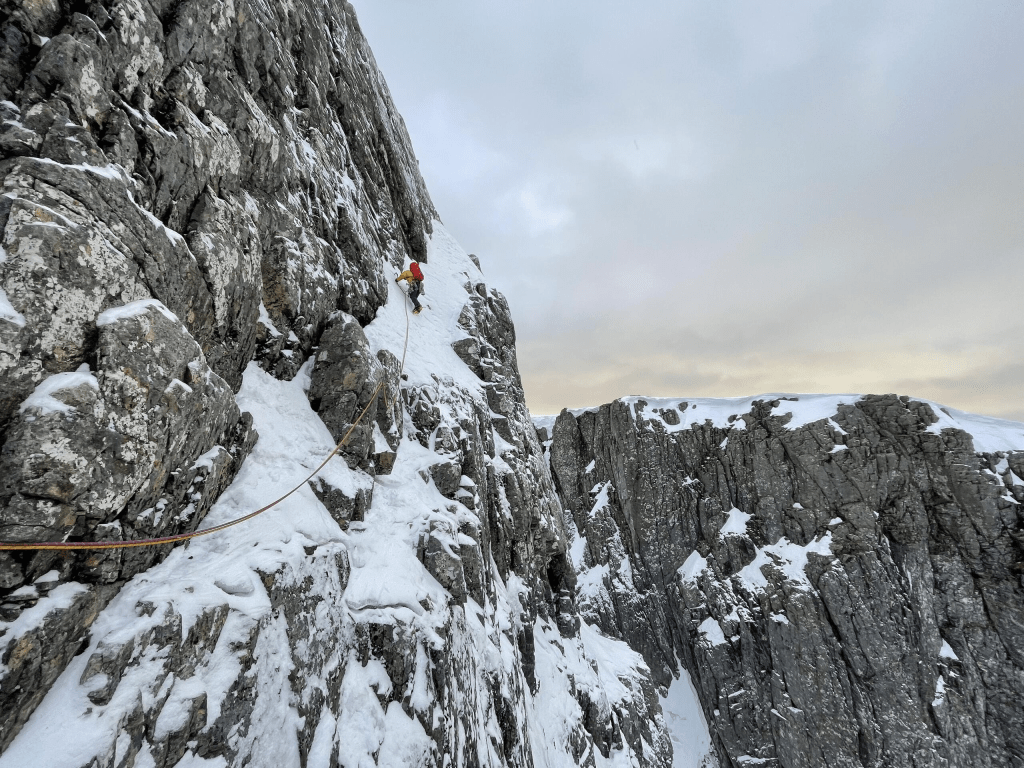
I followed Lara up the first pitch and began the next pitch: a straightforward snowy slog to a rocky band where I belayed. Lara’s next pitch looked excellent: a snowy slog leading to an excellent mixed step. Due to parties ahead, we were belaying slightly off-line. This meant that when Lara reached the mixed step, she had pretty awful rope drag.

‘The rope drag is fucking awful’. I could see that she was practically being pulled off the mountain. There was little I could do to help.

‘Come back if you want to – can still go down’. I said – not wanting to put any pressure on to commit to a dangerous section of climbing.

She paused, then hammered in nut with some difficulty, before commencing a delicate dance up the wall. Carefully positioning her axes and fighting immense rope drag, she fought her way up the pitch and swiftly built a belay. An excellent lead.

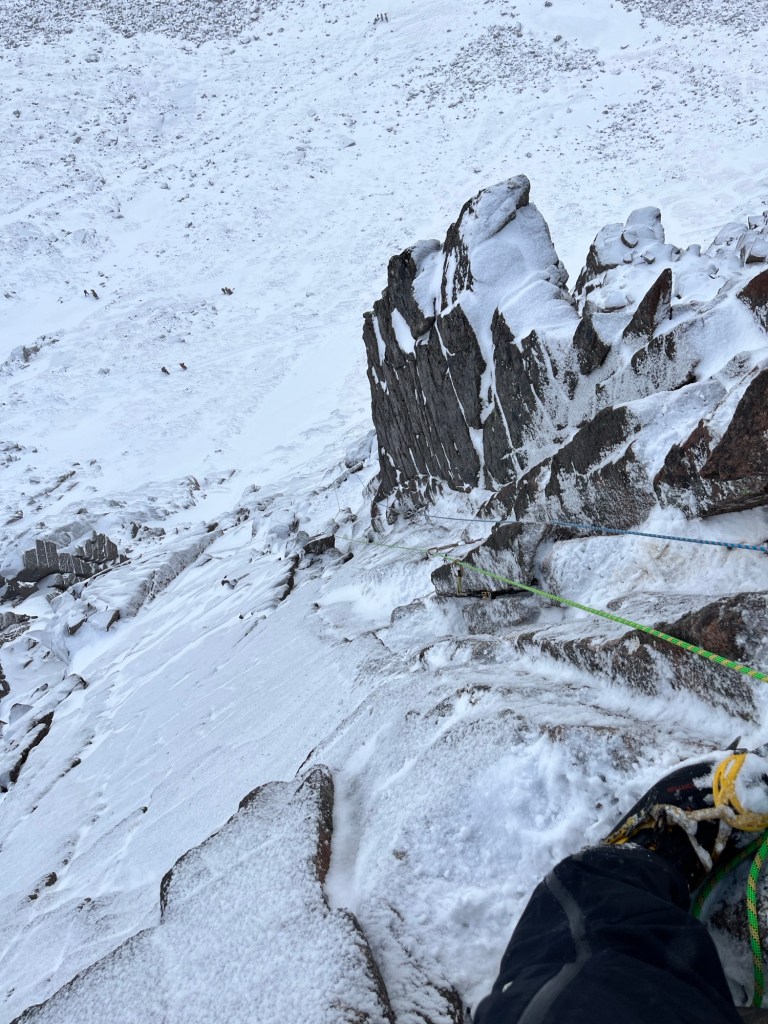
I followed and set off on the final pitch: a wonderful airy pitch with an enjoyable, but improbable looking mixed step in an excellent position. I clipped a peg and placed a good cam before searching for a good hook. Thonk. A smile spread across my face – a small but absolutely perfect incut hook, amazing. I swapped hands on my tool and reached across the rocky step to a sidepull to pull myself across the void on. Some more searching was required, but eventually I found a good hook and scuttled my crampons along a small edge. I smiled as I marveled at the excellent quality of the climbing. Swiftly, I placed one last hook and reached the comfort of a ledge. Here, I placed an excellent hex, and enjoyed a romp up a ramp after an interesting pull over the bulge.

Nicked off UKC – Kelseybisset. Another team on the final pitch

Halfway up the ramp, it occured to me that I would not have enough rope to reach the top, and there would be no other opportunties to belay: I’d violated the age old rule and passed a winter belay. I placed a good cam, and hammered in an offset. I also clipped a bomber tool. It was good enough…just. As Lara approached, enjoying the wonderful exposed mixed step, I suggested she established a belay at the purple hex: a far better position and it would safe us from being solely attached to the wall by slightly sub-optmal belay. This worked excellently, and after she put me back on belay, I made short work of the final 20m or so of climbing to the top.

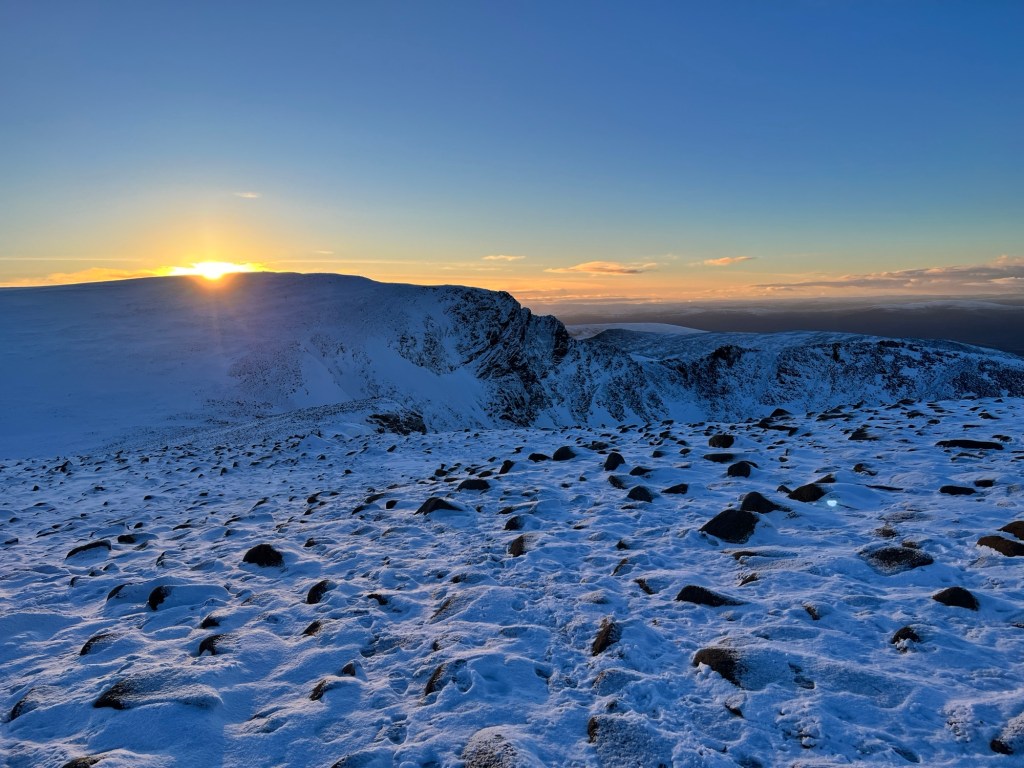
Summit Views

We descended via no4 gully, an excellent bum-slide. The slog back out to the car park was, as ever, a little longer than you’d like. But, we’d had an excellent day of climbing, and dinner tasted especially good that evening.

Guronsan – Bold, Wet, Coreshot

The weather in Val Di Mello had so far been sub-optimal, with frequent afternoon thunderstorms limiting the potential for any climbing. Nevertheless – we journeyed up to the Allievi Rifugio to spend the night. The first objective for the day had been sopping wet – so our eyes turned to Guronsan – a ‘well equipped’ and ‘modern’ route up the 400m Pizzo Torrone Occidentale, at an amenable grade. Everything was telling us it should be a nice, quick, easy day. Back at the rifugio for a nice early afternoon coffee and a slice of cake, but, alas, the mountains never let you get away with things that easily.

A stunning valley

Lara quested up the first pitch – a 50m friction slab. This pitch quickly gave us a harsh reality check of the nature of the bolting on this route – run out! The first bolt was about 25m up the pitch, which is not entirely unreasonable given the lower section of the route is likely often covered by snow, but the remaining runouts were large and consequential: the final 25m of climbing, having just three bolts, and given the compact nature of the rock, absolutely no opportunities to place additional protection. The mist in the air coated the rock with a fine layer of moisture: not enough to significantly hinder progress, but enough to make the smears feel sketchy and poor. Lara inched her way further up the pitch, linking together ripples of weakness in rock to make slow but steady progress. I kept paying out rope, feeling relieved each time Lara clipped a bolt, and gradually fearing the consequence of a fall as she edged further away from them. After a masterful lead, she reached the belay.

The initial friction slab

It was my turn to lead now. The next pitch looked no better. There was a 10m runout to the first bolt – risking a factor two fall straight onto the belay, with no opportunities to use any of the small rack we’d brought. I was a little tentative setting off from the belay, but took a deep breath and focused on climbing well and not fucking up. A corner led to a bold step out right, where the first bolt glistened at me. Daring me to commit to the slab and move away from the safety of my corner. I took a deep breath and positioned my foot onto a nubbin of granite, pressing it deeply into the rock, I tentatively transferred my weight to the nubbin. I stayed on the rock, breathed, and clipped the bolt. I was safe. The run out to the next bolt was just as terrifying – the climbing was no easier either, but it was at least more secure and a little steeper and more positive. The pitch continued in this fashion, this cycle of clipping a bolt and creating this bubble of safety around you, then questing your way towards it, knowing that you are entirely committed as the technical and friction-based style of the climbing is exceptionally hard to reverse. The final runout to the next belay was larger, about 15m from the last bolt. 10m before the belay, the rock became sopping wet. I traversed 5m to the left and right of the line to place two pieces of gear: good medium-sized cams.

‘Watch me here Lara, this bit is sopping’.

I began questing up the slab: overgripping terribly in the hope that I would be able to save myself from a massive fall should my feet pop. Slowly – I edged higher, the belay was just metres away now. I was entirely committed, there was no way for me to downclimb the wet rock back to the safety of the gear I’d placed, and although a fall would have been safe, it would have been massive (around 20m). All that was left before I reached some juggy flakes leading to the bolts was a small quartzite band. Terrified, I placed my foot on a crystal and stood up – expecting to take flight at any moment, but to my surprise the wet rock provided just enough friction to keep me on the mountain. Happy days! I enjoyed the final few metres of juggy romping to the belay.
At last I could rest for a little. Lara followed me up the pitch, and we both remarked how utterly terrifying, sandbagged, and serious the climbing had been so far. We agreed to carry on anyway: the next pitch looked better bolted, and it was an abseil descent anyway so we were not exposing ourselves to any additional danger by continuing the climb.

Looking down the bold second pitch

The climbing was more enjoyable now: Lara quested up a slab above to a bulge, which took cams well and was overcome elegantly. The bolts were placed intelligently on this pitch, although still extremely spaced (8-10m apart), they were where you wanted them, protecting difficult moves, but leaving the easier climbing feeling quite bold.

Pitch 3

After this pitch, the grade dropped off a bit and the bolting became better. A few rambly pitches led to a spectacular slab, which was amazingly with exciting moves on the arete, involving high feet. A little steeper than the slabs on the first and second pitches, the holds here were more positive, and therefore the climbing felt far more secure and enjoyable. The runouts were even good craic at this point: you never felt unsafe, but you knew you had to pay attention and focus one each individual move.

After a final scramble, we reached the top. It had been a stressful morning with some serious climbing. We layered up, and sat down, enjoying a rest. The weather had come in a bit at this point: cloud has turned into drizzle, and as we had our wraps it felt like we were back in Scotland. We then began the abseils down, the first one dropping straight over a sharp granite edge.

The first abseil

As Lara followed me down, we began to pull the ropes. As we pulled it down from above, my heart sank. The blue rope was badly core-shot, and had a 30cm section of white spindly core showing. Fuck. We both realised this was a serious situation: stuck 400m up a cliff, with no phone signal, in deteriorating conditions. It would be a few hours till any help was sent, so sitting it out would be an unpleasant and rather cold option. We had to solve this on our own. Luckily, we’d taken due care to practice self rescue before the trip, so began to formulate a plan (thank you Jez!).

We had 2x60m ropes originally, and needed 2x50s to get down to the ground. One of our 60m ropes was still intact, so I proposed doing a Krab-Block: weighting the undamaged rope and using the other as a tagline to pull it down. Upon doing the next abseil (conveniently the longest one of the route), we could assess if we had enough ‘healthy’ rope to simply cut off the coreshot end, and make progress down the route with shortened, but still long enough rope, or if we’d need to continue using a Krab block.

I set off – immensely focused. I checked, double checked, and triple checked everything we did, and Lara did the same. Dropping a rope here, or setting up something incorrectly would be unthinkable.

We made it to the next anchor, and to our immense joy, we had enough healthy rope to remove the coreshot section and proceed down as normal. Blissful. Nevertheless, we still had 7 50m abseils to go. Focus was still required.

We carefully made it down, each time we pulled the ropes breathing a sigh of relief as they came hurtling past us – not caught up on some devilish spire of rock forcing complex manoeuvres to retrieve them. I felt exhausted upon reaching the ground.

Tired. Cold. Good day!

I scoffed a bar of ritter and we made it back to the rifugio. The coreshot had only cost us an hour or so, but mentally it had been a very stressful experience. Ritter, coffee, and tortellini that night tasted especially good, and we schemed our plans for the next days route that evening.

Fingers Ridge

The thaw over the last week had decimated almost all the remaining snow – leaving the Northern Corries depressingly black. A brief midweek snow had revived things a little, and put things just about into condition. Psyche was high – with good weather and uni work cast aside, we journeyed up to Aviemore on Friday night.

The weather was due to be excellent

Dossing behind the youth hostel, we spent a cold night in the tent before our alarms blared us into action. Soggy porridge oats, the joy of slightly damp clothes, and getting showered with condensation awoke us slightly rudely, and we reached the bus stop a little chilly.

Up arriving at the ski centre car park – we set off towards Snechda. The conditions were excellent – good visibility and low temps. Dreamy. The route looked in acceptable condition – just white enough to avoid the Blackwatch. We approached the base of the route via a steep snow slope, and established a belay.

The first pitch did not set us up particularly well. I initially tried to do the standard route, which traverses across a slab. With any more build up, this would be straightforward if bold, but in these conditions it was not something I felt comfortable doing. There was no gear, only poor hooks in thin turf that felt like they could easily rip, and my feet were smearing on rounded granite – not good. I down climbed (somewhat shaken), and took the alternative start for lean conditions, a turfy corner. The initial section was unprotected, but soon there began to be some gear. Generally the climbing was straightforward, except a short step which had good gear, but was run out and the hooks were not excessively inspiring. I fought my way up this, and reached a belay to bring Lara up.

Lara made short work of the pitch, and began questing up the rib. The climbing was more enjoyable now, proper snowed up rock climbing, with good gear, and plenty of good hooks and torques. She dispatched this pitch with ease and style, and found a belay to bring me up.

I then set off up a thin slab, with good gear and satisfying torques, to reach a system of grooves and ledges leading to a belay. This was my favourite pitch of the climbing- 40m of reasonably sustained joyous movement, with plenty of gear, and hooks exactly where you need them. I’d warn of some loose blocks on this pitch, of significant size that could easily scupper someone. Due care must be taken, even in frozen conditions.

From the top of the excellent 40m pitch

As Lara was seconding a flurry of snow came in, quickly covering everything. It was cold but joyously elemental, and an excellent day to be on the hill. Lara reached me and begun the pitch leading to the fingers – a slabby rib with a few tricky steps. This was an excellent and enjoyable pitch, with good positions and exposure. She, of course, made short work of it, and brought me up to the Fingers.

Following Lara – reaching the fingers

Although intimidating, the fingers were not particularly difficult, the hooks were good and by bridging between the two they could be overcome with ease. A final short, technical slab led to the top (avoidable to the left or right), where we topped out in joyous golden light. Lara was rather cold at this point, so we swiftly made moves to get off the hill.

Overall, this was a highly enjoyable route. I do not feel it merits 3*, but 2* seems appropriate. The quantity of loose blocks and the unpleasant climbing on the first pitch do sadly detract from the fantastic finale. Nevertheless – a truly excellent day in the hill.

Stunning

Stella Retica – Piz Badile

Piz Badile is a mountain I’ve wanted to climb for a long time. Routes like the Cassin and the North Ridge tackle such inspiring features no self-respecting climber could resist their pull.

The South Face – from the Marimonti

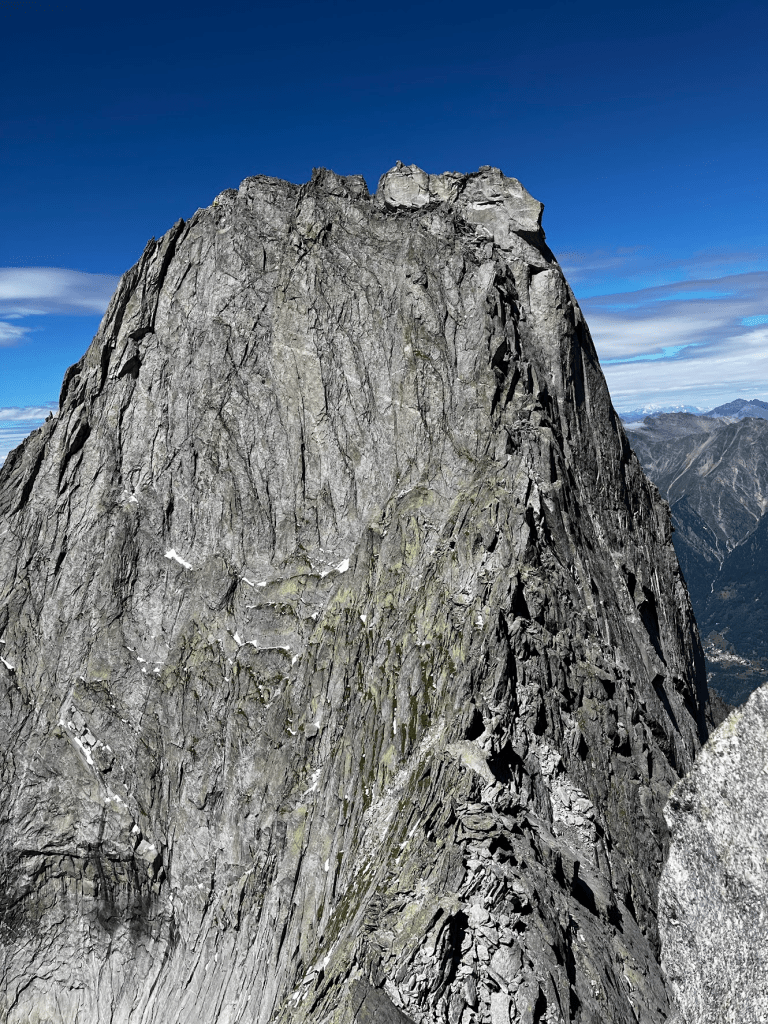
The South Face of the Badile, although less dramatic and smaller in scale, still stands 500m high and is home to some dramatic and awe-inspiring routes. The face is bordered on the left by a rocky spur which the Normal Route follows, and on the right by the Marimonti ridge – a stunning line which Charlie and I climbed a few days later. The Monteleni (established in 1935 by M. Molteni and M.Camporini) is the classic of the face. A weaving and wonderful line taking the most amenable line up the face – precisely weaving together ledges and groves to create an undeniable masterpiece of a route. For modern climbers – the difficulties are perhaps too low to be interesting, never getting harder then V+, and mostly around III-IV. Other modern routes on the face are far more serious propositions with sections of VII and VII+ – and as is standard for the area – have limited gear and no in-situ belays. For most – Stella Retica marks the sweet-spot. Generally well equipped with bolts – and with retreat possible for almost the entire route – it tackles a wonderful line, on excellent rock, up the right-hand side of the face. The climbing is fairly sustained around 5c-6a, and the route is 500m in length.

We woke up at 4:30 in the Gianetti – our noise awakening a Swiss Couple who would be behind us on the route (who later chastised us for being too noisy). After a swift breakfast, we set off to the base of the route. The amphitheatre at the base of the South Face was stunning – smooth granite slabs melted seamlessly into shear walls, with streaks of water glistening in the early morning sun.

We had some difficulty locating the start of the route – the guidebook topo was frankly awful, and there were no bolts or paint visible. We opted to quest up a grove and hope to find a bolt – which luckily, Lara did after 50m of climbing! Great success! As Lara begun her pitch – the swiss couple approached from behind…

‘Very noisy in the morning, yes. Quite route you see’

We’d spotted them from afar on the approach and joked that they’d be following us up the route. We were both rather displeased.

‘Ah man…very fair. I’m sorry totally our fault’

‘It is ok yes, but you must move fast today yes there is a storm approaching later – you need to move very fast to stay safe’.

‘We can overtake if you move slow?’ Asked the swiss women – a rather reasonable request, but nevertheless, it came across as a little rude.

‘Yes of course’ I sighed.

The ropes went tight and I begun following up the pitch. I reached Lara and told her about my conversation at the base. She too was displeased. We decided that we would climb at our own pace – and just enjoy ourselves regardless of the pressure from behind.

The next pitch was excellent – a flakey juggy pitch up to a rightward traverse. The bolting was sparse, and I was glad to have a few friends to keep everything a bit safer. Lara followed swiftly and set off up her next pitch.

The Swiss man followed swiftly. He was tall, perhaps 195cm – and climbed beautifully. He was like a spider – climbing with his hips far from the wall and his arms moving in a long, lolloping fashion. The ease with which he dispatched the pitch was quite inspiring. After our…tense… interaction at the start, we both had an enjoyable conversation about the quality of the climbing on that pitch, and how nice the positions were.

Upon reuniting with Lara – I did the easy walking pitch across the ledge and took Lara up to the base of the crux slab: a 40m friction slab pitch with no gear and one bolt to protect the crux. Lara climbed it excellently – calmly, accepting the massive runout at the top, where a fall would have significant consequences.

The Swiss wads were some distance behind us at this point. Somewhat of a relief – it’s never pleasant climbing with a team close behind you. I led the next pitch, and enjoyable 55m quest up a corner system, then over a bulge to a slab above. The quality of the rock was superb – excellent granite – with beautiful alpine flowers on every ledge. Although the sheer exposure of this face is undoubtedly less than the North Face of the Badile, and the face feels somewhat broken up, the warm glow of the sun on your back and the views out and across to Italy are genuinely stomach-churning. The crag overall felt similar in character to Shelterstone in the Cairngorms, just South facing, and twice the size.

Lara crusing

The next pitches were exceptionally enjoyable – although not difficult (no harder than 5b), they provided an enjoyable ramble up to the difficulties on the upper pitches. The bolts – although sparse – meant you were never left doubting which way you had to go, and every belay was on a comfortable ledge.

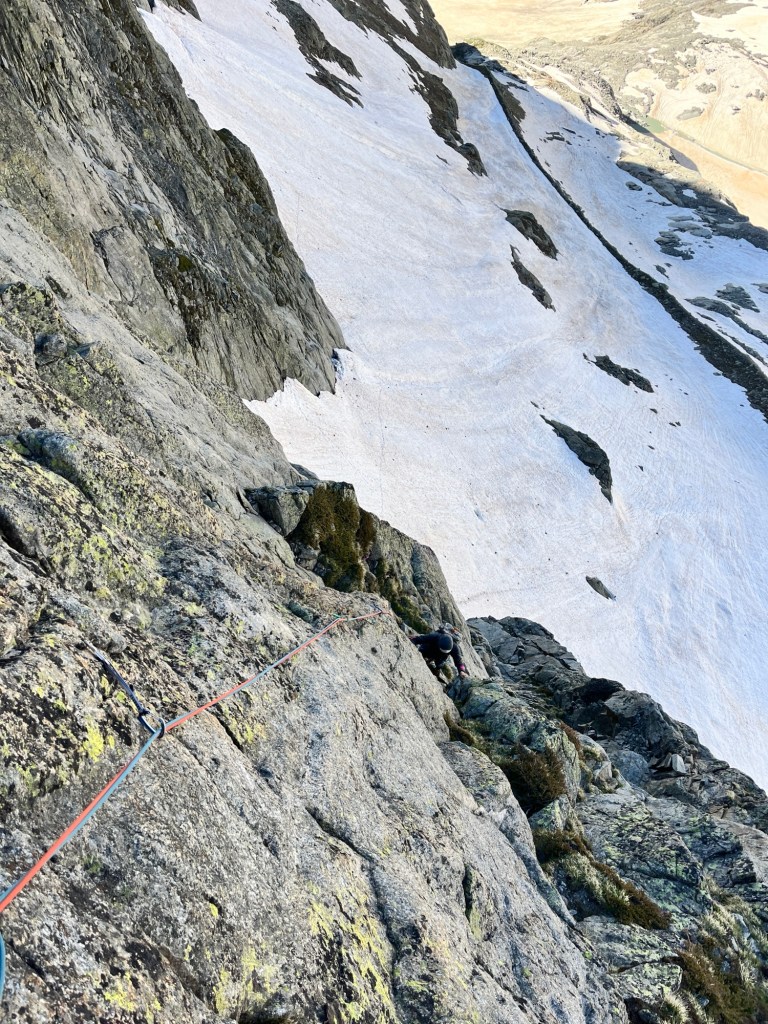
The enjoyable groove pitch.

The last few pitches were a little harder – a long corner, with a fair bit of trad gear required to keep it safe was an exceptionally enjoyable pitch. The positions here were excellent, as the route traversed onto the steeper and less ledgey central portion of the face. I loved this pitch, especially the section overcoming the bulge in the middle.

Lara’s pitch looked rather intimidating – a long rising traverse, about 45m, on fairly poor rock. In classic granitic fashion – this was not simply ‘break a small hand-hold and take a whip’ rock, but ‘pull on the entire flake your climbing on cautiously because it feels like it might snap rock. The bolts were very sparse, and the opportunities for good gear were limited due to the poor quality of the rock. Lara cautiously (and brilliantly) edged across the void, gingerly pulling on every flake, and slotting cams hopefully behind expanding flakes. The Swiss couple below were watching us from below – but kindly waited on the ledge, putting no pressure on us to rush now: they were satisfied we’d made fast progress up the face. Lara reached the belay and began bringing me across.

I led the last pitch, a bold but not excessively difficult pitch rambling to the final ridge. Lara followed quickly, and we took coils and began the short traverse to the proud monument marking the top of Piz Badile. As we moved along the crest – the views down into Switzerland and down to the North Face and the Cassin were frankly awe-inspiring. I knew I would have little choice but to return as soon as possible and tackle that gut-wrenchingly stunning line.

Happy, but knackered

We had lunch at the summit – perhaps one of the happiest meals of my life. It had been the best month of my life – and I was so proud of what we’d achieved. All that awaited was a straightforward descent, then Ritter, Coke, and Coffee a the Gianetti.

And luckily for us, the descent was just that: straightforward. After initial route-finding difficulties, we moved together down, climbing the normal route – placing a few points of intermediate protection between us. A few abseils were required lower down the ridge, and we reached the ground just as the thunderstorms the Swiss had warned us of began to rumble in the distance.

That night, after the storms had passed, and we sat and had dinner looking across the Italian Alps, the Swiss man approached us:

“Good touring with you guys today – you were fast today yes well done!”

A beautiful route, a great trip, and most importantly, the approval of a Swiss mountaineer. Great Success.